Hegseth protesters AUSA panel: six anti-war demonstrators interrupted Defense Secretary Pete Hegseth one at a time early in a panel at the Association of the U.S. Army's 2026 annual meeting in Washington on Wednesday, shouting condemnations of the U.S. war with Iran and of the humanitarian crisis in Gaza before security removed each of them from the hall.
Hegseth heckled / Protesters interrupt the defense secretary six times at AUSA over Iran and Gaza
Track it live: Live war tracker — follow the conflicts behind the protest, including the Iran war tracker.
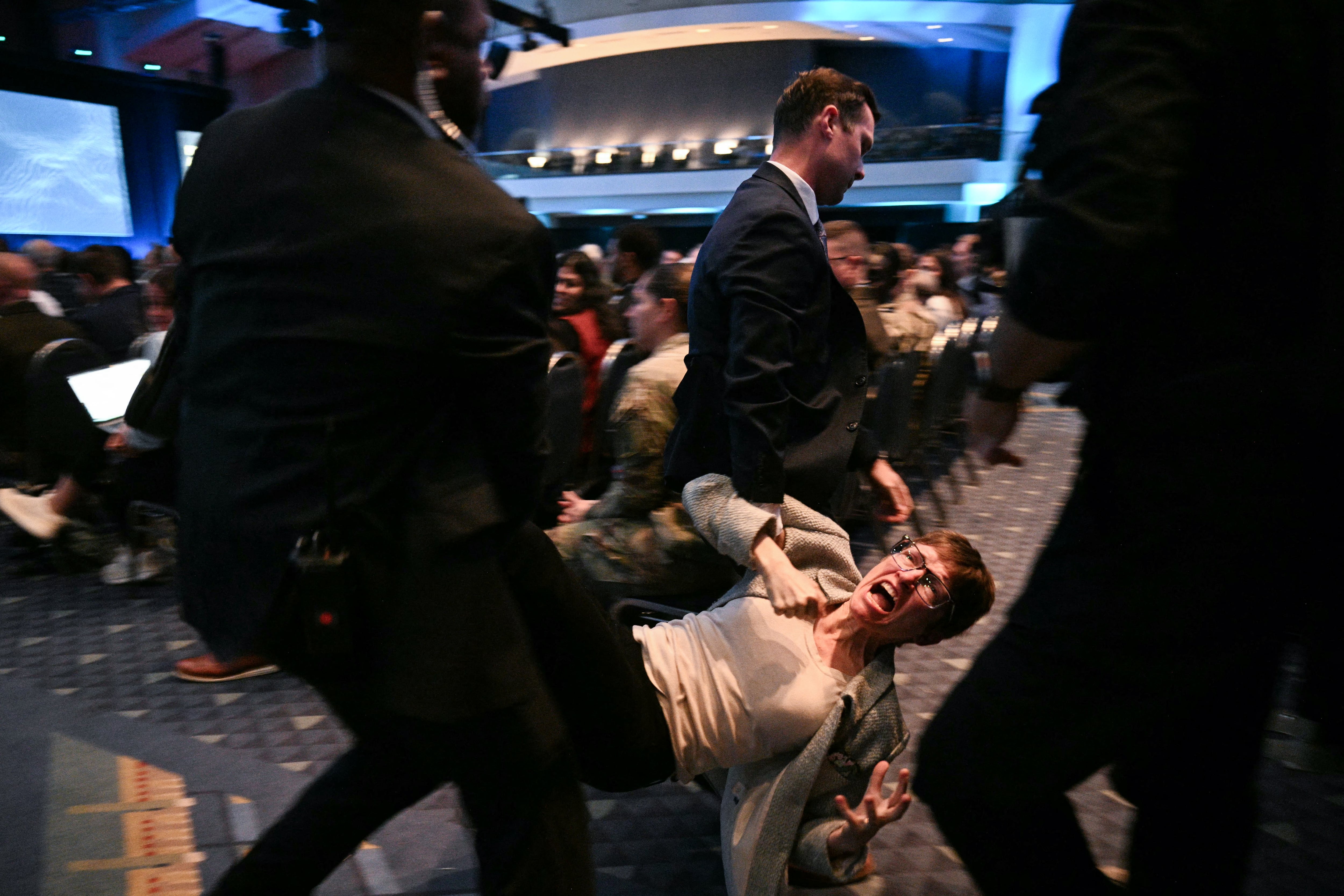
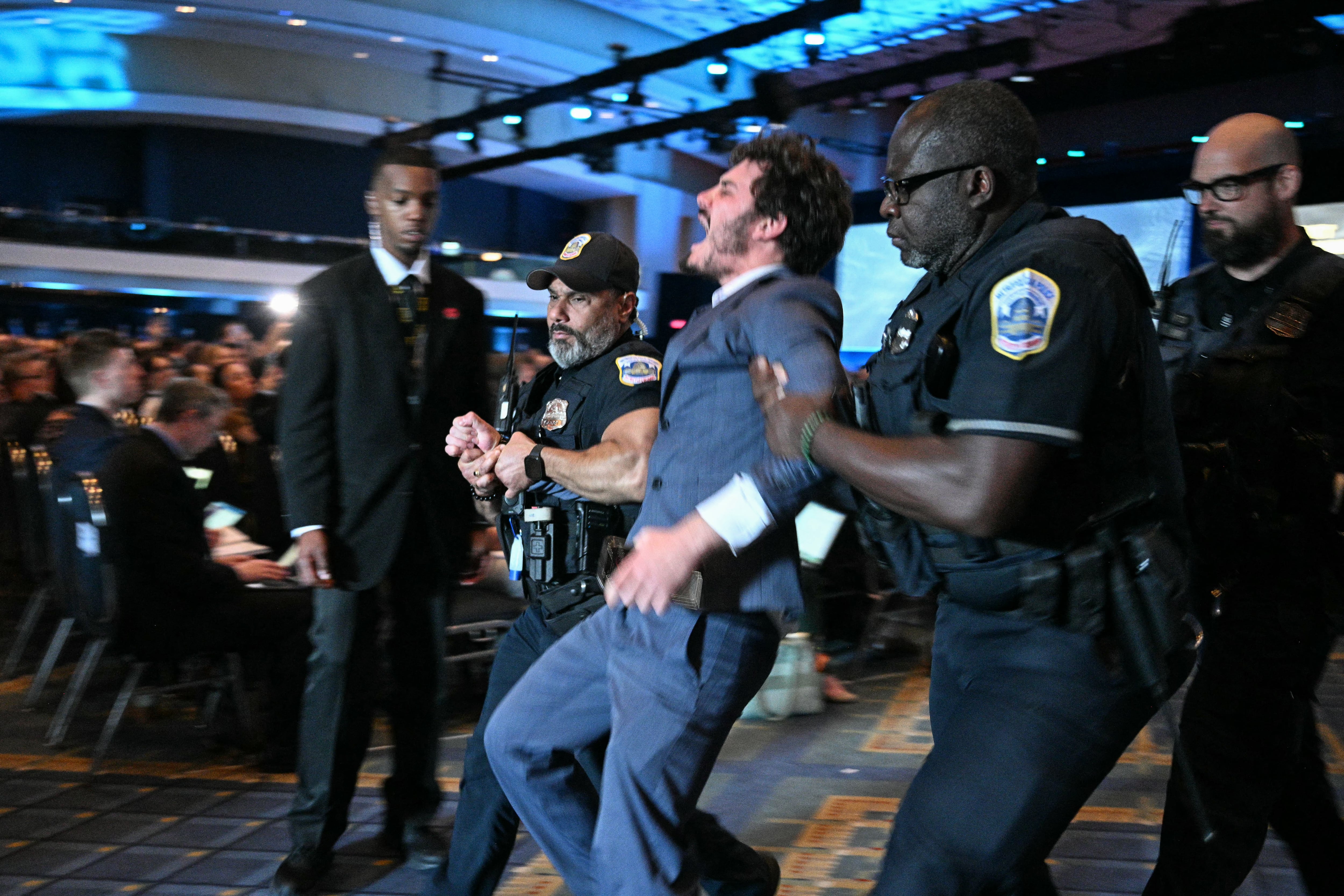
The interruptions came early in a roughly hour-long panel on Wednesday at the AUSA 2026 Annual Meeting & Exposition, held at the Walter E. Washington Convention Center in Washington, D.C. Six people interrupted the speakers at various points near the start of the session, according to Military Times and Defense News, which counted six; Fox News, whose account was carried by the New York Post, counted at least five interruptions in the first half hour. The protesters shouted condemnations of the U.S. war with Iran and referenced the humanitarian crisis in Gaza. Security removed each of them from the packed ballroom. The panel — a marquee session on Project Agincourt, the Pentagon's push to accelerate autonomous weapons — eventually continued, with the panelists at points simply talking over the shouting.
Six interruptions, one at a time
The pattern, as reconstructed from the reporting of Military Times, Defense News and Fox News, was deliberate in its pacing. The protesters were spread through the room and did not shout together. One would rise, shout, and be removed; a few minutes would pass; then another would rise somewhere else in the hall. The spacing stretched a protest that might have lasted thirty seconds into a recurring disruption across the opening stretch of the panel, and it meant the session could never fully settle before the next voice went up.
The words were aimed personally at the secretary. "You're not a warrior, you're a coward," one protester yelled, adding, "Children in Gaza are starving." Another shouted, "You're killing my family." Protesters repeatedly used the words "war criminal" — an accusation they directed at Hegseth over the conduct of the Iran war and U.S. support for Israel's campaign in Gaza. According to Military Times and Defense News, the final protester, as security pushed him out of the ballroom, shouted profanity-laced condemnations, told Hegseth "we'll see you at the Hague" — a reference to the International Criminal Court — and said he should be ashamed of himself. These are the protesters' claims and characterizations, stated in their own words; Hegseth has not been charged with any crime by any court.
The removals were physical. Event security escorted or pulled the protesters out as they kept shouting, and at least one woman was carried out of the room by multiple officers, still screaming her protest as she went. How six protesters came to be inside the hall at all is an open question that none of the day's reporting answered: the AUSA annual meeting is a registered-attendee event, and it was not clear how the demonstrators obtained the credentials that got them seats in a ballroom with the secretary of defense on stage.
Hegseth's response evolved in public as the count rose. To the first interruption he answered with a quip — "She thinks highly of me" — which drew brief applause from parts of the crowd. As the interruptions continued, the humor thinned. "Appears we have a bit of a tactic," he observed, naming the one-at-a-time pattern out loud. Reporters in the room described him growing visibly more irritated with each successive outburst, and Fox News described his later reaction as slamming what he characterized as a semi-coordinated effort. At another point he dismissed the protesters as spouting slogans and pivoted to the administration's central claim about the war: that Iran will never have a nuclear weapon. Some spectators answered the protesters on the room's behalf, chanting "USA, USA, USA" after one interruption before quieting as the panel resumed.
The panel that drew them: Project Agincourt
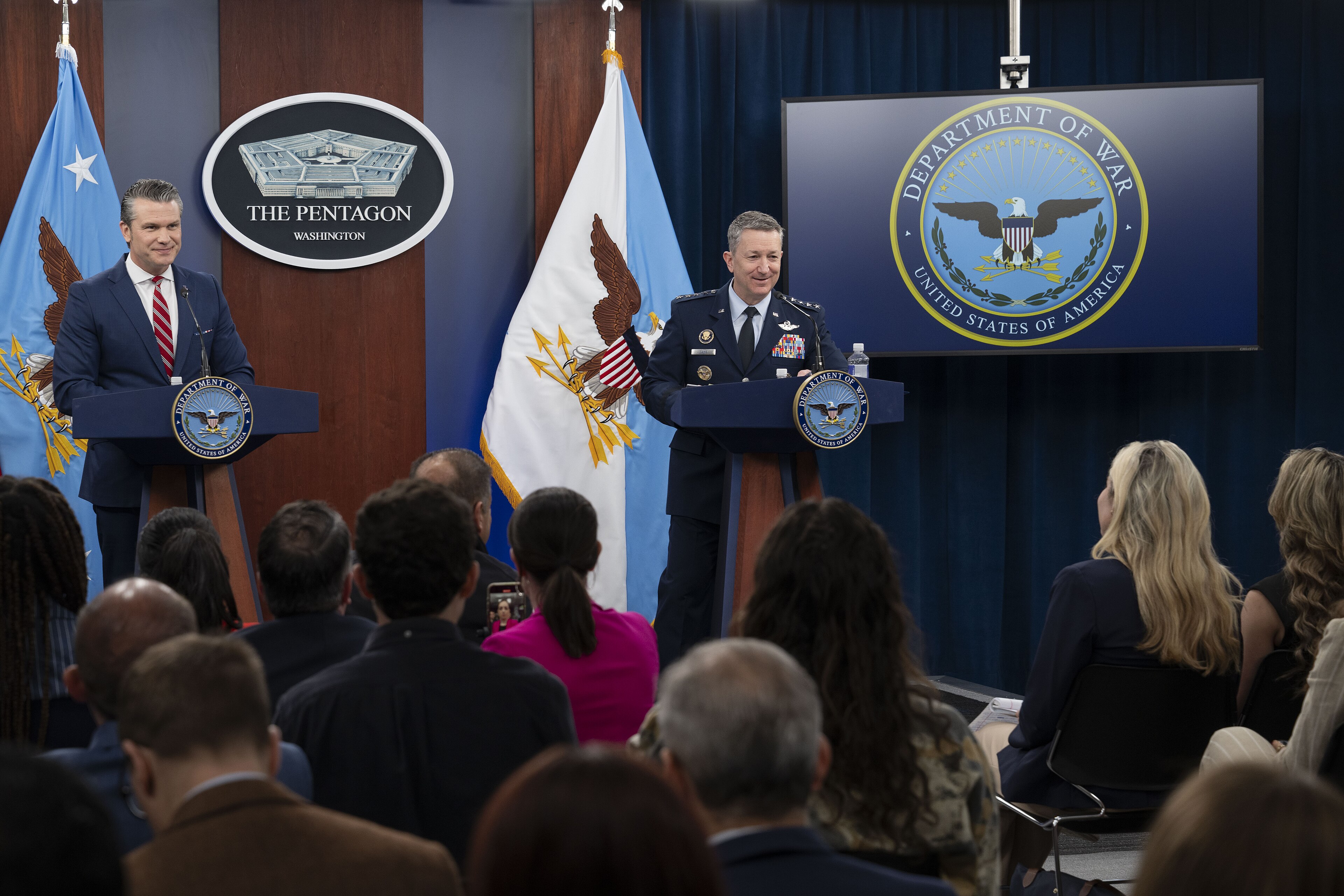
The session the protesters chose was not a general speech. It was a panel on Project Agincourt, the Pentagon initiative to accelerate the development and acquisition of autonomous systems — drones, robotics and other unmanned and AI-enabled weapons — and to cut the time between a technology's demonstration and its deployment in the field. Hegseth has made the project a signature of his tenure: two weeks ago, at Quantico, he unveiled a new four-star Autonomous Warfare Command to run it, arguing that the United States must mass-produce autonomous weapons at a pace its current acquisition system has never attempted. The AUSA panel was the initiative's showcase conversation, staged before the Army's flagship audience of officers, defense executives and contractors.
Sitting with Hegseth were the service secretaries who would have to buy and field what Agincourt promises: acting Army Secretary Adam Telle, acting Navy Secretary Hung Cao, Air Force Secretary Troy Meink, and Assistant Secretary Derrick Evans. That composition is part of why the panel mattered beyond its talking points — it was the acquisition leadership of three services presenting a shared autonomous-weapons agenda to the industry that will bid to build it — and part of why it drew protest. For the demonstrators, a panel about accelerating autonomous warfare was not a neutral technology discussion: their shouted argument, in substance, was that new weapons programs deepen wars they say the United States should be ending, and that the men on the stage bear personal responsibility for the wars already under way. For the department, Agincourt is framed in exactly opposite terms — as deterrence, and as the means to fight a future war with fewer American casualties by putting machines in the most dangerous roles.
Both sides, in their own framing
The protesters' case, as they stated it in the hall, rested on the two conflicts. On Iran: that the United States is waging a war they consider criminal, with Hegseth as one of its principal executors. On Gaza: that children are starving in a humanitarian crisis they tie to American weapons and American support. Their method was disruption aimed at the person, not the program — the accusations were personal ("coward", "war criminal", "you're killing my family"), delivered from inside the defense establishment's own room, on camera, and timed so that each removal would extend the scene.
The response from the stage and the organizers rested on different ground. Hegseth treated the interruptions first as heckling to be waved off, then as an organized tactic to be named, and answered the substance with the administration's defense of the war itself: that its purpose is to ensure Iran never obtains a nuclear weapon. The Association of the U.S. Army, in a statement to Fox News Digital, split the question in two. "The First Amendment right to protest is fundamental," the association said — and then drew its line: everyone who registers for the annual meeting agrees, on entering, to abide by a code of conduct, so the outbursts were "not appropriate during the forum." In AUSA's framing, the protesters were free to hold their views and to voice them elsewhere; what they had surrendered, by registering, was the right to voice them that way in that room. The audience reaction cut across both framings — applause for Hegseth's first quip, "USA" chants answering one protester — suggesting a room that largely sided with the stage, which is what made the protesters' persistence, one after another, the story of the hour.
Why this matters
Protests outside defense conferences are routine; protests inside them, sustained across six removals in front of the secretary, are not. The AUSA annual meeting is the defense establishment's flagship gathering — the week when the Army's leadership, its industrial base and its congressional patrons are all in the same building. Dissent voiced there does not reach the secretary through a briefing paper; it reaches him live, mid-sentence, in front of the audience he most needs to persuade. That is a signal about where opposition to the Iran war now sits: not only at campus rallies and street marches, but willing to obtain credentials, sit quietly in a ballroom, and spend an arrest-risking afternoon one voice at a time.
The credential question is the loose thread with practical consequences. A registered, badge-controlled event got penetrated by at least six protesters acting in an evidently coordinated sequence, and as of Wednesday evening no organizer had explained how. If the answer is that they registered under ordinary attendee categories, conferences across Washington will have to decide whether ordinary registration is still sufficient vetting for events with cabinet secretaries on stage. If the answer is something sloppier — borrowed badges, day passes, exhibitor credentials — the fix is different but the embarrassment is the same. Either way, the question will be asked at every comparable forum for the rest of the conference season.
The scene also lands at a specific point in the war's political calendar. Hegseth is heading to Capitol Hill to defend the administration's Iran war as a 60-day congressional deadline on the conflict looms — the frame Fox News put on its coverage of the panel, and the context in which Wednesday's shouting will be replayed. The protesters were, in effect, an advance demonstration of the argument waiting for him in Congress: that the war's costs, in Gaza's shadow and in Iran itself, have outrun its stated purposes. His defenders will answer with the argument he previewed from the stage — Iranian nuclear capability as the war's justification — and with the conduct point AUSA made: that there is a difference between dissent and disruption, and the protesters chose the second. Both arguments were audible in the ballroom on Wednesday, which is precisely why a one-hour panel about drone procurement became the day's political news.
What happens next
The immediate aftermath is procedural. AUSA and the convention center's security will review how the protesters got in, and the next defense forums on the Washington calendar — there is a steady circuit of them through the autumn — will quietly compare notes on whatever AUSA finds. Expect tighter credentialing at secretary-level sessions, whether or not anyone announces it: earlier badge checks, more visible security inside halls rather than only at doors, and possibly closed seating sections near stages. None of that resolves the underlying friction the day exposed — a credentialed room is a porous thing in a city where the defense industry employs tens of thousands of people, some of whom oppose the wars their industry supplies.
The larger sequel is congressional. The 60-day deadline framing means the Iran war's authorization fight is about to move from cable panels to the hearing rooms where Hegseth will testify under sustained, televised questioning — a setting where the protesters' accusations will be repeated, in more measured language, by the war's critics in Congress, and answered with the administration's nuclear argument by its defenders. Wednesday's scene previews the tone of that fight: personal, moralized and aimed at the secretary himself. And the forums circuit will not move on: every future Agincourt showcase now carries the possibility of a repeat, because Wednesday proved the tactic works — six people, no props, no banners, nothing but timing, turned the Pentagon's flagship technology panel into a referendum on the war. Whether that reads as democratic dissent breaking through or as a breakdown of the norms that let institutions deliberate depends, as it did in the ballroom, on which side of the shouting you were sitting. Both readings left the Washington Convention Center on Wednesday with evidence for their case.
Related coverage: Hegseth unveils Autonomous Warfare Command at Quantico · Iran's Hormuz shipping tactics and the oil-market stakes · A ship goes down in Hormuz: GFS Pride lost, Giselle holed
Sources: Military Times (October 14); Defense News (October 14); New York Post / Fox News (October 14); Daily Caller (October 14). The protesters' accusations are their own claims, reported as shouted; the count of interruptions is six per Military Times and Defense News, at least five in the first half hour per Fox News; how the protesters obtained credentials for the registered-attendee event has not been explained by organizers.