Washington won agreement against coercing countries through food trade. On the larger fight over subsidized production and cheap exports, it met a refusal that shows why unilateral tariffs remain the administration's preferred instrument.
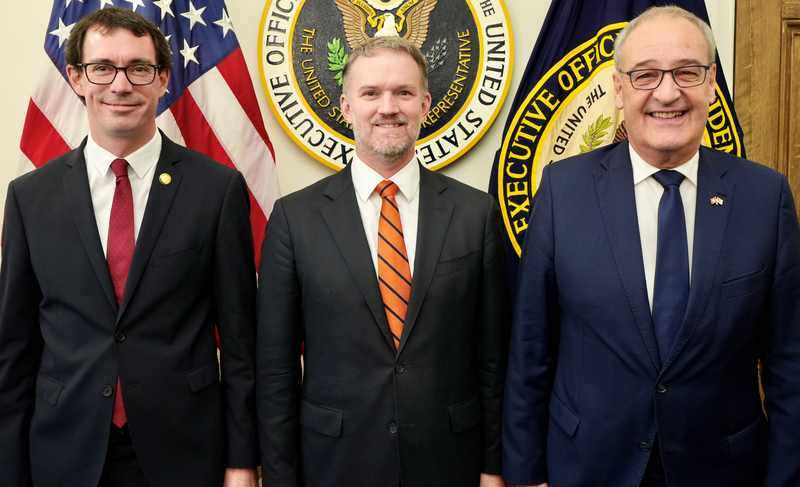
MILWAUKEE — G20 excess industrial capacity has become the latest test of whether the world's largest economies can still describe a shared trade problem, much less solve one. A “handful” of trade ministers rejected U.S. language calling for cooperative action against excess production and non-market policies, according to a chair's statement issued one day after the Milwaukee ministerial ended. The holdouts were not named. Their refusal prevented the consensus Washington wanted and exposed the political limit of an agenda aimed principally at China's industrial model.
The U.S. presidency said the draft was backed by all but a few members, yet those members “firmly rejected creating this pathway toward cooperative action.” It said the outcome “severely disappointed” Washington. Trade Representative Jamieson Greer argued that nearly all countries privately accept the underlying problem: heavily supported production, particularly in China, can flood foreign markets with cheap exports faster than conventional anti-dumping or safeguard cases can respond. Public agreement, however, is the currency that matters at the G20 — and on this issue it was not available.
Why this matters
The disagreement is bigger than one communiqué. Excess capacity sits at the intersection of three global pressures: China's drive to maintain factory output, Western efforts to rebuild strategic industries, and developing countries' need for affordable machinery, vehicles and clean-energy equipment. A low-priced import can look like destructive dumping to a domestic producer and like an inflation-fighting bargain to a consumer or infrastructure ministry. That is why consensus dissolves when abstract concern turns into a policy remedy.
For the United States, failure to secure G20 backing strengthens the administration's case for acting alone or through small coalitions. Greer said the existing system of remedies is inadequate and pointed to unilateral tariffs as Washington's answer. The same pattern is visible in the administration's broader trade diplomacy, including its contested energy and investment claims involving South Korea and Alaska LNG and the separate $8.4 billion oil-recovery proposal. Big numbers and bilateral leverage increasingly do work that multilateral rules once carried.
G20 trade ministers Milwaukee: agreement and refusal in the same room
The two-day meeting on September 30 and October 1 was built around four U.S. priorities: structural excess capacity, forced labor, food-trade coercion and reform of the Most-Favored Nation principle. The USTR's official preview advertised all four months in advance. The outcomes reveal a hierarchy of political difficulty.
Ministers did reach consensus that “trade in food and agricultural products should not be used as a tool for economic or political coercion.” The official USTR statement framed food weaponization as a humanitarian and economic threat that distorts competition and erodes trust. That language was broad enough for every member to support because it condemned conduct without assigning a country or prescribing a sanction.
Excess capacity was different. Any meaningful statement would point toward monitoring subsidies, limiting state-backed production, coordinating trade defenses or changing market access. China rejects the premise that its competitive industries amount to harmful overcapacity and accuses Western governments of using the charge to disguise protectionism. Beijing had already objected to similar wording at the G20 finance meeting in Asheville a month earlier.
The numbers behind the fracture
Only Mexico and Argentina joined a U.S.-led statement calling for more work to remove forced-labor goods from supply chains. Two signatures from a forum representing the major advanced and emerging economies is not a technical shortfall; it is a warning about how governments weigh labor enforcement against trade exposure and sovereignty.
The weak backing followed the Trump administration's tariffs of 10% or 12.5% on goods from 59 countries and the European Union over allegations that they failed to adequately enforce forced-labor bans. The breadth matters. A tariff aimed at 59 countries is no longer a targeted penalty at the margin of trade; it affects a large share of potential suppliers and creates incentives to reroute production, challenge classifications and negotiate exemptions. Countries may support eliminating forced labor while rejecting Washington's chosen enforcement mechanism.
The capacity dispute is similarly asymmetric. Large importing economies with vulnerable steel, solar, battery or vehicle producers see a direct threat from rapid export growth. Commodity exporters and lower-income buyers may gain from cheaper capital goods. Nations trying to industrialize fear that broad anti-capacity rules could constrain their own development policy tomorrow. The same ton of steel or electric vehicle can therefore be evidence of distortion, a cheap input, or a model of successful industrial policy depending on where the observer stands.
China overcapacity tariffs: who wins and who loses
Domestic manufacturers in the United States and Europe benefit when tariffs raise the landed price of competing imports. Their workers and supplier networks gain breathing room, and governments gain time to build battery, semiconductor and clean-energy supply chains. Treasury revenue also rises, at least before trade volumes adjust.
Importers, retailers and downstream manufacturers can lose because protected inputs become more expensive. Consumers may pay part of the tariff through higher prices, while exporters face retaliation or weaker foreign demand. Developing economies face a mixed ledger: some can capture production diverted from China, but others lose access to the least expensive equipment for power, transport and construction.
Critics of the U.S. approach say unilateral duties turn a real structural concern into a tax and invite copycat protection. Supporters answer that waiting years for a World Trade Organization case allows irreversible factory closures. Greer's formulation — nearly everyone sees the problem, but the remedy system is inadequate — captures the administration's strongest argument. The Milwaukee rejection captures its greatest weakness: countries do not agree on who defines the problem or controls the cure.
MFN tariff reform proposal reaches beyond Milwaukee
The United States also introduced a longer-term challenge to the Most-Favored Nation system of published, unconditional tariff rates. MFN treatment has underpinned the post-World War II trading order: a concession offered to one WTO member is generally extended to others. The principle reduces discrimination and makes tariff schedules predictable, but Washington argues that uniform treatment can reward economies with persistent non-market practices.
No joint statement was proposed. Greer described the MFN tariff reform proposal as a conversation that would continue with like-minded partners “well beyond Milwaukee.” Moving the issue into the G20 is itself significant because MFN reform normally belongs in the WTO, where changes require painstaking negotiation among a broader membership.
A tiered or reciprocal alternative could give governments more leverage against subsidies and closed markets. It could also fragment trade into political blocs, raise compliance costs and weaken the common baseline that smaller countries rely on. Large economies can negotiate bespoke terms; small exporters often benefit most from a rule that does not require them to bargain country by country.
What happens next
Scenario one: a coalition outside the G20
Washington may assemble a smaller group around subsidy transparency, shared monitoring and coordinated defenses in sectors such as steel, electric vehicles and batteries. This is the likeliest route to practical action because it avoids the G20's unanimity problem, but it also risks hardening a U.S.-China economic divide.
Scenario two: unilateral tariffs expand
If coalition-building stalls, the administration can continue using tariffs and investigations. That creates immediate leverage but shifts costs onto importers and raises retaliation risk. Courts, customs authorities and companies would then decide the policy's real reach shipment by shipment.
Scenario three: narrow consensus survives
Food coercion may remain a rare common denominator, allowing members to preserve cooperation where the language does not name an offender. Forced labor could advance through traceability rules and customs cooperation rather than a broad tariff front. Excess capacity would remain managed through national measures rather than one G20 framework.
Scenario four: MFN reform becomes the bigger fight
If Washington turns its Milwaukee discussion into a concrete proposal, the argument could eclipse the communiqué dispute. Rewriting unconditional tariff treatment would alter the architecture of global commerce, not merely one sector's defense. The test will be whether “like-minded” partners see reform as modernization or as permission for permanent discrimination.
The bottom line
Milwaukee produced one consensus and three warnings. Governments can denounce the weaponization of food. They cannot yet agree on excess capacity, a U.S.-led forced-labor statement drew only two partners, and MFN reform remains an American proposition rather than a negotiated project.
The Reuters account from Milwaukee shows that private concern does not automatically become public alignment. The next evidence will not be another expression of worry. It will be whether countries join investigations, synchronize tariffs, publish subsidy data or accept a new tariff principle. Until then, the trade split is not rhetorical; it is the policy.