Sudan’s armed forces have withdrawn from El Fasher after the paramilitary Rapid Support Forces said it had taken the North Darfur capital and captured the army’s 6th Division headquarters. The RSF announced full control on Sunday, September 20. On Monday, army chief Abdel Fattah al-Burhan acknowledged the retreat on national television: “We have agreed to withdraw the army from El-Fasher to a safer location.”
Burhan said the decision was intended to spare civilians and the city from further destruction. He accused the RSF of systematic killing and devastation, condemned what he described as international inaction and promised that the army would retaliate. Those accusations and the RSF’s own victory claims are statements by the parties to the war, not independent findings. The RSF has denied killing civilians.
What is established is the military and political break: El Fasher had been the only one of Darfur’s five state capitals still held by the Sudanese Armed Forces. Its withdrawal leaves the RSF claiming all five and removes the army’s last major urban base in the region. That is why this matters beyond a single front line. The fall of El Fasher strengthens the RSF’s attempt to turn battlefield control into governing authority from its parallel administration in Nyala, while the army remains centered in the north and east.
What happened—and what remains unverified
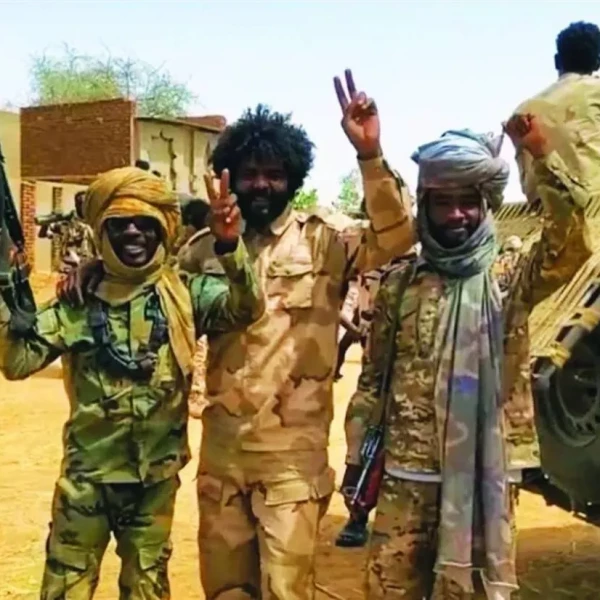
The RSF said its fighters overran the 6th Division headquarters and described the seizure as the “liberation” of El Fasher. That word is the RSF’s political characterization, not a neutral description. Videos posted by the group appeared to show armed men celebrating inside the base. Other social-media footage was reported to show violence against civilians trying to flee. Communications outages, restricted access and the collapse of local health services mean neither set of images can be treated as independently authenticated proof of what happened across the city.
The army’s televised withdrawal statement corroborates the central change in control, but it does not settle the sequence of the final battle, the number of soldiers or civilians killed, the routes used by retreating units, or how much of the city remained contested as forces moved. Public battlefield announcements often compress a fluid event into a decisive claim. Independent monitors, satellite imagery, aid-worker access and testimony from residents will be needed to establish the full account.
The Sudan Doctors Network said 16 civilians were killed and 21 wounded in shelling on September 16. That figure is attributed to the network and has not been independently verified. It should not be combined with unrelated casualty reports to imply a confirmed total for the final assault.
Why the fall of El Fasher matters
El Fasher was more than an army garrison. It was a refuge and logistics center in a region where other major cities had already changed hands. Its loss gives the RSF control of a continuous set of political and military hubs across Darfur and deprives the army and allied local forces of their final state-capital anchor there. The 6th Division headquarters also carried symbolic value: holding it allowed the army to say that Darfur had not been lost, even while the city remained under siege.
The strategic gain does not by itself create internationally recognized sovereignty. The RSF’s administration in Nyala remains a parallel authority, and control claimed at gunpoint does not resolve questions of legitimacy, service delivery or civilian consent. But territory shapes negotiations. The more durable the RSF’s hold becomes, the more any ceasefire discussion must confront two rival centers of power: an army-led state in the north and east and an RSF-dominated zone across Darfur and parts of the west.
That is the de facto partition risk. It does not mean Sudan has legally split, nor that today’s front lines will endure. It means military control, taxation, aid access and administration may increasingly operate through separate systems. Every month of parallel rule can make a national settlement harder even if neither side formally accepts division.
From the April 2023 rupture to the 2026 map
The war began in April 2023 after a power struggle between the Sudanese Armed Forces, led by Burhan, and the RSF, led by Mohamed Hamdan Dagalo, known as Hemedti. The two forces had previously shared power after the fall of Omar al-Bashir and the later derailment of Sudan’s civilian transition. Their dispute over command, integration and the timetable for placing the RSF inside a unified military escalated into open fighting.
The conflict spread from Khartoum to Darfur, Kordofan and other regions. In Darfur, the RSF’s roots in the Janjaweed militias and earlier campaigns gave the war an acute ethnic dimension. Rights investigators and U.N. officials have repeatedly reported attacks on civilians, sexual violence, looting and ethnically targeted killings. Both the RSF and SAF have faced allegations of serious violations; each side has denied various accusations against it.
El Fasher resisted longer than the other Darfur capitals. The RSF had besieged it since spring 2024. Fighting tightened access to food, water and medicine while displacement camps around the city came under repeated attack. Artillery and drone attacks intensified from August 2026, according to the reporting cited here, and U.N. officials warned that reports of summary executions and ethnically motivated killings created a rapidly mounting atrocity risk.
By September 2026, the army had recovered or held important territory in the north and east while the RSF retained a western power base. El Fasher’s fall sharpens that broad military division. It does not end the war: the two forces still contest supply corridors, rural areas and cities beyond Darfur, and armed groups allied to each side retain their own interests.
Before and after: the numbers that change the map
- Darfur’s state capitals: Before the withdrawal, the army held one of five—El Fasher—while the RSF controlled the other four. After the withdrawal, the army holds zero and the RSF claims all five.
- The siege: The RSF encirclement began in spring 2024 and continued into September 2026, more than two years of restricted movement, combat and deteriorating services.
- Civilians trapped: Reporting cited by AFP and Al Jazeera puts the population still trapped in and around El Fasher at roughly 250,000 to 260,000, about half of them children. The range reflects uncertainty created by repeated displacement and limited access.
- The national emergency: Nearly 12 million people have been displaced by Sudan’s war and tens of thousands have been killed. Exact totals vary by source and methodology, and the true death toll is widely believed to be higher than confirmed counts.
- A recent casualty claim: The Sudan Doctors Network reported 16 civilians killed and 21 wounded on September 16. The claim has not been independently verified.
The territorial count is precise in one narrow sense—state-capital control—but it should not be mistaken for complete control of every road, settlement or armed formation in Darfur. The humanitarian figures have the opposite limitation: they are estimates, yet their scale is too large to dismiss. Together, the numbers show a military consolidation occurring inside a civilian emergency.
Who gains, who loses and what critics say
The RSF gains the strongest bargaining position it has held in Darfur. Control of the region’s five capitals and the parallel administration in Nyala give it an argument that it can govern territory, collect revenue and negotiate as more than a mobile armed force. That claim will face scrutiny over civilian protection, alleged abuses, administrative capacity and the legality of institutions created outside Sudan’s recognized state structure.
The army loses its last capital in Darfur, a logistics node and an important symbol. Burhan’s promise of a counteroffensive is meant to reject any inference that the withdrawal is permanent. Whether it becomes operationally meaningful will depend on the army’s ability to supply allied forces across long distances and to contest routes through Kordofan rather than on televised language.
Civilians lose the small margin that an unresolved front sometimes provides. A change of control can reduce fighting in one place, but it can also expose residents associated—accurately or not—with the defeated side. Non-Arab communities, displaced families, local volunteers, medical staff and people trying to leave face particular danger amid U.N. warnings of possible summary executions and ethnically motivated attacks.
Critics of the international response say warnings have not been matched by pressure sufficient to protect civilians or reduce the flow of weapons. A U.N. fact-finding mission has described foreign arms, technology, fighters and logistics as forces sustaining both sides’ ability to wage war. Allegations of outside military support remain contested, and accused states have denied involvement. The policy debate now centers on whether the existing Darfur arms embargo should be enforced more aggressively, expanded across Sudan, or paired with targeted sanctions on commanders, financiers and supply networks.
The immediate humanitarian test
The first obligation is safe passage. Corridors are meaningful only if all armed parties agree to them, routes are monitored, civilians are not screened for political or ethnic affiliation, and aid agencies can reach both those who leave and those who stay. An announced corridor without security guarantees can concentrate vulnerable people on predictable roads.
U.N. human-rights officials have called for urgent action to protect civilians and prevent large-scale atrocities. Their warning rests on reported summary executions, ethnically motivated killings and a pattern of abuses elsewhere in Darfur—not on a verified final casualty count for El Fasher. The RSF’s denial of civilian killings should be recorded, but it does not remove the need for independent access and preservation of evidence.
Health facilities that have closed or lost supplies cannot rapidly absorb mass casualties. A communications blackout also prevents families from locating missing relatives and makes rumor harder to separate from evidence. Restoring telecommunications, protecting hospitals and water systems, and allowing neutral aid convoys are therefore tests of conduct, not secondary tasks after the battle.
What happens next
- Attention shifts toward Kordofan. The region connects Darfur to central Sudan. If the RSF tries to convert its western control into pressure eastward—or the army tries to reopen routes back toward Darfur—Kordofan becomes the likely hinge. That is a strategic assessment, not a forecast of a specific attack.
- Burhan’s counteroffensive pledge is tested. The army can attempt to regroup, reinforce allied formations or use air power and drones against RSF positions. Evidence of mobilization, supply movement and sustained territorial gains will matter more than rhetoric.
- Civilian corridors become the urgent benchmark. The RSF, army-aligned forces and international mediators will be judged on whether people can leave voluntarily and safely, whether aid enters without diversion and whether monitors receive access.
- Sanctions and the arms embargo return to the center. Governments at the U.N. General Assembly face pressure to move beyond statements. Possible measures include enforcing or expanding the Darfur embargo, sanctioning commanders and commercial networks, and improving documentation for future prosecutions. Each measure also carries enforcement and diplomatic limits.
- The parallel-state project advances—or strains. RSF control of every Darfur capital gives its Nyala administration a larger territorial claim, but governing a devastated region requires salaries, services, trade routes and civilian legitimacy. Failure on those fronts could turn a military victory into a prolonged occupation crisis.
During U.N. General Assembly week, Sudan’s diplomats, regional governments and humanitarian agencies have a narrow opportunity to demand measurable commitments: access for monitors, protection for evacuation routes, an end to attacks on civilians and medical sites, and consequences for violations. None guarantees a political settlement. They are the minimum tests of whether outside pressure can alter behavior on the ground.
El Fasher’s fall does not prove that Sudan will divide, that the RSF can govern Darfur uncontested, or that the army can retake the city. It does mark a decisive before-and-after point. The army’s Darfur map has gone from one state capital to none; the RSF’s has gone from four to five. The next chapter will be measured less by competing victory speeches than by whether civilians survive the transition in control and whether diplomacy can keep a battlefield frontier from becoming a national border in all but name.
Sources
- Eastleigh Voice: army withdrawal, Burhan statement and territorial picture
- AFP via The Frontier Post: RSF announcement, siege, video claims and trapped population
- AFP via The New Nation: battle and humanitarian context
- Asian Lite, citing Al Jazeera: Burhan remarks, civilian estimates and reported violence
- United Nations in Sudan / OHCHR: civilian protection, safe passage and atrocity warning
- U.N. Secretary-General: siege and international-humanitarian-law concerns
- Reuters via BusinessWorld: U.N. findings on foreign arms, drones and logistics
- Global Issues / IPS: arms-embargo debate and foreign-support allegations
Reporting cutoff: September 21, 2026. Control claims, casualty reports, alleged atrocities and social-media videos are attributed to the parties or organizations that issued them and have not been independently verified. Communications outages and closed health facilities limit on-the-ground confirmation. This is a fixed reporting snapshot and does not update automatically.