The Dallas forklift ATM theft took minutes, in an empty drive-thru lane, at an hour when almost nobody was awake to see it. One person was — and she filmed it. By the time the sun came up, the machine and the forklift had both been found abandoned near White Rock Trail, the suspect was gone, and the most basic question in the case — whether any money was ever taken at all — had no answer.
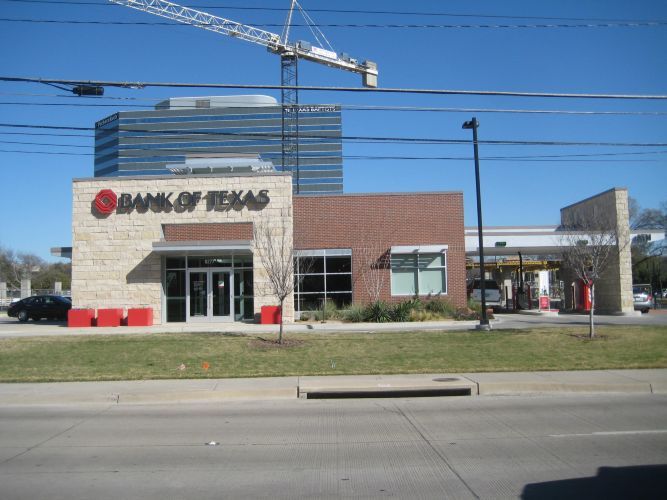
DALLAS — The Dallas forklift ATM theft began, as far as the public record is concerned, with a noise loud enough to wake a neighbour. Around 3:27 a.m. on Wednesday, November 18, 2026, officers responded to a burglary call at the Bank of Texas on Walnut Hill Lane in Dallas, Texas, according to Dallas police statements carried by FOX 4 Dallas and CBS News Texas. What they were responding to was not a smashed window or a pried-open door. A suspect had used a forklift to push over the bank’s drive-thru ATM — the entire machine — and steal it.
Bank drive-thrus are built for the hours when banks are closed, and in the small hours they are among the emptiest commercial spaces in any American city: lit, paved, camera-friendly and deserted. That emptiness is normally a security feature. On Wednesday morning it worked the other way. There was no queue of customers, no staff arriving, no passing trade to interrupt what was happening in the lane. There was, however, a witness. Liz Anderson, a bystander, was woken by the noise, filmed what she saw and called police, she told CBS News Texas. Her video — a bystander’s recording, made on the spot as the theft unfolded — aired on CBS News Texas and FOX 4, and it is the reason this crime, which might otherwise have been a two-line police log entry, is now visible in extraordinary detail.
Dallas police are searching for the suspect. As of the reporting published Wednesday, no one had been arrested, and police had released no description of the suspect. Those two facts deserve emphasis, because almost everything else about this story invites embellishment, and the honest account is strange enough without any. What follows is what is actually known, what the video shows, what was found later near White Rock Trail, and what remains genuinely unresolved — starting with whether the theft, for all its spectacle, ever produced a single dollar for the person who carried it out.
What the video shows
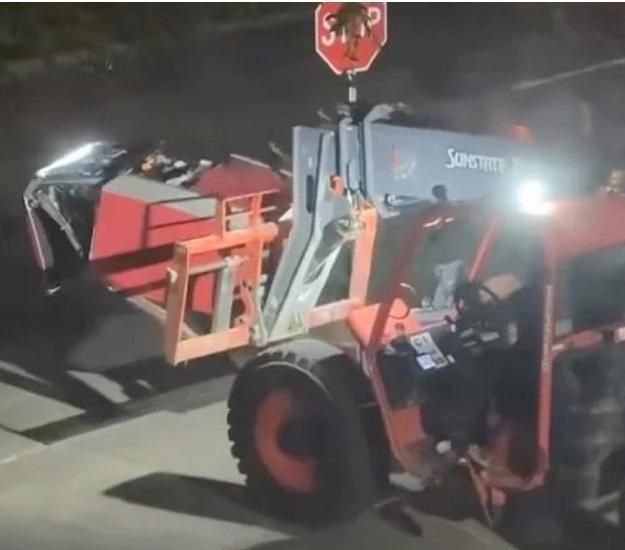
Liz Anderson’s video is the centre of this case, and it is worth being precise about what kind of evidence it is. It is not police surveillance footage, and it was not released by investigators. It is a bystander’s recording — filmed by a resident who heard something wrong outside, looked, and started recording. Anderson told CBS News Texas that the noise woke her up and that she called police. FOX 4’s account of the video describes its essential sequence: the forklift pushes the ATM onto the ground; the forklift then backs up, beeps, and drives away.
Even in that spare description, the details do analytical work. Pushing the machine over first is the tell of the whole method: a drive-thru ATM is anchored against exactly the forces an ordinary thief can apply by hand, so the first problem any would-be thief has to solve is mechanical, not electronic. A forklift solves it by weight and leverage. The beeping matters too, in its way — reversing alarms are fitted to industrial machines precisely so that people nearby are warned, and in a silent street at around 3:27 a.m., that alarm, along with the impact of a heavy machine hitting the ground, is plausibly the noise that woke Anderson and set the police response in motion. The crime’s greatest asset, heavy machinery, was also its loudest liability.
The video’s existence also shapes what police have and have not said. Investigators rarely release a suspect description when they judge that doing so would not help, or when the available images do not support one they are confident in; Dallas police have released none, and no arrest has been made. What the public has is the footage itself, broadcast by CBS News Texas and FOX 4 — a record of a machine being taken, in the open, by someone who either did not know or did not care that a resident was awake, watching and filming a short distance away.
Found near White Rock Trail
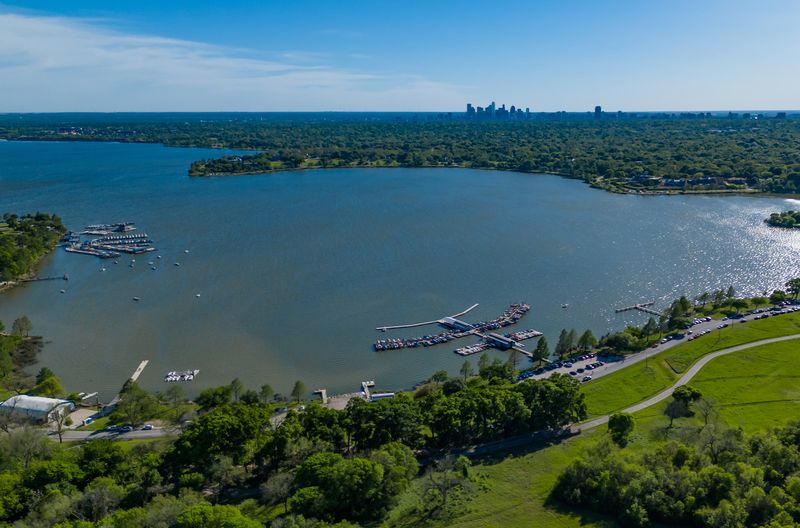
The story’s second act arrived quickly, and it complicated the first. Follow-up reporting by FOX 4 and NBC DFW (NBC 5) said that both the ATM and the forklift were later found abandoned near White Rock Trail in Dallas. The trail, which serves the White Rock Lake area in the city’s east, is a recreational corridor of paths and parkland — the kind of place where large objects left behind tend to be noticed, and where a stolen cash machine and a piece of heavy equipment could hardly remain inconspicuous for long.
Abandonment changes the shape of the investigation in two directions at once. On one hand, recovery is a forensic gift: both machines are now physical evidence, available for examination in a way that a vanished ATM would not be. On the other hand, abandonment is also a message about the crime’s economics. Whoever took the ATM did not keep it, did not (on any reporting available) spirit it to a workshop for a leisurely opening, and left the forklift with it. That pattern is consistent with several very different stories — a plan interrupted, a plan completed quickly, or a plan that never had a realistic second stage at all — and the reporting does not distinguish between them. It is important not to pretend that it does.
The open cash question
Here is the point on which precision matters most, because it is the point on which coverage of crimes like this most often slips: whether any money was removed from the ATM is unknown. No outlet’s reporting establishes that cash was taken, and this report does not claim otherwise. Two tempting inferences both fail. The first is that because the machine was recovered, nothing was taken — recovery proves where the ATM ended up, not what happened to its contents while it was gone. The second is the mirror image: that because the machine was stolen, its cash must have been accessed. Stealing an ATM and opening an ATM are different problems. The first, as Wednesday showed, can be solved with heavy equipment and a few minutes. The second involves a safe engineered to resist exactly that ambition, and no reporting in this case establishes that it was solved at all.
So the honest ledger of the Dallas forklift ATM theft currently reads like this: one ATM, stolen and recovered; one forklift, used and abandoned; one suspect, sought and not yet identified publicly; and an amount of money taken that is, on the available evidence, unknown — a figure that could be substantial or could be zero. No dollar amount for the machine’s contents has been reported, and none is offered here. Cases have been built on less, but conclusions cannot be.
The search
Dallas police are searching for the suspect, and the public posture of the case is deliberately narrow. Officers responded to the burglary call at around 3:27 a.m.; police have said someone used a forklift to remove the ATM; no one has been arrested; and no suspect description has been released. In an era when departments routinely publish stills and descriptions within hours, the absence of both is itself information of a limited kind: it tells the public that investigators are working from material they have not chosen to share, and that the bystander video now broadcast across the Dallas–Fort Worth market is, for the moment, the face of the case.
That broadcast reach is not trivial. A theft filmed this clearly, in a metroplex of millions, generates the conditions in which recognition happens — a viewer who knows the machine, the route or the person. Whether that recognition has occurred is not something any outlet has reported, and the police search, on the public record, remains open. Signal Post News will update this story if Dallas police announce an arrest, release a description, or state what, if anything, was taken from the machine.
Why this matters
It would be easy to file the Walnut Hill Lane theft as a curiosity — the kind of story that travels because it is faintly absurd. That would be a mistake, because the method is neither new nor rare, and understanding why it recurs explains more about the physical security of cash in America than the spectacle does. ATMs sit at an unusual intersection: they hold concentrated value, they stand outdoors or in lightly supervised lanes, they must be accessible around the clock, and their locations are public by design. Every one of those features is a customer convenience, and every one of them is also an invitation that the industry has spent decades trying to rescind without withdrawing the convenience itself.
A recurring pattern, in several dialects
Security experts and law-enforcement agencies generally describe physical ATM theft in a small number of recurring dialects. There are ram raids, in which a vehicle is driven into or at a machine or the structure housing it. There are hook-and-chain attacks, in which a chain or strap is attached to the machine and a vehicle is used to tear it from its mountings. And there is the heavy-machinery variant on display in Dallas, in which construction equipment — a forklift, a telehandler, a loader — supplies the force that vehicles and chains apply less controllably. The variants differ in noise, speed and equipment, but they share a single insight: the weakest point of an outdoor ATM installation is rarely its safe. It is the junction between the machine and the ground it stands on, attacked at an hour when the street is empty.
The heavy-machinery variant adds a further wrinkle that investigators in such cases generally have to work through: construction equipment has a legitimate life of its own. It is stored on sites, moved between jobs, hired, borrowed and parked in yards across every city, which gives both the machine and its movements a kind of background camouflage that a battering ram never has. Where the forklift used on Walnut Hill Lane came from is not stated in any reporting on this case, and this report does not speculate about it; the general point is that tracing a piece of equipment’s movements is a standard, and often productive, line of inquiry in thefts of this kind, precisely because machines of that size are hard to move through a city unnoticed and harder still to explain afterwards.
The countermeasures, and their limits
The banking industry’s answers, described in general terms across trade and security reporting over many years, are layered. Bollards and reinforced mountings raise the force needed to dislodge a machine, buying time and noise — the two currencies in which these crimes are poorest. GPS trackers fitted to machines and to the cash cassettes inside them are designed to make a stolen ATM a beacon rather than a prize, which is one reason abandonment, as in Dallas, is a common ending to these stories. Dye packs attack the value rather than the theft, staining notes so that even a successful opening yields money that announces itself. And around it all sits the oldest layer: lighting, sightlines and cameras, which determine whether a 3:27 a.m. crime has a witness — human, as Liz Anderson was, or electronic.
None of these measures makes a machine invulnerable, and the Dallas case is a clean illustration of the arithmetic the industry cannot escape. A drive-thru lane must admit cars at all hours, which means it must admit, in physical terms, almost anything on wheels. The defences therefore aim not at impossibility but at economics: make the attack slower, louder, more visible and less profitable, until the expected return no longer justifies the risk. That a suspect nonetheless drove a forklift into a lit bank lane in a major city and took the whole machine suggests either a misjudgement of that arithmetic, indifference to it, or a plan whose payoff was never in the machine at all. The reporting does not say which, and the open cash question — the possibility, unproven either way, that nothing was ever taken — hangs over every theory.
What happens next
The investigative avenues in a case like this are well worn, and Dallas police will be understood to be working through the standard set whether or not they describe them publicly: forensic examination of the recovered ATM and forklift; the bystander video and any other footage from the lane and the surrounding streets; the equipment’s own history and movements; and the point of abandonment near White Rock Trail, which is both an evidence scene and a statement about the route the suspect chose to take. Each recovered machine shortens the suspect’s head start, because each carries the physical residue of everyone who handled it. None of that guarantees an identification, and none has yet produced a publicly released description or an arrest.
On the legal side, and speaking in the general terms in which Texas law is ordinarily described: theft in Texas is graded largely by the value of what was taken, with penalties rising through state-jail felony and felony ranges as value increases, and conduct involving burglary of a building or the use of heavy equipment against a bank’s property can attract additional or alternative charges depending on how prosecutors characterise the facts. Which framework would apply here depends on facts that are not yet public — above all, what, if anything, was taken from the machine, and what the evidence shows about how the forklift was obtained and used. It would be premature to attach a specific charge or penalty range to a suspect who has not been identified, and this report does not do so. What can be said is that the recovery of both machines, and the existence of broadcast-quality bystander video, give prosecutors in any eventual case an unusually concrete record of the central act.
For the bank and its customers, the immediate sequel is mundane: a drive-thru lane to repair, a machine to replace, and a fresh look at the physical defences of a site that has now demonstrated its vulnerability in the most public way possible. For everyone else in Dallas, the story ends, for now, where it began — with a noise in the night on Walnut Hill Lane, a resident who filmed instead of turning over, and two abandoned machines near White Rock Trail that raise more questions than they answer. Related Signal Post News coverage: Four killed in Dallas’s Deep Ellum Halloween shootings, Dallas Love Field closed after a reported bomb threat, and Kissimmee’s mayor arrested on grand theft charges.
Sources
Sources: FOX 4 Dallas (KDFW), November 18, 2026 — “WATCH: Forklift used to steal ATM from Dallas bank”: Dallas police statements that officers responded to a burglary call at the Bank of Texas on Walnut Hill Lane around 3:27 a.m., that a suspect used a forklift to push over and remove the ATM, that Liz Anderson’s video shows the forklift pushing the ATM onto the ground before backing up, beeping and driving away, that no one had been arrested and that no suspect description had been released — fox4news.com. CBS News Texas, November 18, 2026 — Liz Anderson, who filmed the bystander video, saying the noise woke her and that she called police; the theft from the Bank of Texas drive-thru near Walnut Hill Lane, as aired in the station’s reports. NBC DFW (NBC 5), November 18, 2026 — follow-up reporting, also carried by FOX 4, that both the ATM and the forklift were later found abandoned near White Rock Trail in Dallas, per Dallas police. Dallas Police Department statements as carried by FOX 4 Dallas, CBS News Texas and NBC DFW. No outlet has reported whether any money was removed from the machine; whether any cash was taken is unknown, and no dollar amount for the ATM’s contents has been reported. General background on physical ATM theft methods and bank countermeasures (ram raids, hook-and-chain attacks, bollards, cassette GPS trackers and dye packs) is presented as general attributed context from security and trade reporting, not as findings in this case.