Congo Ebola outbreak passes 10,000 cases
Kinshasa / Ten thousand confirmed cases, 4,887 dead and nearly half of all patients dying — Congo’s Bundibugyo outbreak is now the largest and deadliest in the country’s history, the second-largest Ebola epidemic ever recorded anywhere, and still accelerating into territory no previous outbreak has reached this fast
Track it live: Live outbreak tracker
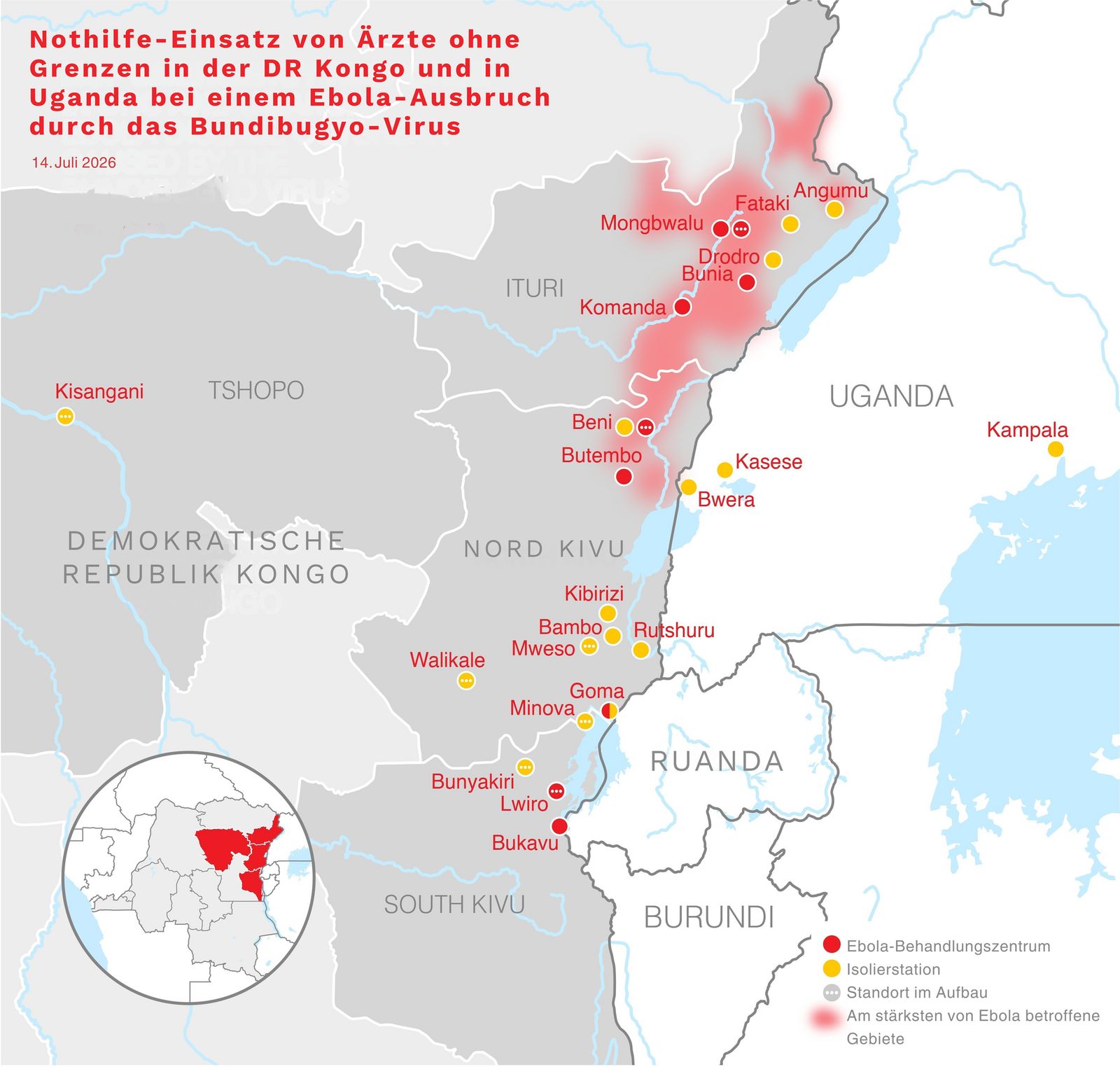
The Congo Ebola outbreak 10000 cases threshold has been crossed. The Democratic Republic of Congo’s latest situation report, published on Tuesday, October 27 with data through October 25 and reported by Reuters, counts 10,060 confirmed cases and 4,887 deaths — a case fatality rate of 48.6 percent, with about 2,684 patients recorded as recovered. The figures land 165 days after Congo declared the outbreak in Ituri province on May 15, 2026, and they confirm what responders have been warning for weeks: this is no longer an outbreak that can be described in the language of containment. It is the largest and deadliest Ebola epidemic in Congo’s history, and it is still growing.
The pathogen is the Bundibugyo species of Ebola virus, the rarest of the strains known to infect humans, and that single fact shapes everything about the response. There is no approved vaccine and no approved treatment for Bundibugyo Ebola. The ring-vaccination playbook that helped end Congo’s previous epidemics was built around a vaccine designed for the Zaire species, and it does not transfer. Responders are fighting this outbreak with the tools that predate the vaccine era — isolation, contact tracing, safe burials, infection control and supportive care — against a virus killing close to one in every two confirmed patients, in provinces where armed conflict and attacks on health workers have repeatedly broken the response’s own infrastructure.
A record that keeps breaking: largest in Congo, second-largest ever
Set the new totals against the historical record and the scale becomes plain. Congo has lived with Ebola longer than any country on earth — the virus was first identified there in 1976, and the country has recorded more outbreaks than any other nation — yet no Congolese epidemic had ever approached five figures before. The 2018–2020 Kivu outbreak, until now the country’s largest, recorded roughly 3,470 cases and 2,280 deaths over nearly two years. The Bundibugyo outbreak has passed both marks in under six months, with room to spare: at 10,060 cases and 4,887 deaths it is more than double the Kivu epidemic on each measure, and its death toll alone exceeds the combined toll of every previous Congolese outbreak.
Globally, only one Ebola epidemic has ever been bigger: the West African epidemic of 2014–2016, which recorded more than 28,600 cases and more than 11,000 deaths across Guinea, Sierra Leone and Liberia. The Bundibugyo outbreak is now the second-largest Ebola epidemic ever recorded, and the comparison that alarms epidemiologists is not the distance still to travel but the speed of the journey. Africa CDC has assessed this outbreak as growing roughly three times faster than the West African epidemic at the equivalent point in its course. West Africa’s epidemic took the better part of a year to pass 10,000 confirmed and probable cases. Congo has reached 10,060 confirmed cases — confirmed alone, before probable cases are counted — in 165 days.
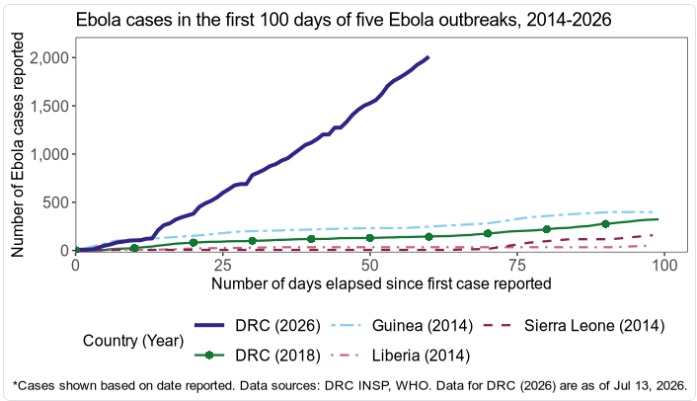
Speed is not a statistic; it is an operational condition. An outbreak growing three times faster than the historical benchmark outruns bed capacity, laboratory throughput, burial teams and tracing workforces that were sized for the benchmark. It also compresses every decision. In a slower epidemic, a week lost to a security incident or a funding delay costs cases at the margin. In this one, the same week can cost a health zone. That is why Africa CDC’s “fastest-growing ever recorded” assessment — echoed in the DRC’s own reporting — matters more than the round number in the headline: 10,000 cases is the milestone, but velocity is the emergency.
Eight provinces, 66 health zones — and a map still expanding
The outbreak’s footprint has widened steadily since May. Transmission is now established in eight provinces, spanning 66 health zones, according to the situation reporting summarised by Reuters and the European Centre for Disease Prevention and Control. Ituri, where the outbreak was declared, remains the epicentre, but the virus has entrenched itself across the east — through the Kivus and into Tshopo and the Uélé provinces — in a pattern that no longer resembles a cluster with satellites. It resembles an archipelago of connected epidemics, each with its own local dynamics, its own security conditions and its own exhausted workforce, all drawing on the same national response.
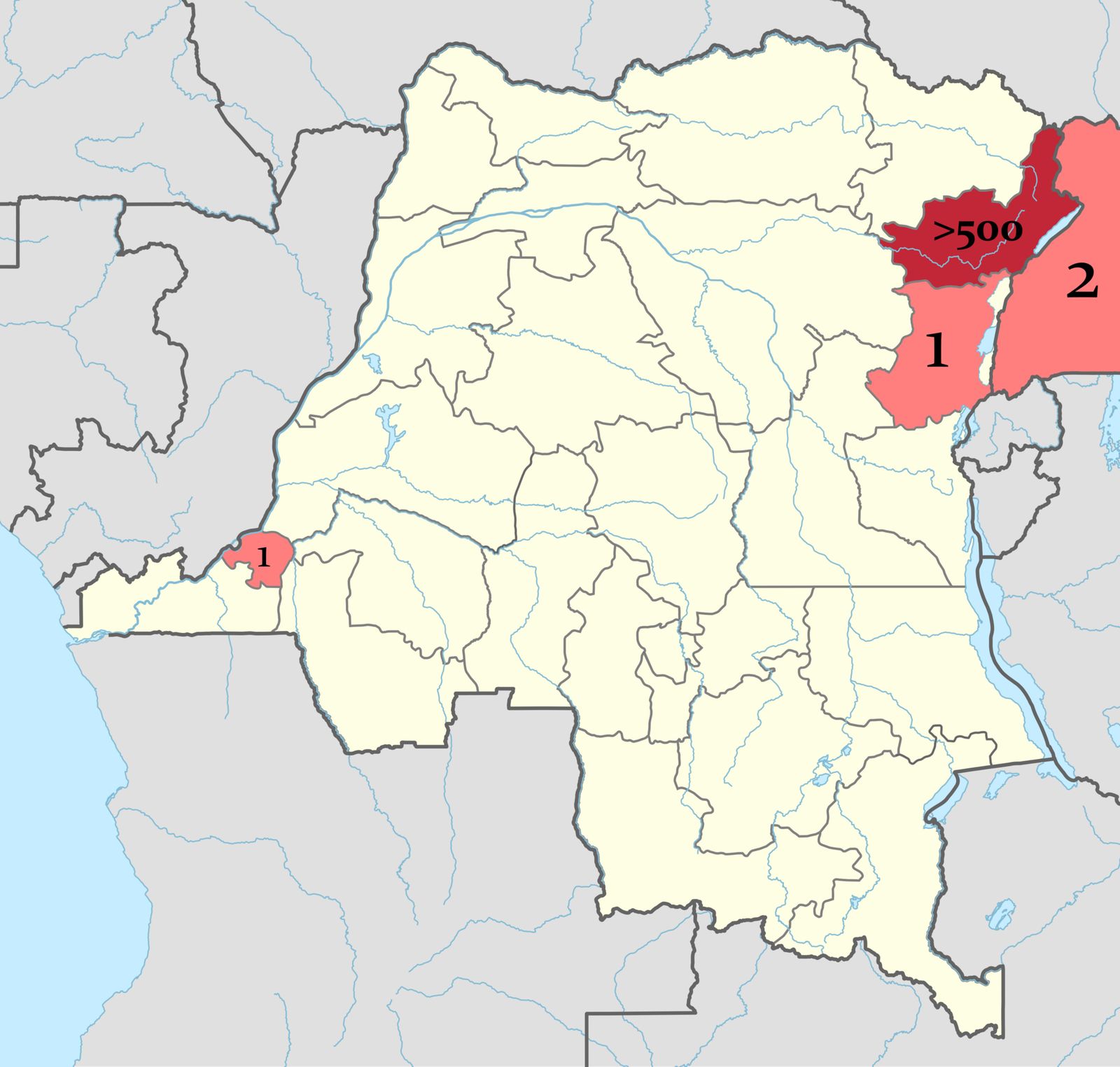
Geography compounds every other difficulty. The affected east is the same region where Congo’s army and allied forces have fought armed groups for decades, where displacement camps crowd around towns like Bunia, and where roads dissolve in the rains. Signal Post News reported earlier in this epidemic on the moment Congo’s Ebola death toll passed 4,000, when a burned transit centre and unpaid surveillance teams already exposed how thin the response had been stretched. In the weeks since, the death toll has climbed by nearly another 900 and the case count by roughly 1,700 — evidence that the curve responders hoped was bending has not yet bent.
The tracing gap: four in five new cases are coming from nowhere on paper
Buried in the situation reports is the figure that most worries outbreak veterans. Roughly 80 percent of new confirmed cases are arising outside known transmission chains — people who were not on any contact list when they fell ill. The benchmark for an outbreak under control runs the other way: responders aim for around 95 percent of new cases to come from already-identified contacts, people being monitored who can be isolated the moment symptoms appear. At 95 percent, the epidemic’s future is largely written down in advance. At 20 percent, four-fifths of the future is invisible until patients surface — at a treatment centre, at a clinic, or at a funeral.
That gap is the arithmetic of why this outbreak keeps outrunning predictions. Every case outside a known chain represents a chain nobody has mapped: the household, the taxi, the market stall, the prayer meeting, the traditional healer, the border crossing. Each unmapped chain seeds the next fortnight’s cases, and each one found late means contacts traced late, which means more cases found outside chains. It is a self-feeding cycle, and breaking it requires the one resource the east cannot easily supply: unimpeded, trusted, daily access to frightened communities by tracing teams who are paid, protected and believed. The 48.6 percent case fatality rate tells the same story from the other end — patients are reaching care late, when supportive treatment has the least to work with, because the system that should find them early is seeing only a fraction of transmission.
Children are bearing the worst of it
The outbreak’s cruellest distribution is by age. Save the Children, reporting on Tuesday, October 27, counted 2,705 confirmed cases among children aged 0 to 17 — more than a quarter of all cases — and a case fatality rate of 72 percent among children under five, dramatically higher than the already-brutal 48.6 percent recorded overall. More than 1,900 children have been orphaned or separated from their caregivers by the epidemic, through death, isolation or the flight of families from affected zones. The charity is opening an Observation Care Centre in Bunia, the Ituri capital, designed for unaccompanied children who must be monitored through the 21-day incubation window without being warehoused in adult isolation facilities.
The paediatric numbers have several drivers, and they interact. Young children cannot describe early symptoms, are nursed in close physical contact by the mothers and grandmothers who are themselves at high risk as caregivers, and deteriorate faster from the vomiting and diarrhoea through which Ebola kills. In treatment centres built for adults, a sick toddler arrives having already lost ground an adult might have held. A 72 percent fatality rate for under-fives is what Ebola looks like when detection is late and care is distant — and it is a leading indicator for the general population, because the same lateness, in smaller degree, is what keeps the overall fatality rate near one in two.
Health workers under attack in Tshopo
The response is also being bled by violence. The World Health Organization reported that on Saturday, in Tshopo province, a nurse was killed and another health worker wounded in an attack — the latest in a series of assaults on the people staffing the epidemic’s front line. Health workers in this outbreak face a double exposure no roster can solve: they are the most likely to meet the virus at its most infectious, in treatment units and at burials, and they are targets in communities where rumour paints response teams as profiteers, or worse, as agents of the disease itself.
Congo has seen this before. In the 2018–2020 Kivu outbreak, treatment centres were burned and epidemiologists murdered, and each attack bought the virus weeks of unobserved spread. The lesson written into every after-action review of that epidemic was that security for health workers is not a courtesy extended to the response — it is the response, because a tracing team that cannot enter a village is a chain the virus gets to keep. A nurse dead in Tshopo is therefore not only a crime and a tragedy for her family; it is measurable in the cases that will surface, unlisted, over the following month.
Across the borders: Kenya counts nine cases, Nigeria one
The outbreak formally ceased to be a single-country epidemic some time ago. Kenya has recorded nine confirmed cases and two deaths, imported through the same travel corridors that bind Nairobi to Congo’s east; Signal Post News reported this week on Kenya’s second Ebola death, a 65-year-old woman, as Kenyan authorities worked to ring-fence their cluster before it could seed community transmission of its own. Nigeria’s single confirmed case followed a stranger itinerary: the patient, the wife of a Swiss diplomat, was evacuated to Switzerland for care, and the investigation into how she was infected has been led by Professor Jean-Jacques Muyembe — the Congolese scientist who co-discovered Ebola in 1976 and has directed the science of nearly every outbreak since.
One case in Nigeria and nine in Kenya are, in themselves, containable events; both countries have deep outbreak experience and moved quickly. Their significance is diagnostic. Exported cases are the smoke that proves the fire is bigger than the visible flame: for every traveller detected, the base rate at home must be large, and the routes the virus travelled — road to Kampala or Kisangani, plane onward — are routes thousands travel weekly. Uganda, South Sudan, Rwanda, Burundi, Tanzania and the Central African Republic all sit inside the epidemic’s natural travel radius, which is why the regional response, from border screening to Uganda’s 21-day quarantine for returnees from Congo, has hardened through October.
The countermeasure race: a vaccine trial, a treatment deal, no approved tools
Against this curve, the scientific response is moving at emergency speed but from a standing start. On October 23, in Bunia, the Tumaini vaccine trial enrolled its first participant, the World Health Organization reported — the first attempt to generate human evidence for a vaccine against the Bundibugyo species while the outbreak it targets is still expanding. Trials run during an epidemic carry an ethical and logistical weight no peacetime study faces: every week of rigour is a week the candidate cannot help, and every shortcut risks a result nobody can trust. But Bundibugyo has caused outbreaks before and will cause them again; a proven vaccine converts every future Bundibugyo emergency from this year’s improvisation into a ring-vaccination campaign.
Treatment science is being bought forward in parallel. Washington’s $270 million agreement with Regeneron, which Signal Post News covered in its reporting on the Regeneron Ebola treatment deal for the Bundibugyo outbreak, is an attempt to ensure that an antibody therapy for this strain exists in manufactured quantity rather than as a laboratory promise. Neither the trial nor the deal changes the arithmetic of the next month: the patients who will fill treatment centres in November will be treated, as the 10,060 before them were, with fluids, electrolytes, oxygen and vigilance. The countermeasures are for the outbreak’s second year, if it is allowed one — and for the next outbreak, if they finish in time.
Why this matters
Speed rewrites the ethics of delay. In a slow outbreak, the international system’s habits — assessments, appeals, pledging conferences, phased deployments — cost time at the margin. In the fastest-growing Ebola outbreak ever recorded, those habits cost health zones. Africa CDC’s three-times-faster assessment means every mechanism calibrated to West Africa’s timeline is calibrated a factor of three too slow.
The tracing gap is the outbreak’s true headline. Case counts measure the past. The share of new cases arising outside known chains — about 80 percent, against a 95-percent-known benchmark for control — measures the future. Until that ratio inverts, declarations of progress in individual provinces should be read as local weather, not climate.
Children’s outcomes expose the system, not the virus. Ebola does not inherently kill 72 percent of infected under-fives; late detection and distant care do. The 2,705 child cases and 1,900-plus orphaned or separated children are the most sensitive gauge available of how far the response is from the households it needs to reach.
Regionalisation is already a fact. Kenya’s nine cases, Nigeria’s one, Uganda’s quarantine regime and a Muyembe-led cross-border origin investigation describe an epidemic whose perimeter is now the region’s airports and highways. What happens in Ituri is being decided partly in Nairobi, Abuja and Entebbe — and the cost of the response will be regional whether the funding is or not.
What happens next
The immediate test is political. African health ministers meet in a virtual summit on Wednesday, October 28 — today — convened as the case count crosses five figures, with the response’s funding, staffing and security gaps at the top of the agenda. Summits in this epidemic have so far produced statements faster than resources; the measure of this one will be whether tracing teams get paid, whether treatment centres in contested zones get protection, and whether the regional states harmonise the border measures they have been improvising separately. Watch, too, for the DRC’s next situation report: the questions are whether the 80-percent unknown-chain share has moved at all, whether the under-five fatality rate is falling as the Bunia Observation Care Centre opens, and whether Tshopo’s attack on health workers is answered with the security the response has been promised. The Tumaini trial, meanwhile, will read out its first safety data into a region that cannot wait for its conclusion. The outbreak has taken 165 days to reach 10,000 cases. On its current trajectory, the next 10,000 would take far less time — which is precisely the future the summit, the trial and the tracing teams are racing to cancel.
Sources
- Reuters, October 27, 2026: reporting on the DRC situation report of October 27 (data through October 25) — 10,060 confirmed cases, 4,887 deaths, case fatality rate 48.6 percent, about 2,684 recoveries, transmission across eight provinces and 66 health zones.
- Associated Press and Al Jazeera, October 2026: reporting on the outbreak’s record scale — largest and deadliest in DRC history, second-largest ever behind West Africa 2014–2016 (28,600+ cases, 11,000+ deaths) — and Africa CDC’s assessment that it is the fastest-growing Ebola outbreak ever recorded, at roughly three times the West African pace at the equivalent point.
- Save the Children, October 27, 2026: 2,705 confirmed cases among children aged 0–17, under-five case fatality rate of 72 percent, more than 1,900 children orphaned or separated, and the opening of the Observation Care Centre in Bunia.
- World Health Organization, October 23–27, 2026: first participant enrolled in the Tumaini vaccine trial in Bunia (October 23); a nurse killed and a health worker wounded in an attack in Tshopo province on Saturday.
- European Centre for Disease Prevention and Control (ECDC), October 2026: epidemiological updates on the Bundibugyo outbreak’s provincial spread and exported cases, including Kenya (nine cases, two deaths) and Nigeria (one case; patient evacuated to Switzerland; origin investigation led by Prof. Jean-Jacques Muyembe).
Note: case and death figures are confirmed cases from the DRC situation report published October 27, 2026 with data through October 25; the 48.6 percent case fatality rate is calculated on confirmed cases and typically moves as outcomes are resolved. Probable cases are additional to the totals above.