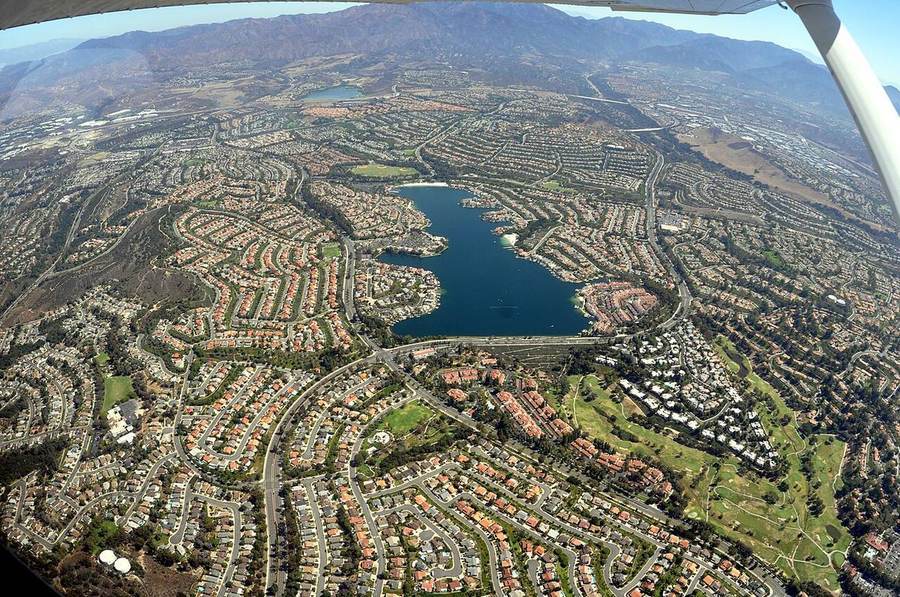
Mission Viejo was farmland until the 1960s, when the Mission Viejo Company began building one of the largest master-planned communities in American history. The result is a city that feels designed rather than accumulated: curving streets, abundant parks and trails, a private lake at its center, and housing organized into distinct neighborhoods, nearly all with homeowners associations. For buyers who want suburban order done at the highest level, Mission Viejo is the south-county answer.
The master plan: how the city is organized
Mission Viejo's neighborhoods were built in phases over decades, and the phases show. Earlier neighborhoods offer established landscaping, mature trees, and classic 1970s–80s floor plans; later phases bring 90s and 2000s construction with more modern layouts. The city reads as a collection of villages — Mission Hills, Pacific Hills, Casta del Sol (a 55+ community), and others — each with its own HOA, character, and price tier.
The planning shows in daily life: an extensive trail system, community parks, sports facilities, and the city's deliberate commercial centers mean most errands and recreation happen within the city. The Saddleback Valley setting — rolling hills with the Saddleback mountains as backdrop — gives the city a scenic quality that flat suburbs can't match.
Lake Mission Viejo: the private-lake factor
Lake Mission Viejo is the city's signature amenity: a man-made private lake reserved for members, with swimming, boating, fishing, and two private beaches. Lake membership is tied to property ownership in the lake association's area — buyers should verify exactly which properties carry membership rights, what the dues are, and what the membership includes.
The lake shapes the market in two ways. Lake-proximate and lake-view homes command premiums, and lake membership is a genuine lifestyle asset for boating and beach-club families — a private waterfront without leaving the suburbs. But it is also a cost layer: membership dues stack on top of HOA dues, and buyers must budget the full picture.
HOAs: the price of the plan
Nearly every Mission Viejo home belongs to an HOA, and the associations are active: architectural review, landscaping standards, common-area maintenance. Dues vary by neighborhood and cover the amenities that make the city attractive — pools, trails, greenbelts. As with any HOA purchase, review the budget, reserves, and pending assessments during escrow, and understand the architectural rules before planning any exterior changes.
Lenders count HOA dues in the housing ratio, so they directly affect qualification — a meaningful consideration in a city where dues plus potential lake membership stack up. For the full evaluation framework, see our guide to buying a house with an HOA in California.
Compared with Irvine's multi-layer HOAs and Mello-Roos, Mission Viejo's structure is generally simpler — one HOA per neighborhood, established reserves, no new-development special taxes in the older phases. Buyers comparing the two master plans should read our guide to buying a house in Irvine for the full contrast.
Schools, parks, and family infrastructure
Mission Viejo's family appeal rests on schools, parks, and safety — the classic suburban triad, executed at a high level. The Saddleback Valley and Capistrano school districts serve the city with strong reputations, and school assignments influence neighborhood premiums the way they do everywhere in south county. Verify assignments for the exact address.
The park and trail network is the city's quiet superpower: miles of trails, community and neighborhood parks, sports parks, and the lake. For active families, this infrastructure is a daily-life upgrade that compounds — the city was literally designed around it.
Commute: the 5 and the south-county reality
The 5 freeway is Mission Viejo's lifeline — north to the Irvine Spectrum and central county, south to San Clemente and San Diego County. Commutes to the Irvine job centers are the most common and the most manageable; commutes north of the 55/405 interchange get longer. The 241 toll road offers an eastern alternative toward Rancho Santa Margarita and the Irvine area.
South-county buyers should be realistic: Mission Viejo is a suburban family city, not a commuter hub. The lifestyle bargain is space, order, and amenities in exchange for drive time — and for remote or hybrid workers, that bargain has never been better.
How the buying process works here
Mission Viejo's market is steady rather than frenzied: family homes in sought-after school zones move well, while the city's large inventory gives buyers real choice. HOA document review is a central escrow step — take it seriously, and pay special attention to lake-membership terms where applicable.
Standard California sequence throughout: pre-approval, tour, offer with inspection and appraisal contingencies, escrow, close — plus California closing costs beyond the down payment. First-time buyers should start with our first-time buyer guide for Orange County.
Inspection focus follows the era: 70s–80s homes need the midcentury-to-modern checklist (electrical panels, plumbing, roofs, HVAC age); hillside properties need drainage review; and every buyer should confirm HOA and lake dues in writing before removing contingencies.
Who wins — and who should keep looking
Mission Viejo rewards family buyers who want master-planned order, strong schools, the lake lifestyle, and Saddleback Valley scenery — and who are comfortable with HOA governance as the price of the manicured environment. Remote and hybrid workers get the suburban bargain at its best here.
It is a weaker fit for buyers who chafe at HOA rules, want historic character or architectural variety, or need a short commute north of the 405. Those buyers should look to central-county cities like Tustin — or accept that the master plan, done this well, is exactly what they're paying for.
Frequently asked questions
What is Lake Mission Viejo and who can use it?
Lake Mission Viejo is a private man-made lake reserved for members, offering swimming, boating, fishing, and private beaches. Membership is tied to property ownership within the lake association's area — verify that a target property carries membership rights, and budget the membership dues on top of HOA dues.
Do all Mission Viejo homes have HOAs?
Nearly all. The city's neighborhoods each have homeowners associations handling architectural review, landscaping, and common areas. Review HOA budgets, reserves, and rules during escrow — dues affect both your monthly budget and your mortgage qualification.
Is Mission Viejo a good place for families?
It was designed for them: strong school districts, an extensive park and trail system, the lake, sports facilities, and a safe, orderly environment. School assignments vary by address and influence neighborhood premiums — verify assignments for any specific home.
How is the commute from Mission Viejo?
The 5 freeway is the main artery: manageable to the Irvine Spectrum area, longer heading north past the 405 interchange. The 241 toll road offers an eastern alternative. The city suits remote/hybrid workers and Irvine-area commuters best; buyers commuting to LA should test the drive honestly.
Thinking of buying or selling in Orange County?
Get a free, no-pressure consultation. Tell us what you are looking for and get a fast callback. Casa Blanca Realtors is our featured local pick for Orange County buyers (partner).
Get My Free ConsultationFree consultation · Fast callback · No pressure.
Sources and further reading
Consumer Financial Protection Bureau: home-buying resources · U.S. Department of Housing and Urban Development · California Department of Real Estate