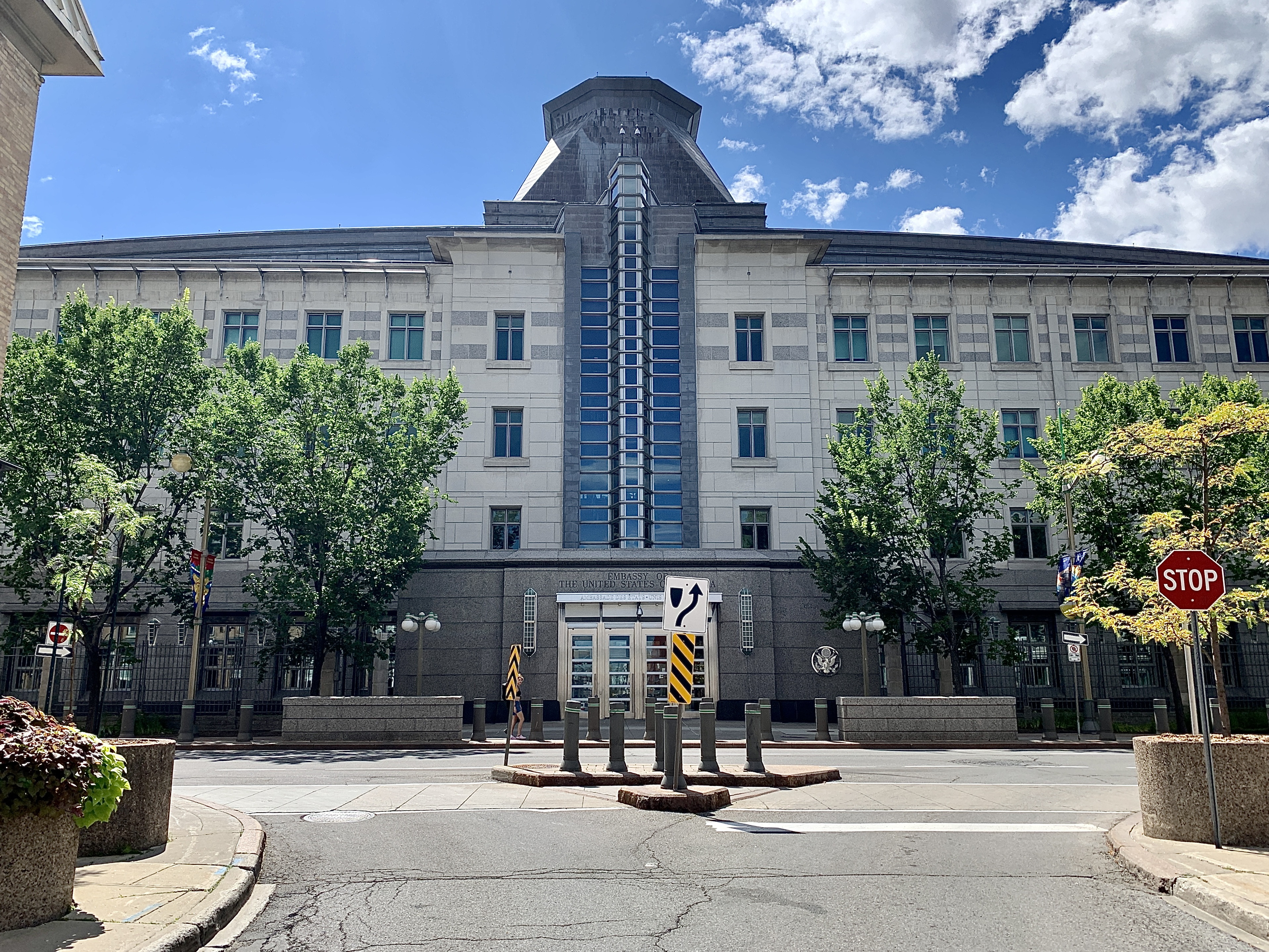
Politics / The Canada election interference US midterms row escalated on Wednesday, October 21, when the US Embassy in Ottawa published a formal fact sheet accusing the Canadian government of brushing off concerns about potential interference in the November 3 midterm elections — and listing, one by one, the public statements by Canadian ministers and premiers it says amount to plans to influence American politics. Prime Minister Mark Carney and Ontario Premier Doug Ford, standing together on Parliament Hill to announce a C$8.7 billion shield for tariff-hit industries, rejected the charge outright. Both sides are describing the same facts — targeted counter-tariffs, meetings with Democrats, a $75 million advertising campaign — in opposite languages: Washington calls it interference, Ottawa calls it defending Canadian jobs against a trade war Washington started.
The Canada election interference US midterms dispute now has a document at its centre. The fact sheet, titled "Monitoring Canadian Activities in U.S. Politics" and released by the US Embassy in Ottawa on Wednesday, October 21, 2026, opens by quoting Canada's own leaders against themselves. It begins with Prime Minister Mark Carney's words of October 16 — "Our expectation is, to be absolutely clear, on foreign governments, United States included, is we don't get ourselves involved in their elections, they don't get themselves involved in our elections" — and Industry Minister Mélanie Joly's of October 14: "Absolutely not. I would never do that, and we would never accept that also being done to us in Canada." Then comes the accusation, in one sentence: "The Canadian government brushes off concerns about potential interference in U.S. elections, even as its ministers and premiers openly describe plans to influence American politics in official documents and public appearances." Everything that follows in the document is an attempt to prove that sentence out of Canadian mouths.
What happened, and when
The fact sheet landed in the middle of an already crowded Wednesday in Ottawa. Carney, flanked by Joly and Ford, was on Parliament Hill to announce a C$8.7 billion (about $6.2 billion) package to protect Canada's manufacturing heartland — steelmakers, automakers and critical minerals in Ontario — from the American tariff campaign. Asked about the embassy's document, both men denied any intention to sway the vote south of the border. "The United States initiated a series of trade actions. We've responded to those to protect Canadian jobs, to protect Canadian companies and develop our economy," Carney said. "All of our actions are in the interests of Canadian workers, Canadian families and the future of this economy." Ford, who is himself quoted in the embassy release, said he has "no interest at all" in interfering in American elections. "I'll tell you what the American people want. They want certainty, they want stability," Ford said, noting that he spent 20 years in the United States and "loves the American people." "We're going to focus on what we can do here in Ontario and in Canada to make sure we protect our economy, protect the people and protect communities. That's what we're going to focus on, and the people of the United States will make that determination in the midterms." The Canadian Press asked for comment from Joly, the minister quoted most often in the document, but she was not made available on Wednesday; her stated position, given to CBC the previous week, is that Canada would never engage in election interference and that her recent visits to the United States were made "to attract investments" from American companies — a strategy she says she will continue.
The embassy document did not arrive from nowhere. US Ambassador to Canada Pete Hoekstra said last week that American officials are "closely watching" Canadian politicians for signs of interference ahead of the midterms. "We're monitoring it, we're evaluating it and if some of it becomes election interference then America will respond to it," Hoekstra said. A month earlier, Peter Navarro, one of President Donald Trump's top trade advisers, used an economic conference in Washington to warn Canada directly: "The problem you have is you lobby this country and you've been successful in the past and you think you can keep doing that. Memo to Canada: You cannot do that. That game is up and if you interfere in our elections in Maine or Michigan you will pay even more dearly." The fact sheet is the moment those warnings were converted from remarks into a formal, itemised, on-the-record document — published thirteen days before Americans vote on November 3.
What the fact sheet actually lists
Read closely, the document is a dossier of quotations rather than a disclosure of covert activity. Its core exhibits concern Joly, whom the Canadian Press counts as quoted five times in the list. In September 2026, in the run-up to the midterms, Joly met US Democratic officials in Boston and Chicago; when asked what she expected in terms of tariffs if Democrats were to win the midterm elections, she responded, "That's exactly why I'm meeting so many governors and potential presidential candidates" (as reported by La Presse Canadienne on September 19, 2026). On August 25, 2026, she said of Canada's counter-tariff design: "We're also targeting products that will target states in the U.S. And so we're being wise and strategic to put political pressure, and that's why we think it's the right thing to do right now." The document reaches back to March 2025 for two more: on March 6, 2025, in Montreal, Joly said Canada was "making sure to put pressure on American businesses, in key Republican states to put pressure on the Trump Administration," and on March 7, 2025 she told the Toronto Star that Canada was "doubling down on products that will have an impact politically in Republican states." Each remark was made publicly, on the record, while explaining Canada's response to US-imposed tariffs — a context the Canadian Press noted the embassy's list does not provide.
Ford appears twice. In August 2026, in a letter to Carney dated August 17, the Ontario premier pushed the federal government to consider additional retaliatory tariffs on imports from "politically significant states to the current administration's base of support." And in October 2025, his government announced a CAD $75 million anti-tariff advertising campaign in the United States built around selective excerpts of former President Ronald Reagan criticising tariffs; Ford told the Empire Club on October 14, 2025 that "we're going to repeat that message to every Republican district there is, right across the entire country." That advertisement, aired during the World Series, so angered Trump that he cancelled trade talks with Canada in October 2025 — a rupture whose consequences are still running. The list then widens beyond ministers: in August 2026, Canadian Liberal MP Anthony Housefather campaigned in Florida on behalf of US Representative Debbie Wasserman Schultz ahead of her Democratic primary; on October 13, 2026, three weeks before the midterms, Canadian Consul General Bernadette Jordan appeared at a Vermont roundtable on trade tensions alongside members of Congress from only one party, Democratic Representatives Becca Balint of Vermont and Jim McGovern of Massachusetts; and in March 2025, the Government of Canada launched an anti-tariff billboard campaign aimed at "informing Americans" in 12 mostly Republican-voting states and in Washington, D.C.
The 11 voting cases — and what they do and do not show
The document's second half changes register entirely. "Several Canadian citizens have also been criminally charged and convicted in the United States with unlawful interference in U.S. elections," it states, adding that "Canada has the second highest total of prosecutions for fraudulent or illegal voting of any country" and that in 2026 at least 11 Canadians have been charged or sentenced for illegal voting in general elections and primaries held from 2012 to 2024, citing the US Department of Justice. It names the eleven — cases in Idaho, New York, Kentucky, Minnesota, Florida, Massachusetts, North Carolina and Alabama, charged or sentenced between January and October 2026. Precision matters here, and every major outlet that covered the document supplied the same caveat: the fact sheet presents no evidence linking any of those individual cases to the Canadian government, to any Canadian political party, or to any coordinated effort. They are prosecutions of individuals for voting in elections held between 2012 and 2024 — assembled in the document beside ministerial quotations about tariffs, but not connected to them by anything the embassy published. The wider context, reported by the Associated Press, is that the Trump administration has launched a government-wide effort to investigate and prosecute noncitizen voting, with the Justice Department saying it has arrested more than 200 people since the beginning of 2026 for illegally voting as noncitizens in past elections — a number election experts and administrators describe as extremely small against the tens of millions of ballots Americans cast, and the underlying issue as a relatively minor one.
The document closes with a sentence addressed not to the Canadian government but to Canadians: "All Canadians should refrain from attempting to participate in or influence U.S. elections in any way. Americans decide America's elections."
The $6.2 billion announcement underneath the row
It is easy to miss, under the diplomatic noise, what Carney and Ford were actually on Parliament Hill to do — and the announcement itself is part of the argument. The C$8.7 billion ($6.2 billion) package includes C$5.2 billion ($3.7 billion) over five years for steelmakers and C$2.5 billion ($1.8 billion) for automakers, including C$1.5 billion ($1.1 billion) in federal funding, aimed at Ontario, the country's manufacturing heartland. It was unveiled on the same day that US-owned steelmaker Cleveland-Cliffs announced layoffs at its plant in Hamilton, Ontario — a coincidence of timing that underlined Carney's central claim: "US tariffs have upended a trade bargain that's existed for decades. They've raised costs for American families while putting Ontario workers and businesses at a disadvantage and under a cloud of uncertainty." Carney put numbers on the damage: Canadian automotive exports to the United States have fallen by more than 10 percent, while US exports to Canada have fallen by more than 20 percent. "Tariffs make both our industries weaker and reduce choice for our families," he said. He also disclosed that he had spoken with Trump "for quite some time" about trade and other issues — the conversation ranged across Iran and the Middle East, and the two leaders had discussed Ukraine a few days earlier — but gave no indication of a breakthrough, while insisting Canada remains ready to negotiate. The recent history explains the stalemate: trade negotiations collapsed in August after the two countries appeared close to an agreement, and Trump subsequently imposed 50 percent tariffs on about $20 billion worth of Canadian goods, prompting Canadian retaliation.
Ford used the occasion to say something larger. "It's clear that Canada's relationship with the United States has changed permanently," he said. "No matter what happens in the midterms, no matter who sits in the White House, we're not going back to the way things were." That sentence, from the premier of Canada's largest province, standing beside its prime minister, is the strategic backdrop against which the embassy's complaint should be read: Ottawa has already priced in a permanently different relationship — Carney has set a target of doubling Canadian exports to markets other than the United States over the next decade — and Trump's repeated threats to make Canada the 51st US state have fuelled a surge of Canadian nationalism that no Canadian politician can afford to be seen defying.
Why this matters
The significance of the fact sheet is not what it reveals — it reveals nothing that was secret. Every quotation in it was uttered in public, most of them to cameras, by politicians who wanted to be heard. Its significance is what it does. By converting a trade dispute into a formal accusation of election interference, Washington has changed the legal and rhetorical category of the argument thirteen days before a midterm election whose outcome will decide whether Trump governs with a compliant Congress or a hostile one. Interference is among the most serious charges one democracy can level at another; it is the vocabulary ordinarily reserved for covert influence operations, hacked emails and clandestine funding. Applied here to open diplomacy and openly announced counter-tariffs, it stretches the concept to cover something every trading nation does when hit with tariffs: designing retaliation to be felt where it will be noticed. Canada targeted bourbon, motorcycles and Republican-state products for the same reason the European Union targeted Harley-Davidsons in 2018 — because trade defence, to work as leverage, must be politically legible. Whether legible pressure becomes "interference" when an election is near is precisely the question the two governments are now fighting over, and it has no settled answer in international practice.
There is a second, colder reading, supplied by Daniel Béland, a political science professor at McGill University in Montreal, who told the Associated Press: "The items featured in the US embassy's 'fact sheet' are not genuine examples of foreign interference and the implicit assumption that Canada could significantly alter the outcome of the midterms is absurd." Accusing Canada ahead of the vote, Béland argued, "could pave the way to 'Blame Canada' rhetoric after the electoral results are in." That is the document's insurance function: if Republicans lose the House or the Senate on November 3, a ready-made external explanation — foreign interference, formally documented in advance — will already exist in the public record. And there is a third reading, which is Ottawa's: that the accusation is itself a form of pressure, designed to silence the most effective Canadian argument in the trade war — the argument, made directly to American voters in Republican districts, that Trump's tariffs are costing American jobs and raising American prices. Telling Canada it may not make that argument during an American election campaign is, from Ottawa's vantage point, asking Canada to disarm for the duration of the only season when the argument matters most.
Context: how the neighbours got here
For decades, lobbying Washington was not a Canadian vice but a Canadian doctrine. During the negotiations that produced the Canada–US–Mexico Agreement in Trump's first term, Ottawa systematically leaned on US labour unions, business groups, governors and members of Congress to make its case, and was praised at home for doing so. Since Trump returned to the White House in early 2025, Canadian provinces have hired their own representatives in Washington for the continuing trade fight. Navarro's K Street complaint — "you lobby this country and you've been successful in the past" — is, on the historical record, simply accurate; what has changed is Washington's willingness to tolerate it. The counter-examples cut the other way, and CBC catalogued them: the Globe and Mail recently reported that Republican political operatives were on the ground in Alberta earlier this year helping the province's separatist campaign, and Alberta separatists attended meetings in US State Department offices in Washington last year. Trump himself has made public statements backing favoured candidates in other countries, including Argentina and Hungary. None of that settles the argument — whataboutism never does — but it does establish that cross-border political advocacy, in both directions, has been a standing feature of this relationship, and that the line now being drawn is new, unilateral and drawn by one side.
The numbers, in context
Put the document's quantities beside the election's scale. Eleven individual voting prosecutions, covering elections held over twelve years, in a country where tens of millions vote in a midterm and more than 150 million voted in the last presidential cycle. A $75 million advertising campaign — real money, but a rounding error beside the billions American campaigns and outside groups will spend before November 3, including the $366 million in midterm spending by Elon Musk's groups that we reported in Musk's $366 million midterm spending drive. Twelve states' worth of billboards. Against that, the genuinely large numbers in this story are the trade numbers: 50 percent tariffs on roughly $20 billion of Canadian goods, a 10-plus percent fall in Canadian auto exports to the US, a 20-plus percent fall in US exports to Canada, and a C$8.7 billion industrial rescue announced the same morning. The interference row is loud; the trade war is what is actually moving money, jobs and — if the border-state Senate races are any guide — votes. In Michigan, Republican candidate Mike Rogers is running a 30-second ad that says, "Here in Michigan we know that Canada is not our enemy. We need to end this tariff war now," while Maine's Republican Senator Susan Collins, in office since 1997, has tried to distance herself from Trump's tariffs. When a president's own party's candidates campaign against his trade policy in the two states his adviser named, the policy — not a foreign plot — is the simplest explanation for the electoral risk.
Who benefits, who loses
In the short run, the fact sheet costs Washington nothing and buys it three things: a deterrent signal to every other trading partner tempted to aim retaliation at Republican constituencies during the campaign; a pre-registered explanation for a bad November; and a fresh pressure lever in a stalled trade negotiation. It costs Ottawa something real but manageable: Canadian officials must now calculate a diplomatic surcharge on every American trip, meeting and advertisement for the next thirteen days — although Joly's "that will continue to be my strategy" suggests Ottawa has decided the surcharge is worth paying. The clearest losers are the integrated industries on both sides of the line — the steelworkers in Hamilton losing shifts at Cleveland-Cliffs, the auto suppliers whose exports are down double digits in both directions — for whom the row is another layer of uncertainty on top of the tariffs themselves. The clearest domestic winner, in Canada, is Carney: an American embassy accusing Canada of meddling, weeks after threats of annexation, is close to a perfect foil for a prime minister whose political project is a more independent Canada, a dynamic we have tracked since his party's Alberta fights in Carney's Red Deer rally and the Alberta referendum battle. In the United States, the beneficiaries are harder to name: the accusation hands Democratic campaigns a "trade war is hurting us" storyline and hands Republican border-state candidates one more reason to run away from the White House — the opposite of discipline a governing party wants in a campaign's final fortnight, a period already as volatile as the scene at Trump's Clemson rally, where protesters were punched as the president watched.
What happens next
Three scenarios cover the plausible range. In the first and most likely, the row burns as campaign fuel and nothing structural follows: the midterms proceed on November 3 with the entire House and a third of the Senate contested and Republicans defending majorities in both; polls suggest Democrats could wrest control of one or both chambers, and the result — not the fact sheet — drives what happens to the trade talks. In the second, Republicans lose ground and the document is activated: "Blame Canada" rhetoric hardens into policy, Hoekstra's warning that "America will respond" is cashed in as new tariffs or a harder line in the resumed negotiations, and Ottawa's permanent-change doctrine gets its confirmation. In the third, the trade war's border-state pain produces the opposite result — a post-election Washington, chastened by Michigan and Maine, quietly reopens the channel that collapsed in August, and the fact sheet is filed away as a campaign-season artefact neither side mentions again. Which scenario materialises depends less on anything Canada does in the next thirteen days than on American voters — which is, in the end, the one proposition in this dispute that both capitals' statements actually agree on: as the embassy put it, Americans decide America's elections, and as Ford put it, the people of the United States will make that determination in the midterms.
Sources
Sources: US Embassy & Consulates in Canada — Fact Sheet: Monitoring Canadian Activities in U.S. Politics (October 21, 2026); BBC News — US embassy accuses Canada of brushing off allegations of election interference (October 21, 2026); CBC News — U.S. Embassy says Carney government brushing off 'potential interference' in midterms (October 21, 2026); The Canadian Press — U.S. embassy accuses Canadian politicians of interfering in American elections (October 21, 2026); The Business Standard / AP — Carney says Trump's tariffs hurt US families as embassy accuses Canada of election interference (October 22, 2026); ANI via DevDiscourse — US accuses Canada of seeking to influence 2026 midterm elections (October 22, 2026); Al Jazeera — US accuses Canada of election interference ahead of midterms (October 21, 2026).
Related
Related on Signal Post News: Musk's $366 million midterm spending drive · Carney's Red Deer rally and the Alberta referendum battle · Trump's Clemson rally turns chaotic as protesters are punched