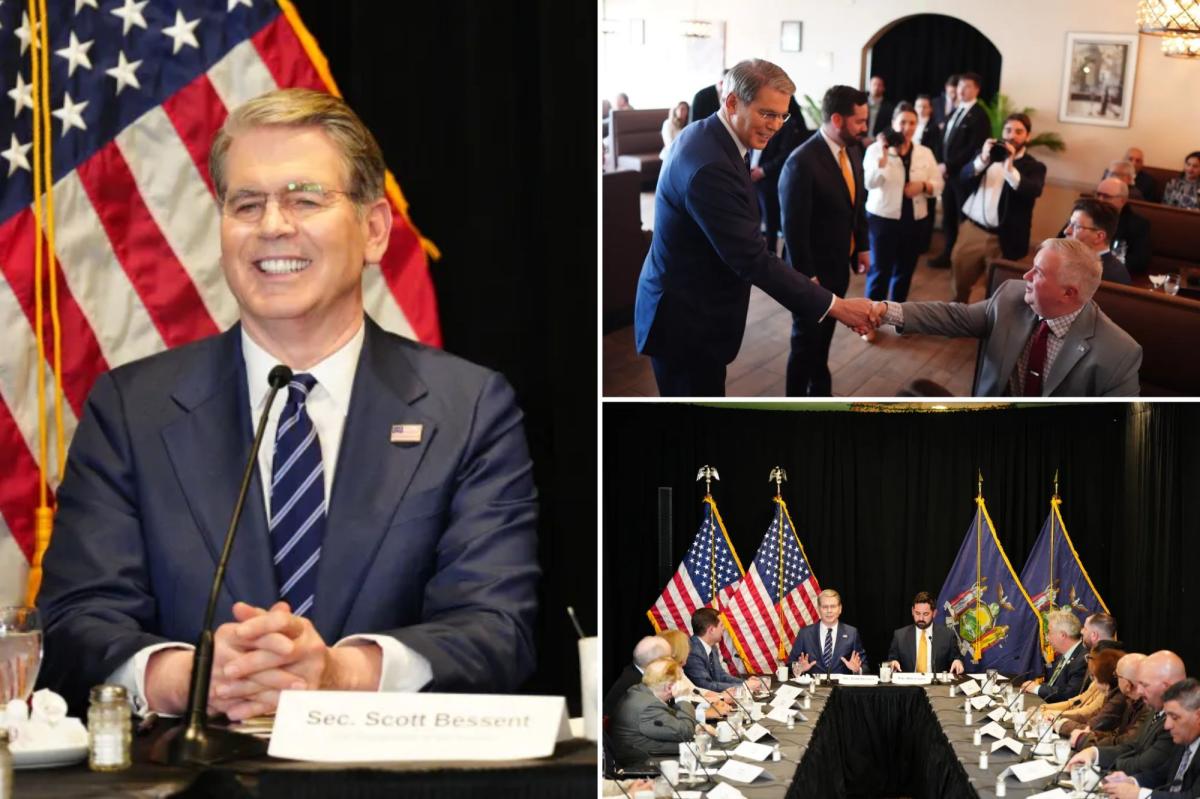
What happened
US Treasury Secretary Scott Bessent and US Trade Representative Jamieson Greer met Chinese Vice Premier He Lifeng at JPMorgan Chase's Manhattan headquarters on Sunday, September 20, for a day-long ministerial session, first reported by Reuters. China's chief trade negotiator Li Chenggang was also present.
The session came four days before President Trump hosts President Xi Jinping at the White House beginning September 24 — which would be Xi's first White House visit in 11 years.
Three agenda items were confirmed going in: the status of the trade truce reached at the Busan summit on October 30, 2025, which suspended heightened reciprocal tariffs and China's rare-earth export controls for one year and expires on November 10, 2026; China's delivery — described by the US side as underdelivery — on rare-earth export commitments; and bilateral guardrails around artificial intelligence.
The AI proposal
The most concrete new element to emerge was on AI. Bessent told reporters after the talks that the two sides discussed setting up a formal US-China AI dialogue, with a particular emphasis on national security: a notification mechanism under which the two countries could alert each other to AI-related incidents rising to the national-security level, covering shared goals and shared threats.
"We think that, just like with any cross-border activity, that moving from opaque to more transparency between the number one and the number two AI powers in the world is very important," Bessent said. He said the talks had been formalized as "the USA-China AI dialogues," with a follow-up session planned in China in two months. He also said Washington was open to discussing both open-weight and closed-weight AI models — a notable framing, given that Chinese open-weight models have grown popular with American companies as cheaper alternatives to closed systems from Anthropic, OpenAI and others, and have even been used on a US government website despite FBI accusations against one model's developer, Alibaba, of misappropriating Anthropic technology.
The Chinese response to the AI proposal was guarded. State news agency Xinhua confirmed that He and Bessent met for economic and trade consultations and characterized the exchanges as "frank, in-depth and constructive" on key economic and trade issues, including implementation of agreements from earlier rounds — but offered little detail on the AI notification mechanism itself. He and Li left the JPMorgan building without speaking to media.
Greer added two clarifying points: US export controls on sophisticated AI chips and semiconductor manufacturing equipment were not on the agenda for the AI mechanism talks — the hardest-edged American leverage stays off this particular table — and Sunday's discussions were meant to prepare the groundwork for a "successful summit" between Trump and Xi on Thursday and Friday in Washington.
How we got here
The Busan framework of October 2025 was itself a truce, not a settlement: a one-year suspension of escalatory tariffs and export controls that gave both sides breathing room without resolving the structural issues — industrial overcapacity, technology controls, market access, investment screening — that have defined the relationship for a decade. Earlier in 2026, the two countries established standing forums including a Board of Trade and a Board of Investment, designed to create structured channels for managing disagreements before they spiral.
On AI specifically, Trump and Xi first discussed potential consultations on AI development during a May meeting in Beijing, but that forum was never formalized — making Sunday's session the first real attempt to give the idea institutional shape.
Rare earths are the oldest card in this deck. China dominates the global supply of rare-earth elements critical to technology manufacturing, and has used export controls as leverage before. The Busan truce suspended those controls; the American complaint now is that Beijing's implementation has fallen short of its commitments. With the truce expiring in less than two months, the minerals question is inseparable from the tariff question: each side's leverage is the other's vulnerability.
Why this matters
The November 10 deadline is the forcing function for everything else. If no extension or replacement is in place by that date, the suspended tariffs snap back and the framework collapses — returning both economies to the escalatory dynamic of 2025. That gives the September 24 summit the character of a last clear chance: not to resolve the structural rivalry, which no single meeting can do, but to agree on the terms under which the rivalry stays managed for another stretch.
The AI dialogue matters for a different reason. The United States and China are the two centers of advanced AI development, pursuing different regulatory philosophies and competing for high-end computing hardware. An incident-notification mechanism — even a thin one — would be the first bilateral crisis-communications tool purpose-built for AI, analogous in spirit to the Cold War hotlines built for nuclear risk. Its significance lies less in what it would immediately accomplish than in the recognition it embodies: that AI systems are now strategic assets whose failures could be mistaken for attacks.
For markets, the weekend's choreography was reassuring but not decisive. A "very successful" ministerial, in Bessent's description, plus a confirmed leaders' summit, suggests both sides prefer extension to rupture.
What each side wants
Washington's wish list is relatively legible: verifiable Chinese delivery on rare-earth exports, so American supply chains stop living shipment-to-shipment; a truce extension that preserves tariff leverage without triggering the economic damage of snapback; and an AI transparency framework that gives the US visibility into Chinese capabilities and incident response. What Washington is not offering, per Greer, is relief on semiconductor export controls — the technology-containment pillar stays intact.
Beijing's objectives are the mirror image: an extension of tariff relief without new conditions, a path toward easing the technology restrictions it views as containment by another name, and recognition — through the summit pageantry itself — of its status as a coequal power.
What the numbers tell us
Fifty-one days: the interval between the September 20 ministerial and the November 10 truce expiry. That is the actual negotiating window, and it explains the urgency around a summit that might otherwise look ceremonial. Eleven years: the gap since Xi's last White House visit, a measure of how far the relationship has traveled from engagement to managed rivalry. Two months: the interval Bessent named for the follow-up AI dialogue in China — a concrete deliverable, modest but real.
One figure deserves skepticism rather than acceptance: the characterization of the talks as "very successful." Ministerials before summits are almost always described this way by their hosts; the description predicts nothing about the summit's outcome.
What happens next
The base case is a summit that produces a truce extension with cosmetic wins on rare earths and the formal launch of the AI dialogue — enough to keep the framework alive past November 10 without resolving its structural tensions. This is the outcome both bureaucracies appear to be engineering toward, and it would be received by markets as the absence of bad news.
The downside case is a summit that fails to agree on extension terms, sending both sides into a seven-week scramble before the snapback deadline — a period in which each would have incentives to escalate preemptively to improve its bargaining position. The upside case, a genuine structural agreement on trade and technology, is considered unlikely by most observers precisely because the issues that divide the two countries are the ones Greer kept off Sunday's agenda.
Beyond November, the structural reality reasserts itself whatever the summit produces: two economies deeply intertwined and increasingly securitized, managed through a patchwork of truces, dialogues and deadlines. Sunday's meeting did not change that reality. It did, however, keep the machinery of management running — and in the US-China relationship, the machinery working is itself a kind of news.
Sources
CNN, "Bessent proposes AI safety notifications in talks with China ahead of Xi-Trump meeting," September 20, 2026: Read the report
Reuters, "US Treasury's Bessent plans to discuss AI and rare earths with China's He, source says," September 18, 2026: Read the report
Trevora News, "U.S.-China AI Safety Dialogue Opens Before Trump-Xi Summit," September 20, 2026: Read the report
TFTC, "Bessent He Lifeng Trade Talks Before Trump-Xi Summit," September 2026: Read the report
CoinDesk, "Scott Bessent calls China talks on AI, trade very successful ahead of Trump-Xi summit," September 2026: Read the report