AUTOMATIC ENROLLMENT COMPLETE
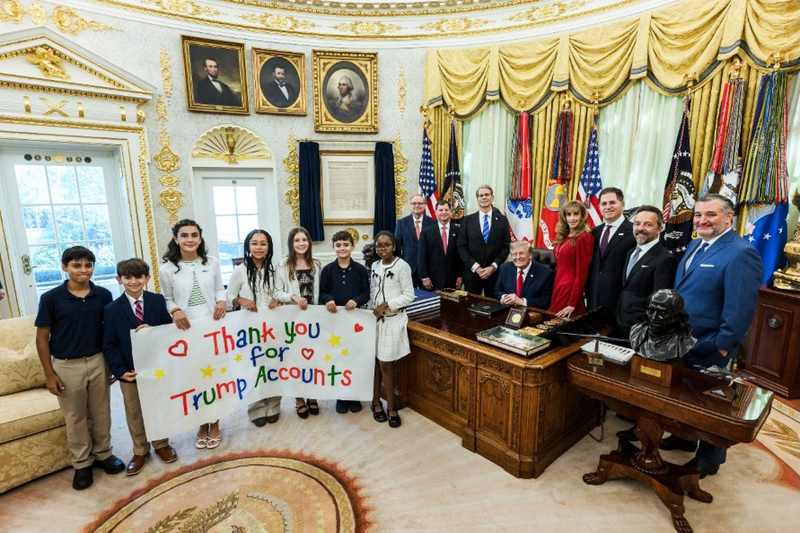
WASHINGTON — President Donald Trump announced Wednesday that automatic enrollment in Trump Accounts is complete, with nearly 70 million American children now holding a tax-advantaged investment account in their name — more than 60 million of them created automatically by the Treasury Department.
Trump made the announcement in the Oval Office alongside philanthropists Michael and Susan Dell, Treasury Secretary Scott Bessent, IRS chief executive Frank Bisignano, investor Brad Gerstner and Sen. Ted Cruz, as children held a banner reading “Thank You for Trump Accounts.” Trump said “every single eligible minor child in America has now been automatically enrolled.”
Why it matters: the end of the paperwork gap
By enrollment, Trump Accounts are now the largest child-savings program in U.S. history. Before automatic enrollment, parents had voluntarily created about 8 million accounts since the July 4 launch. Treasury estimated an opt-in process would reach only about half of eligible children, leaving millions outside the system because an adult had not found, understood or completed the paperwork.
Creating the account first reverses that default. The government establishes the account in the child's name; the parent decides whether to claim and actively manage it. That distinction matters most for households with less time, financial experience or access to administrative help. Officials said 80% of the accounts are linked to families earning under $200,000 a year.
Background: what a Trump Account actually is
Congress created Trump Accounts under the tax-and-spending law Republicans passed in 2025. The program launched July 4, 2026, when Trump rang the opening bell from the Oval Office. The accounts are tax-advantaged investment vehicles for children under 18 who have a valid Social Security number. Bisignano described the structure as “an IRA for children,” with money invested in the S&P 500.
Children born from 2025 through 2028 qualify for a one-time $1,000 federal deposit after a parent claims the account. Family and friends can contribute up to $5,000 a year, while employers may contribute up to $2,500 within that same $5,000 annual limit. The money is generally locked until the child turns 18.
Treasury's automatic-enrollment decision solved one access problem, but it did not eliminate the need for parents to verify an account and activate all of its benefits.
The numbers, decoded
Officials said more than $4.5 billion has been deposited since July 4: $1.3 billion in $1,000 federal seed contributions, more than $600 million from family and friends, and $2.6 billion in philanthropic gifts. About 10 million of the nearly 70 million accounts currently hold money. Bisignano said he expected that number to reach 25 million by the end of this week.
The largest single gift is the $6.25 billion commitment Michael and Susan Dell announced last December. It provides $250 each for 25 million children. Michael Dell said those deposits would be completed by the end of this week, accounting for the projected jump from roughly 10 million funded accounts to 25 million.
Corporate participation is another part of the funding pipeline. About 70 large companies have committed to matching contributions, including IBM, American Airlines and Broadcom. Trump also named Uber, Intel, Nvidia and Steak n' Shake, while Bisignano predicted the number of participating companies would eventually reach into the hundreds. Officials said about 13 additional philanthropists were preparing gifts, and Gerstner described a commitment aimed at young people in Indiana.
Bisignano encouraged relatives to make account contributions in place of gift cards. The White House also offered an illustration in which a couple thousand dollars invested in kindergarten could grow to an estimated half a million dollars by retirement through compounding. That is an illustrative calculation, not a guaranteed return; markets fluctuate, fees and taxes matter, and actual results will vary.
Who wins — and where the questions are
The most direct winners are children in working families who receive decades of potential compounding without paying an enrollment fee. Employers gain another benefit they can offer workers, and philanthropists gain a direct channel to a broad population rather than only to households that signed up first.
The central caveat is that enrollment is not activation. An unclaimed account sits in a group trust and can receive only broad philanthropic donations. A parent must claim it through the Trump Accounts app or IRS Form 4547 before the family can manage the account, add personal contributions, receive employer matches or obtain the $1,000 federal seed for an eligible child born from 2025 through 2028.
Economists have also questioned the headline projections attached to the program, particularly illustrations that assume steady long-term market returns. The program was created by Republican legislation that the White House notes every Democrat voted against. Trump said, however, that he had heard Democratic senators speak positively about the accounts. Those positions can coexist: lawmakers can oppose the broader tax law while supporting or accepting a child-savings mechanism inside it.
Bessent called the program the “beginning of the ownership society” and a real-time financial-literacy project. Cruz framed it as a way to give a generation an early stake in the stock market. Whether those goals are met will depend less on the number of records created than on how many families complete the claim process and keep the accounts funded.
What happens next
Dell-funded deposits are expected to land by the end of the week, moving the funded-account count from about 10 million to 25 million. The administration expects commitments from about 13 more philanthropists, while companies continue building contribution and matching programs.
The claiming wave is the real test. Nearly 70 million accounts now exist, but each must be tied to a verified parent or guardian before it becomes a managed family account. A large gap between enrollment and claims would leave the program broad on paper but thin in active participation.
How to claim your child's account
Parents can use the Trump Accounts app at trumpaccounts.gov to verify their identity and relationship to the child, or they can file IRS Form 4547. Claiming unlocks account management, family contributions, employer matches and — for eligible children born from 2025 through 2028 — the one-time $1,000 federal deposit.
Families should distinguish the steps clearly: Treasury's automatic enrollment creates the account, but a parent or guardian still has to claim it. That final verification determines whether the account becomes a practical savings tool rather than an unclaimed entry in the group trust.
Sources and reporting notes
- The White House: “Trump Accounts Put 70 Million Kids on the Path to Financial Freedom”
- Newsmax: “Bisignano to Newsmax: 25 Million Trump Accounts to Be Funded by Week's End”
- Detroit Free Press / USA Today: “President says 70M 'Trump accounts' have been created. What are they?”
Reporting note: Enrollment figures, attributed quotations and program rules are drawn from the cited reporting and White House/Treasury material. Compound-growth examples are illustrative calculations using a constant hypothetical return; they are not investment projections. Policy and political interpretation is Signal Post News analysis.
Signal Post News will update this report as Treasury publishes claim totals and additional funding commitments.
Back to all stories