Sochi tanker fire
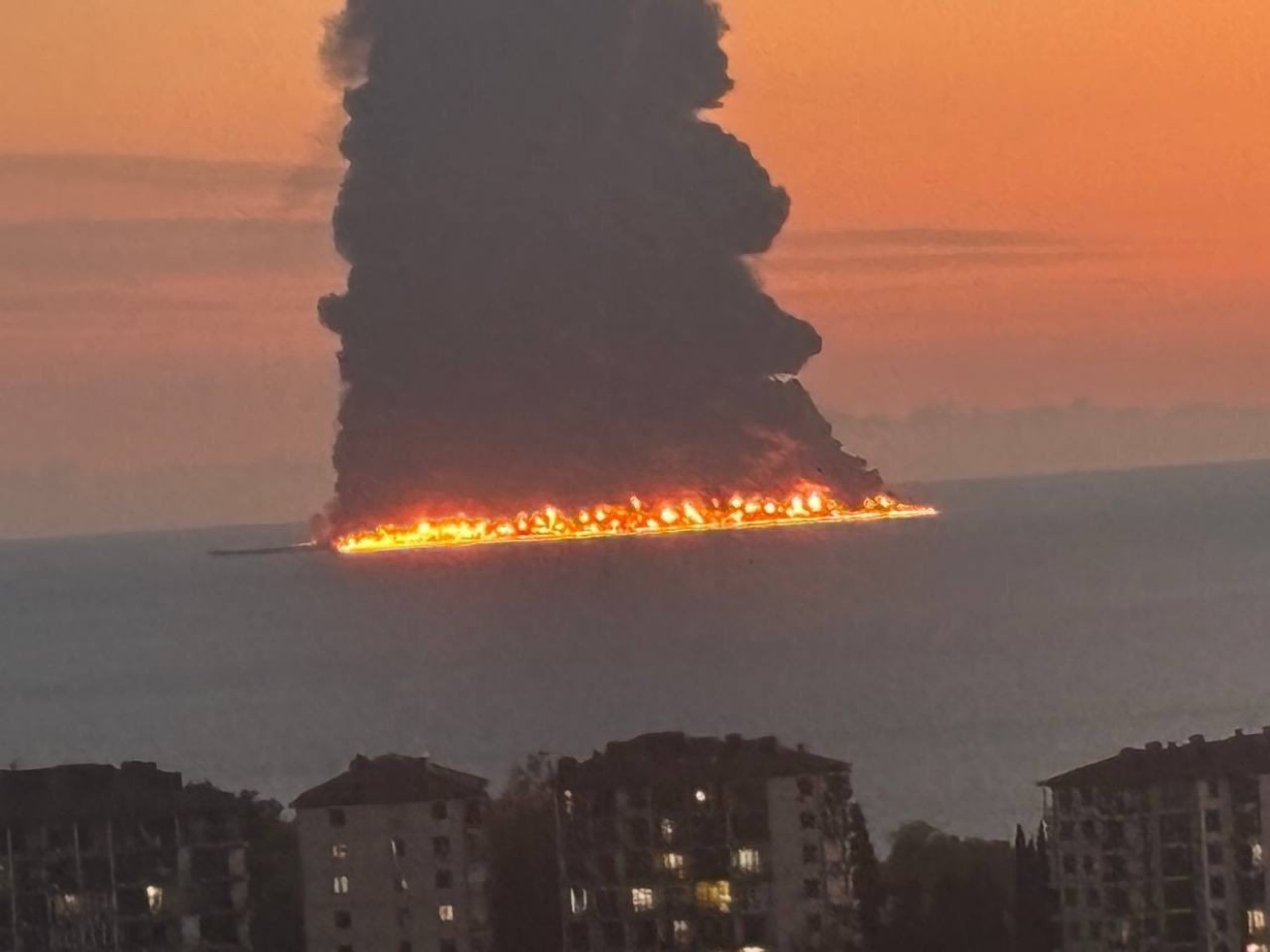
Images of a ship burning at sea are powerful because they appear to settle the story at a glance. This one does not. A bright orange fire runs across part of the vessel while smoke spreads into the evening sky, visible from the Russian resort city's shoreline. That is the firm visual record. The next questions — what ship, carrying what, with whom aboard, struck by what or failing where — require evidence that the pictures cannot supply.
That evidentiary gap matters more in the Black Sea than it would on an ordinary commercial route. The sea is both a working corridor for oil, grain and manufactured goods and a theater of war in which merchant hulls, naval forces, drones, mines and port infrastructure can occupy the same narrow geography. In that environment, a dramatic image can become an accusation before rescue services have accounted for the crew or investigators have reached the ship.
What the eyewitness evidence shows
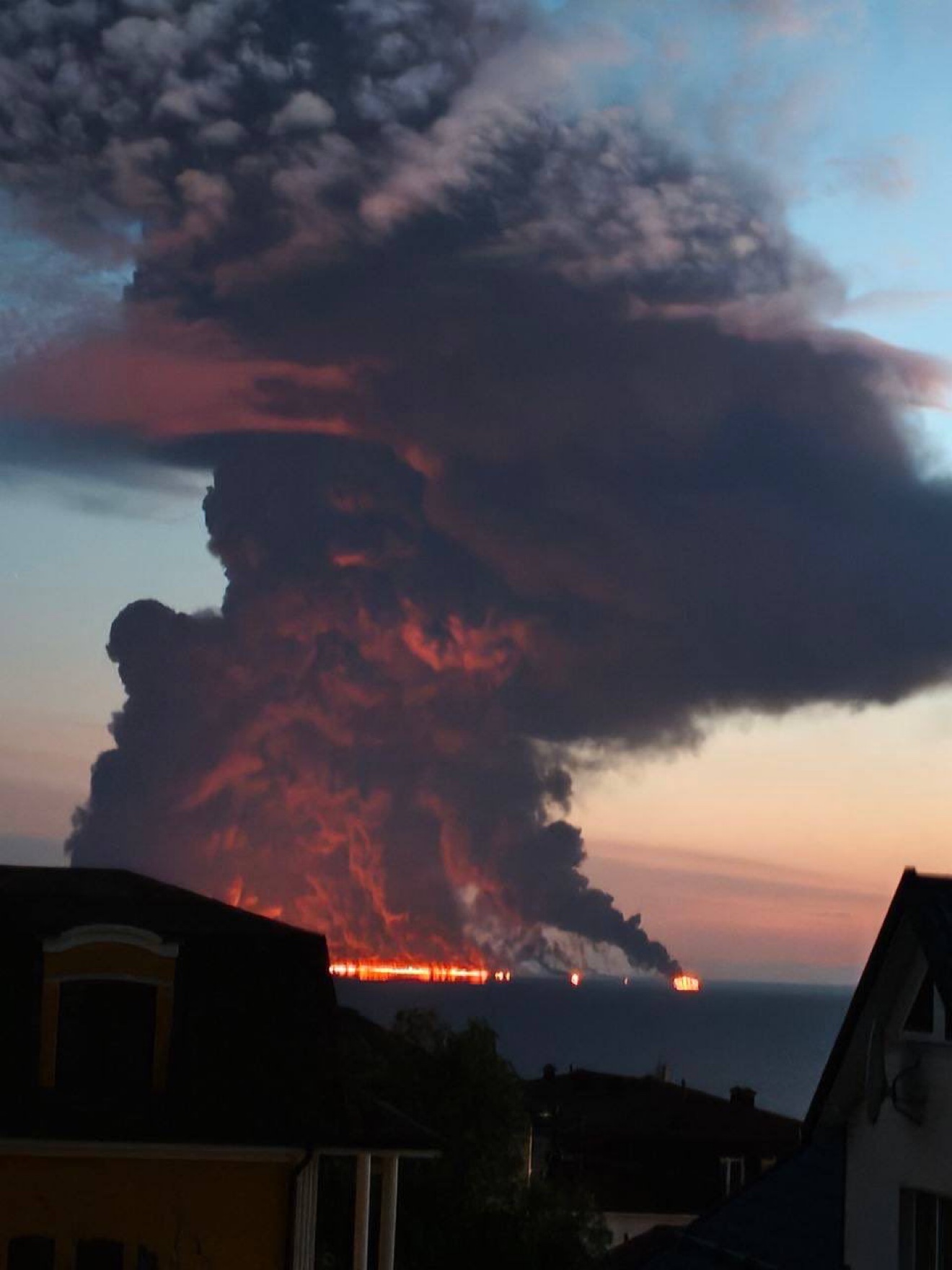
The two photographs available to Signal Post News show the same central fact from different perspectives: a vessel offshore, visibly engulfed in flames, with a dense black smoke column large enough to be seen from land. The first view, taken near sunset, gives a clearer sense of the fire itself. The second shows the plume rising above the horizon and widening as it moves away from the vessel.
Neither frame offers a readable ship name, flag or registration number. The distance and smoke also prevent a reliable assessment of hull damage, cargo-tank involvement or whether emergency vessels were alongside. There is no visible evidence in the images that can distinguish an onboard mechanical failure from an external strike. A photograph can confirm an event without explaining it; that is the limit of this record.
What remains unconfirmed
The unknowns are not peripheral. No independently verified identification of the vessel was available at publication. Its flag, owner and operator were unconfirmed. So were its port of origin, destination and cargo. It may be described as a tanker on the basis of its apparent profile and reports circulating with the images, but the exact type of tanker and whether it was carrying oil, petroleum products or another liquid cargo had not been established.
The human accounting is equally incomplete. There was no confirmed crew manifest, rescue total, casualty figure or official statement establishing whether everyone aboard had been reached. In a maritime emergency, those numbers often change as coastal authorities, owners and rescue coordinators reconcile separate reports. Until that process produces an official record, claims of deaths, injuries or a complete rescue should be treated as claims rather than facts.
Most importantly, the cause is unknown. Nothing available establishes that Russia, Ukraine or any other actor started the fire. No verified debris, radar track, distress transmission, blast analysis or government finding had been made public. Terms such as “drone strike,” “missile attack,” “sabotage,” “engine-room fire” and “cargo explosion” describe possible explanations, not conclusions.
The tanker war around the Black Sea
The caution is necessary because this autumn has produced a crowded and contested maritime record. Names including MoLoChKa, Armada Leader, Kairos, Virat and Skiros have appeared in reports about tanker incidents, alleged attacks or vessels linked in public discussion to Russian energy trade and the so-called shadow fleet. Each case has its own facts and disputes. Their accumulation has nevertheless changed how governments, owners and insurers read any new fire at sea.
The risk is no longer confined to the approaches to Ukrainian ports. On October 5, the Turkish-owned Royad Mammadov caught fire and sank off Romania, with Romanian authorities confirming deaths and rescues while the cause remained under investigation. President Volodymyr Zelenskyy attributed that incident to Russian drones; Moscow had not commented on that specific allegation at the time of the report.
A day later, reports of attacks on ships in Bulgaria's exclusive economic zone brought the danger closer to another NATO member's maritime space. Those incidents have been described by officials and reporting as drone attacks, but they do not prove what happened off Sochi. Context can sharpen the questions; it cannot substitute for attribution.
Why this fire matters
Commercial shipping depends on predictability. Owners need to know whether a route is navigable, crews need confidence that rescue and communications will work, and insurers need a risk they can price. An unidentified burning tanker does the opposite: it widens the range of worst-case assumptions while offering little hard information with which to narrow them.
If the ship was carrying fuel, authorities will also need to establish whether there is a spill, whether the fire reached cargo tanks and whether coastal waters face a pollution threat. If it was empty or carrying a less hazardous product, the environmental consequences could be much smaller. Those distinctions cannot be read from the color of the smoke alone.
The energy impact is similarly conditional. A single vessel does not determine regional oil supply. Repeated losses, however, can push up war-risk premiums, reduce available tonnage and make shipowners reluctant to call at ports associated with elevated danger. The resulting costs move through freight rates and delivery schedules before they ever appear in retail fuel prices.
Escalation is the harder risk to price. A confirmed military attack near a major Russian city would invite a different response from Moscow than an accidental engine-room fire. An unproven allegation repeated as fact could itself harden positions, while a delayed official account can create space for competing narratives. That is why the sequence matters: rescue first, identification second, forensic evidence third, political judgment after that.
Accident or attack: what each hypothesis would mean
An accident remains a plausible hypothesis because serious shipboard fires occur without hostile action. Fuel leaks, electrical faults, machinery failures, hot-work accidents and cargo-handling problems can all produce rapid fires and heavy smoke. If investigators find the origin inside an engine room or cargo system, the central questions will turn to maintenance, operating procedures, firefighting readiness and whether the vessel met applicable safety standards.
An attack is also a hypothesis that investigators must examine because of the wider war and recent incidents at sea. Evidence for that explanation would require more than chronology or proximity: fragments, impact damage, radar or electronic records, verified video of an incoming weapon, or an official finding grounded in such material. If a deliberate strike were confirmed, the next questions would be who launched it, whether the vessel was the intended target and what military or economic rationale was claimed.
Both hypotheses carry consequences, but neither should be promoted merely because it fits an audience's prior view of the war. An accident could expose weaknesses in an aging or lightly regulated shipping network, including vessels associated in public debate with sanctions evasion. An attack could signal that the maritime campaign is expanding toward routes and anchorages near Russia's own coast. The evidence must decide between them.
The data: confirmed versus claimed
Confirmed by the available visual record: a large vessel burned offshore from Sochi on October 6; flames were visible on the ship; and a substantial black smoke column could be seen from shore.
Not confirmed at publication: the ship's name, registration, flag, owner, operator, exact type, cargo, route, crew number, rescue status, injuries, deaths, pollution impact and cause. Also unconfirmed were claims connecting the vessel to Russia's shadow fleet or describing the fire as a drone strike or explosion caused by a particular actor.
That division is the most useful data point available. It keeps a genuine emergency in view without giving rumor the same weight as evidence. It also provides a checklist against which official statements can later be measured.
Who benefits, who loses
Until attribution is established, claims about strategic beneficiaries are necessarily conditional. If an attack removed a vessel serving Russian energy trade, Ukraine could gain economic pressure and symbolic reach, while accepting the risk of retaliation and concern among neutral shipowners. If the fire was accidental, actors seeking to portray Black Sea commerce as unsafe may still exploit the images, but that political use would not make them responsible for the event.
The immediate losers are less abstract: the people aboard, their families waiting for an accounting, the owner and charterer, rescue personnel entering a dangerous scene, and any coastal communities exposed to smoke or pollution. Beyond them sit the insurers, crews and traders who must make decisions before investigators finish. Uncertainty itself becomes a cost.
Russia could use an accidental-fire finding to argue that early attack claims were reckless. Ukraine could point to a confirmed strike, if evidence ultimately supports one, as part of the broader contest over maritime logistics. Neither outcome is established now. The responsible position is to leave the answer open while preserving the evidence that can close it.
What happens next
The first signal will be Moscow's official response: whether Russian maritime, emergency or defense authorities identify the vessel, report a rescue operation or describe a cause. A ship name should unlock registration records, ownership, flag and recent port calls. Crew accounting will determine the human scale of the incident and whether search-and-rescue operations are continuing.
The second signal will be the official record. Distress calls, automatic identification data, port logs, satellite imagery and statements from the operator can establish where the vessel was and what it was doing. Fire investigators can identify an origin point; divers or salvors may recover physical evidence if conditions permit. Environmental monitoring can show whether oil or another pollutant entered the sea.
The third will be whether governments make claims before releasing evidence. A prompt attribution may be accurate, but speed is not proof. Conversely, silence does not prove concealment; maritime emergencies often produce fragmented information before agencies agree on a public account. The standard should remain consistent for every side.
For now, the Sochi tanker fire is an arresting image attached to an incomplete record. The vessel burned. The smoke rose high enough to be seen from shore. Everything that turns those facts into a story about a particular ship, cargo, crew or attacker still has to be demonstrated.
Reporting basis
This is a fixed October 6, 2026 report based on two eyewitness photographs relayed by @TheInsiderPaper on X and the verified contextual record in Signal Post News's linked Black Sea coverage. The images confirm the offshore fire and smoke column. At publication, no independently verified official record established the vessel's identity, flag, cargo, crew status, casualty count or cause.