Kashagan $5 billion fine
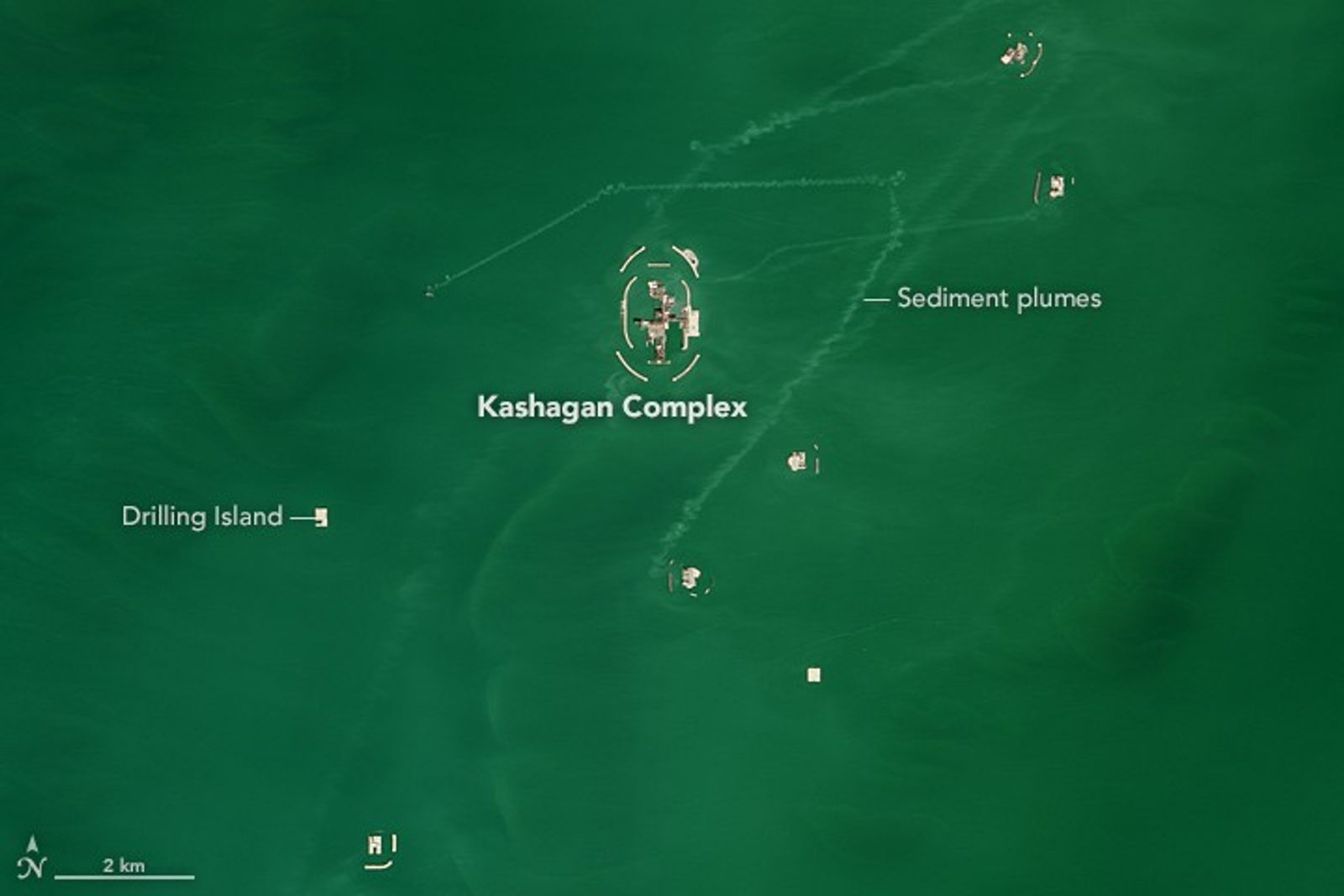
ASTANA, Kazakhstan — Kashagan $5 billion fine: A Kazakh court has dismissed a lawsuit by the North Caspian Operating Company (NCOC) that sought to overturn the start of enforcement proceedings to collect an environmental fine of about $5 billion against the operator of the Kashagan oilfield, Russia's Interfax news agency reported on Monday. The ruling removes the last domestic legal barrier to collecting one of the largest environmental penalties ever levied against an international oil consortium — and sharpens a years-long standoff between Astana and the Western oil majors that built one of the world's most difficult megaprojects.
At issue is 2.3 trillion tenge ($5.06 billion) that Kazakh environmental regulators say NCOC owes for storing sulphur — a toxic byproduct of processing Kashagan's hydrogen-sulphide-rich oil and gas — in volumes exceeding its environmental permit. NCOC, whose partners include Shell, Eni, TotalEnergies and Exxon Mobil alongside state-owned KazMunayGas, China's CNPC and Japan's Inpex, rejects both the allegations and the fine, and the underlying dispute is also before international arbitration.
Why this matters
Five billion dollars is not a routine environmental penalty; it is one of the largest corporate fines of its kind anywhere. The figure is nearly a tenth of the roughly $55 billion the consortium has poured into Kashagan since discovery in 2000, and it lands at a moment when oil markets are already on edge: Brent crude climbed toward $106 a barrel on Monday as a stalemate in U.S.–Iran talks compounded supply anxiety. The deeper significance is institutional. Astana has spent years tightening its grip on the terms of its oil deals — local-content rules, renegotiated production-sharing terms, larger state stakes — and critics among the majors call it resource nationalism. Kazakhstan rejects the label, but the fine's scale, its enforcement machinery (asset freezes, criminal-liability warnings against executives), and the parallel arbitration track make this the clearest test yet of whether environmental regulation is the instrument or merely the idiom of that campaign. For every international oil company operating in a resource-rich state, the outcome sets a precedent on how far a host government can go in using domestic courts to rewrite the economics of a signed deal.
How we got here
The enforcement timeline has been a legal seesaw. In July, Kazakhstan's Justice Ministry gave NCOC until July 20 to pay voluntarily; when the deadline lapsed, enforcement began, NCOC property and vehicles were frozen on July 21, and managing director Giancarlo Ruiu was warned he faced administrative and even criminal liability for non-compliance. The original penalty order had earlier been overturned over procedural violations — only for regulators to reissue it; the reissued fine was upheld by the Atyrau Regional Court in June 2026. In early September the ministry suspended enforcement while a court reviewed NCOC's appeal, but insisted it still intended to collect. Monday's dismissal of the company's lawsuit ends that pause and lets the bailiffs move again.
The field behind the fight
Kashagan is worth understanding because its history explains why $5 billion feels both shocking and, to Astana, almost routine. Discovered in 2000 about 80 kilometres off Atyrau in the shallow, ice-prone north Caspian, the field holds an estimated 13 billion recoverable barrels. It defeated engineers for over a decade: conventional rigs cannot work in water just a few metres deep that freezes for five months a year, so the consortium built five artificial islands from rock and concrete, laid undersea pipelines, and deployed icebreaking ships. Production began in September 2013 — and stopped a month later when gas plumes revealed cracked pipes corroded by Kashagan's 17-percent hydrogen-sulphide gas, a concentration at which a few breaths can kill. The pipes were replaced and output restarted in October 2016, reaching roughly 380,000 barrels a day by 2019. The sulphur at the heart of the fine is the physical residue of taming that poisonous reservoir: mountains of yellow byproduct that regulators say were stockpiled beyond permitted limits.
Who wins, who loses
For Astana, the win is leverage — a fine this large, even if never collected in full, is a bargaining chip over production-sharing terms, local hiring, and the next phase of Kashagan expansion. The treasury of a country that produces roughly 2 percent of the world's daily oil could plainly use the money. For the consortium, the immediate loss is financial exposure with an awkward split: Exxon's 16.81 percent stake implies about $851 million of theoretical exposure, though legal liability may be divided differently and the sum is a fraction of a quarter's free cash flow. The strategic loss is bigger: the episode will be priced into every future investment decision in Kazakhstan, and into boardroom risk models from Baku to Lagos. The losers could also include the arbitration system itself — if domestic enforcement races ahead of the international tribunal, the credibility of the treaties that are supposed to protect investors erodes. And markets lose a measure of calm: Kashagan is still producing, so there is no physical supply shock today, but a dispute that escalates toward asset seizure is exactly the kind of tail risk that keeps Brent above $100.
What happens next
Three tracks now run in parallel. First, enforcement: with the lawsuit dismissed, Kazakh bailiffs can resume seizing or freezing NCOC assets to satisfy the 2.3 trillion tenge, and executives face renewed warnings of criminal liability. Second, arbitration: NCOC's case before an international tribunal continues, and a ruling there could in theory unwind the fine — but enforcement in the meantime is the point of pressure. Third, negotiation: fines of this magnitude in Kazakhstan's oil history have often ended in settlements — revised fiscal terms, larger state stakes, or development commitments dressed up as compromise. Watch the Justice Ministry's next filing and any quiet boardroom signals from Shell, TotalEnergies, Eni and ExxonMobil. The most likely endgame is not a $5 billion wire transfer but a deal neither side can yet admit to wanting.
The sulphur piles at Kashagan are a monument to what it costs to make an impossible field work. The $5 billion fine is Astana's answer to a different question — who the field ultimately works for. Courts, bailiffs and arbitrators will decide the money. The precedent is already decided: the era when a production-sharing agreement signed in the 1990s was the final word on a country's resources is over.
Sources
- Reuters — Kazakh court rejects Kashagan oil operator's bid to block enforcement of $5 bln fine
- Reuters — Kazakhstan says it intends to pursue case against Kashagan oil operator despite appeal
- Times of Central Asia — Kazakhstan Pauses Collection of $5 Billion Fine from Kashagan Operator
- NASA Earth Observatory — Kashagan Oil and Gas Field, Kazakhstan