The 55 freeway Santa Ana shutdown began with a call at about 2:54 p.m. on Monday, October 19, 2026: a woman in crisis was on the overhead sign structure above the Costa Mesa Freeway near 17th Street. It ended roughly two and a half hours later the way everyone underneath it had hoped — with Santa Ana police negotiators talking her into coming down, Orange County firefighters bringing her safely to the ground by ladder, and not one injury reported.
Negotiators talked for two and a half hours, firefighters raised a ladder, and one of Orange County's busiest freeways stood still — then she came down, and everyone went home safe
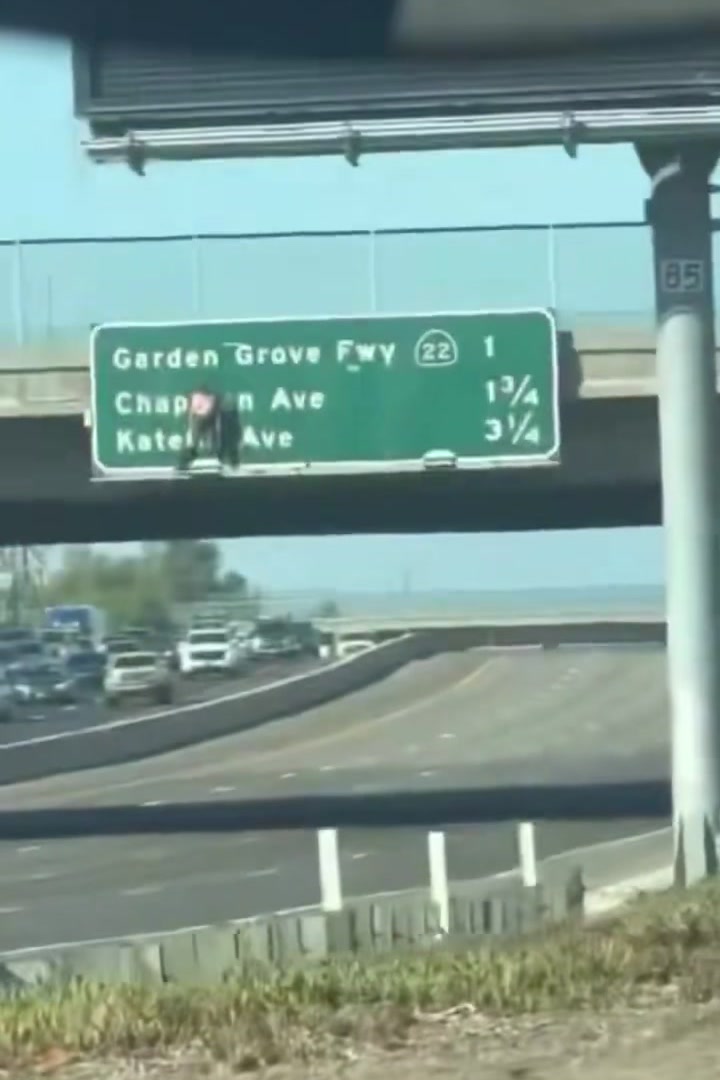
SANTA ANA — The first call came in at about 2:54 p.m., according to scene accounts posted by local witnesses: a woman was on the sign structure above the 55 Freeway near 17th Street, on the Santa Ana side of the Tustin line, in visible crisis above the lanes. Santa Ana police said their patrol officers responded at approximately 3 p.m. to a report of a woman standing on the 55 Freeway overpass near 17th Street. The structure she was on — clearly visible in video filmed from the freeway below — is the overhead sign gantry whose green panel points drivers toward the Garden Grove Freeway (Route 22), Chapman Avenue and Katella Avenue. It is not a place anyone can reach accidentally, and it is not a place anyone can be brought down from quickly.
So the freeway stopped. The California Highway Patrol shut the 55 down around the scene — scene reporting through the afternoon described the freeway as shut down at 17th Street, with traffic in both directions halted at the height of the response — while Santa Ana police negotiators began the slow work of talking to her, and Orange County Fire Authority crews positioned the equipment that would eventually bring her down: an aerial ladder truck. By 4:13 p.m., more than an hour in, the scene was still active and she had not come down. Footage posted at 5:21 p.m. showed closures still in place and negotiators still working as the evening commute built around the closure.
Then, at about 5:30 p.m., it ended the way negotiators train for it to end. Santa Ana police said that after approximately two and a half hours of negotiations, members of the department's Crisis Negotiation Team convinced the woman to surrender, and she was safely brought down with assistance from the Orange County Fire Authority — down the ladder, in the care of firefighters, as the department's own photograph of the rescue shows. She was taken to a local hospital for a mental health evaluation. No injuries were reported — not to her, not to any responder, not to anyone in the thousands of cars that waited below. "Thank you to everyone for your patience as officers worked to bring this situation to a safe resolution," the department wrote in its update, posted at 6:05 p.m.
Two and a half hours above the lanes
The timeline matters because time was the strategy. From the first call at about 2:54 p.m. to the resolution shortly after 5:30 p.m., the incident consumed the heart of the afternoon — the hours when the 55, which carries more than 260,000 vehicles a day past this stretch by the Orange County Transportation Authority's count, begins its grind toward the evening peak. Drivers were diverted onto surface streets through Santa Ana and Tustin and onto the parallel corridors — the 5, the 22, the 57 — each of which absorbed spillover it had no spare capacity for. Anyone who drove central Orange County on Monday afternoon felt this incident, whether or not they ever saw the sign.
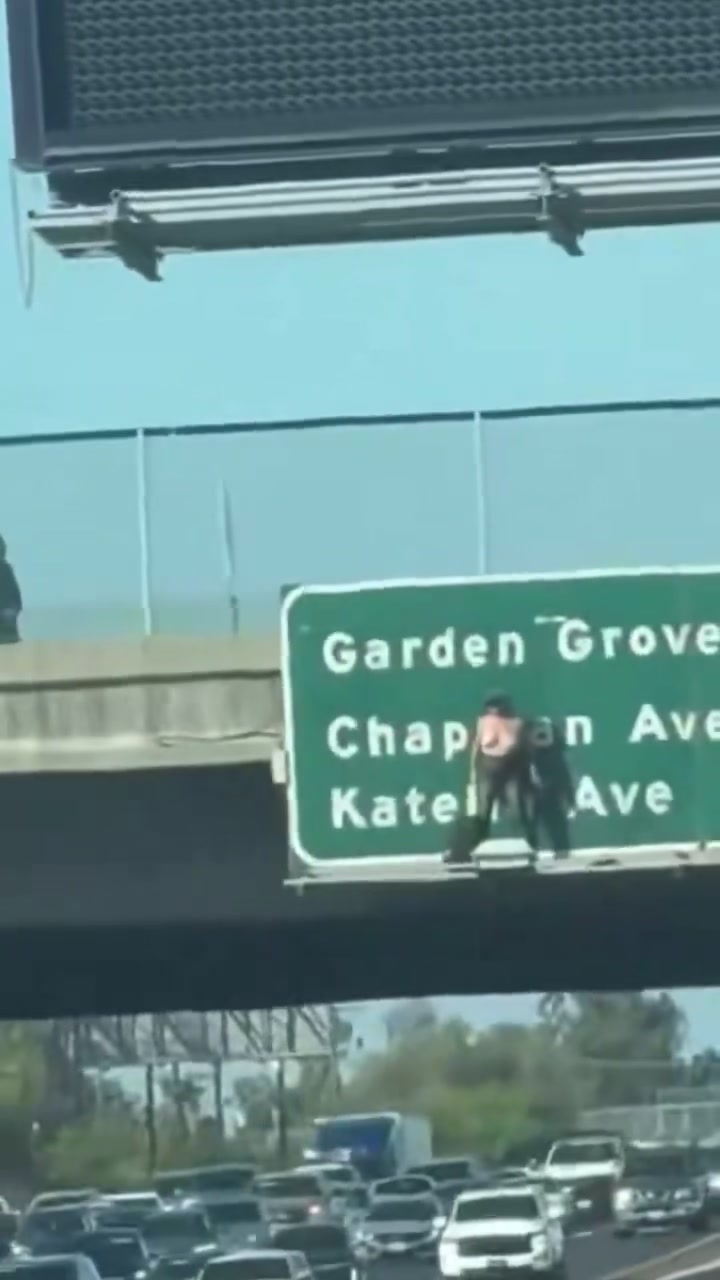
What the drivers below could not see was the shape of the response. The freeway closure was not an inconvenience layered on top of the rescue; it was part of the rescue. Closing the lanes removed the noise, the movement and the risk from beneath the structure, gave fire crews room to position the ladder truck, and gave negotiators the one resource that decides most of these incidents: unhurried time. Crisis negotiation doctrine, in Santa Ana as in most large departments, is built on the finding that people in acute crisis who are given time, a calm voice and a way to climb down — literally and figuratively — usually take it. Two and a half hours is a long time to hold a freeway. It is also, by the standards of these calls, a success story told at the speed it needed to be told.
Why this matters
It matters first because of how it ended, and how it could have. Freeway sign and overpass incidents are among the most dangerous calls in urban policing: the person is exposed, the margin for error is measured in feet, and everything about the setting — height, traffic, an audience of thousands filming from their cars — works against a calm outcome. Monday's call ended with a ladder, a hospital evaluation and an apology to commuters for the delay. That outcome was not luck. It was the product of a system that has been built, expensively and deliberately, over decades: dedicated negotiation teams, fire-service technical rescue, and a doctrine that treats the person in crisis as someone to be talked down and gotten help, not a problem to be cleared so traffic can move. The 55 Freeway was closed for hours because the priority order was life first, traffic second — and the public, judging by the responses under the police department's own post, largely understood that.
It matters, too, because of where it happened. The 55 is not a marginal road. The Costa Mesa Freeway runs about 18 miles from Newport Beach to the 91 in Anaheim, threads the 5 interchange in the Santa Ana–Tustin corridor where Monday's call came in, and is in the middle of a $475 million OCTA–Caltrans improvement project between the 405 and the 5 that is adding a general-purpose lane and a carpool lane in each direction precisely because the corridor is saturated. A corridor carrying a quarter-million vehicles a day has no slack: close it at 3 p.m. on a Monday and the shockwave reaches every parallel route in central Orange County within the hour. Monday's shutdown was a reminder, delivered in brake lights, of how much of the region's daily life runs on a handful of freeway miles — and how completely those miles can be stopped by a single person in crisis above them.
How a call like this is worked
For readers who watched the afternoon unfold in fragments — a closed freeway, a ladder truck, hours of waiting — the sequence on scene followed a well-worn pattern. Patrol officers arrive first and secure the area; the highway patrol takes the freeway itself, closing lanes and building the detour; the fire authority brings the technical rescue capability — in this case the aerial ladder that Santa Ana police credited with helping bring her down, and that the department's photograph shows extended over the roadway with firefighters assisting her in the basket. The specialized piece is the Crisis Negotiation Team: officers trained to establish contact, slow everything down, and keep talking. Their work product is not dramatic. It is a conversation, sustained for as long as it takes, aimed at a voluntary outcome. On Monday it took about two and a half hours, and it worked.
What happens after the ladder comes down is quieter but just as structured. Santa Ana police said the woman was taken to a local hospital for a mental health evaluation. Under California law, a person who, because of a mental health disorder, is assessed as a danger to themselves can be held for up to 72 hours for evaluation and treatment — the framework designed to turn a crisis call into the start of care rather than a booking. Police have not released her name, her age or any information about what led her to the sign on Monday, and there is no indication they will; that privacy is deliberate, and it is part of the point. She is a patient now, not a suspect, and the public record of this incident properly ends at the hospital door.
What we know — and what we don't
Known: the first call came in at about 2:54 p.m. Monday (scene accounts); Santa Ana patrol officers responded at approximately 3 p.m. to a woman on the 55 Freeway overpass near 17th Street (Santa Ana PD); the freeway was shut down around the scene through the afternoon (multiple scene accounts); after about two and a half hours of negotiation by the SAPD Crisis Negotiation Team, she agreed to come down and was brought down safely with Orange County Fire Authority assistance (Santa Ana PD); she was taken to a local hospital for a mental health evaluation (Santa Ana PD); no injuries were reported. Not known: her identity, age or condition, none of which has been released; how she reached the sign structure; and the precise minute every lane reopened — lanes began moving again after she was brought down and the department's 6:05 p.m. update showed traffic flowing beside the scene, but neither CHP nor Caltrans had published an exact all-lanes-reopened time as of Monday evening. Any account claiming a motive for her being up there is speculation; no official has offered one.
If you or someone you know is struggling, help is available right now: call or text 988 to reach the Suicide and Crisis Lifeline, free and confidential, 24 hours a day, anywhere in the United States. You do not have to be in crisis to call — and if Monday afternoon proved anything to the thousands of people who watched it unfold from their cars, it is that the people on the other end of calls like this one would always rather talk.
What happens next
For the freeway, very little: the 55 was back to being the 55 by Monday night, carrying the tail of the commute it had spent the afternoon refusing to carry. For the agencies, there will be the usual after-action accounting — closure timing, detour performance, the coordination between a city police department, the highway patrol and the county fire authority that Monday's response required and, by every account, got. For the woman at the center of it, what happens next is private and should stay that way: an evaluation, and whatever support follows from it. And for the rest of Orange County, the afternoon leaves behind a fact worth keeping from an incident that could so easily have left something worse: the system built for exactly this call — the negotiators, the ladder truck, the closed lanes, the patience — was used, in full, on an ordinary Monday, and it brought everybody home.
More coverage: Henderson Fire shuts I-5 through Camp Pendleton · Norte Fire damages six homes in San Juan Capistrano · Tropical Storm Rachel brings wind and rain to Orange County
Sources
Santa Ana Police Department, official Instagram update (@santaana_pd), October 19, 2026, 6:05 p.m. PT — officers responded at approximately 3 p.m. to a woman on the 55 Freeway overpass near 17th Street; approximately 2.5 hours of negotiations by the SAPD Crisis Negotiation Team; she was safely brought down with Orange County Fire Authority assistance and taken to a local hospital for a mental health evaluation; department photograph of the OCFA ladder-truck rescue. Eyewitness video and scene reporting via Instagram — @ocxhoods (first call reported 2:54 p.m.; scene active at 4:13 p.m.), @ocactive_ (incident logged about 2:53 p.m.), @dapastudios (closures and negotiators, 5:21 p.m.), and onlooker reports of the ladder descent at about 5:30 p.m. Corridor data: Orange County Transportation Authority / Caltrans SR-55 Improvement Project (I-405 to I-5; $475 million; corridor carries more than 260,000 vehicles per day). California Welfare and Institutions Code §5150 (72-hour evaluation hold) as general legal context. 988 Suicide and Crisis Lifeline (SAMHSA).