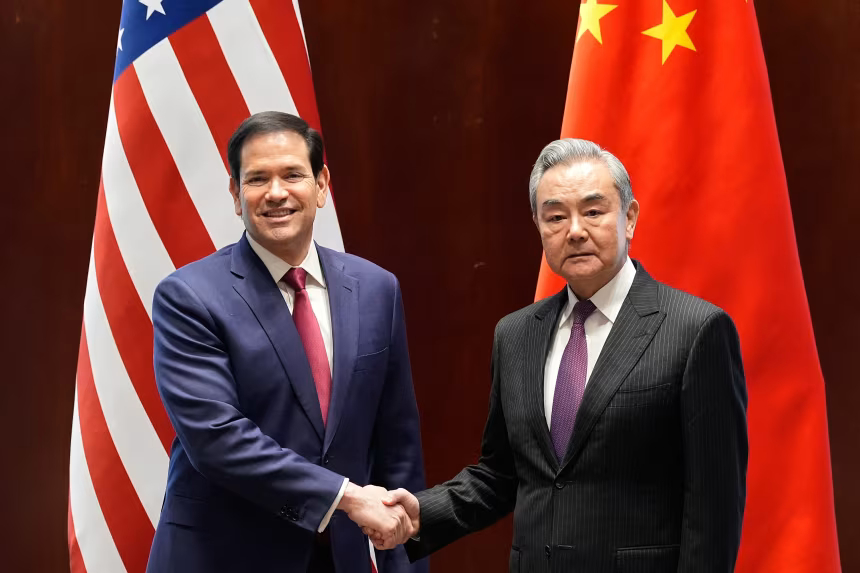
China’s foreign ministry said Wang urged the two countries to prepare for the next stage of high-level interactions “in the spirit of equality, respect and reciprocity.” The ministry said the officials discussed communication, cooperation and the management of differences.
The conversation came one week before an anticipated visit by Chinese President Xi Jinping to the United States. President Donald Trump had said a meeting was set for September 24, but Beijing’s official summary of the call did not explicitly confirm that meeting.
What remains unresolved
The careful wording leaves a distinction between preparations for high-level exchanges and formal confirmation of a leaders’ summit. The two governments continue to manage disputes that span trade, advanced technology, security and the Middle East.
China’s account also said Wang and Rubio discussed the Middle East. The call followed Wang’s meeting with Iranian Foreign Minister Abbas Araqchi, during which Beijing called for restraint and a return to talks between Iran and the United States.
Why the wording matters
Diplomatic readouts are negotiated in public even when the call itself is private. Each government chooses which subjects to emphasize, how to describe disagreement and whether to present a future meeting as confirmed. Phrases such as “prepare for the next stage” signal movement, but they stop short of announcing a date, location or agenda.
That is why the gap between President Trump’s public statement and Beijing’s written summary deserves attention. It may reflect nothing more than different announcement procedures. It could also mean that details remain unsettled. Until both governments provide matching confirmation, the most accurate description is that senior officials are preparing for further engagement.
A relationship managed issue by issue
Washington and Beijing are not negotiating a single dispute. Their relationship spans tariffs and market access, semiconductor controls, supply chains, military communication, Taiwan, regional security and cooperation on global crises. Progress in one area can occur while tensions rise in another.
That makes high-level communication useful even when it produces no dramatic agreement. A phone call can clarify what each side expects from a leaders’ meeting, identify issues that need staff-level work and reduce the risk that a public statement is misread as a policy change.
The call is evidence that channels remain open — not evidence that the hardest disputes have been resolved.
Trade and technology remain central
Economic friction is likely to shape any next round of talks. The two governments have competing views on export controls, industrial policy and what counts as fair access to each other’s markets. Technology restrictions are especially sensitive because they sit at the intersection of commercial competition and national security.
Any headline claiming a broad “reset” should therefore be tested against specifics. Did either side announce a change in tariffs? Was an export rule altered? Did companies receive new access? Without an attributable policy change, a constructive call is best read as preparation rather than settlement.
The Middle East enters the conversation
The discussion of the Middle East shows how bilateral diplomacy now overlaps with other security crises. China maintains relationships across the region and has urged restraint, while the United States remains directly involved in diplomacy and deterrence. The two powers may share an interest in preventing wider escalation even when they disagree over pressure, sanctions and the sequencing of negotiations.
That overlap can create narrow areas for coordination. It can also add leverage and complexity to the broader U.S.–China relationship, with regional issues becoming part of a larger conversation about strategic trust.
What to watch before a summit
- Matching confirmation: whether both governments name the same date and format for a leaders’ meeting.
- A defined agenda: whether trade, technology or security issues are identified for concrete decisions.
- Working-level preparation: whether officials announce follow-up talks before the leaders meet.
- Policy, not tone: whether any tariff, export-control or diplomatic measure actually changes.
The call matters because sustained communication can prevent miscalculation. But diplomacy should be measured by what follows: confirmed meetings, clear commitments and verifiable changes. For now, the strongest conclusion is modest — the two governments are talking, and both appear interested in keeping the next stage of engagement possible.
Why this matters
High-level contact reduces the chance that strategic competition becomes accidental crisis. A call does not resolve trade, security or technology disputes, but it creates channels for clarifying intent. In a relationship large enough to affect global growth and conflict risk, process is a substantive outcome even when no agreement is announced.
How we got here
U.S.–China relations have moved from engagement toward managed rivalry, with tariffs, export controls and regional security disputes hardening on both sides. Periods of dialogue repeatedly alternate with breakdown. The historical lesson is that summit diplomacy works best when working-level negotiations have already narrowed the choices; leader meetings rarely substitute for preparation.
Who benefits, who loses and what critics say
Businesses, allies and markets benefit from predictability. Political hardliners may lose leverage when compromise becomes possible, while smaller countries can lose autonomy if great powers treat them as bargaining space. Critics call talks performative; that is fair when communiqués outrun implementation, but refusing contact makes miscalculation more likely.
What the evidence actually says
The available account confirms discussion of future exchanges but does not confirm a leaders’ meeting. That gap is important. Diplomatic language often preserves flexibility, so the absence of a date may mean negotiations continue—or simply that no agreement exists. Markets should not price a summit as settled until both sides publish compatible details.
What happens next
The base case is continued working-level engagement with selective cooperation and persistent rivalry. A positive scenario produces a scheduled summit and concrete guardrails; a negative one sees domestic politics or a regional incident close the channel. Watch matching official statements, not anonymous optimism, for evidence that the process is advancing.
Sources: The call and the Chinese foreign ministry’s account were reported by Reuters on September 17, 2026. The accompanying February 2026 photograph is identified as a file image and is not presented as a picture of the September phone call.