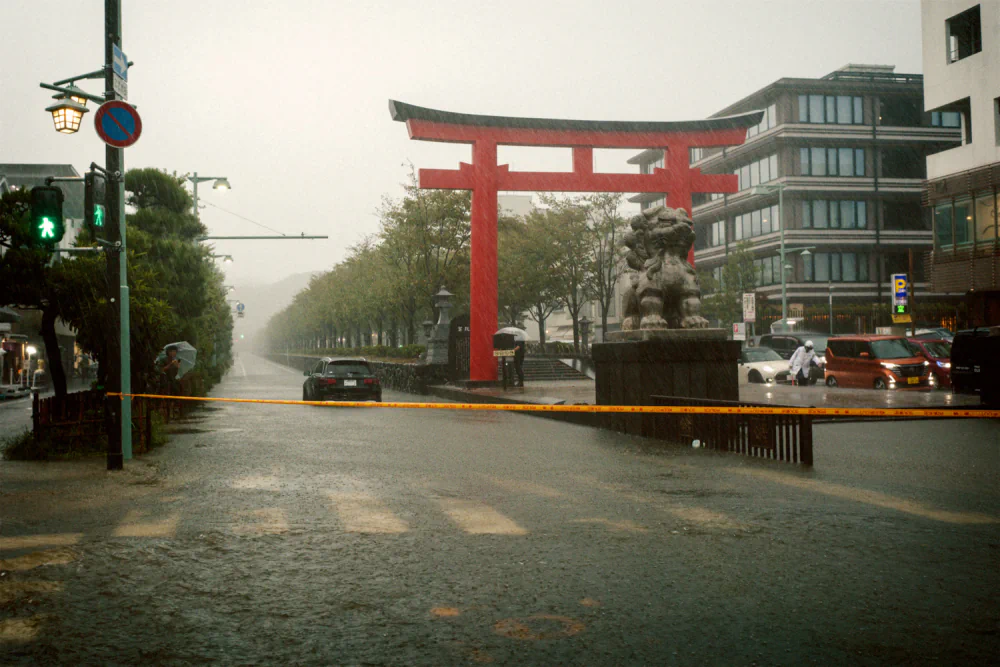
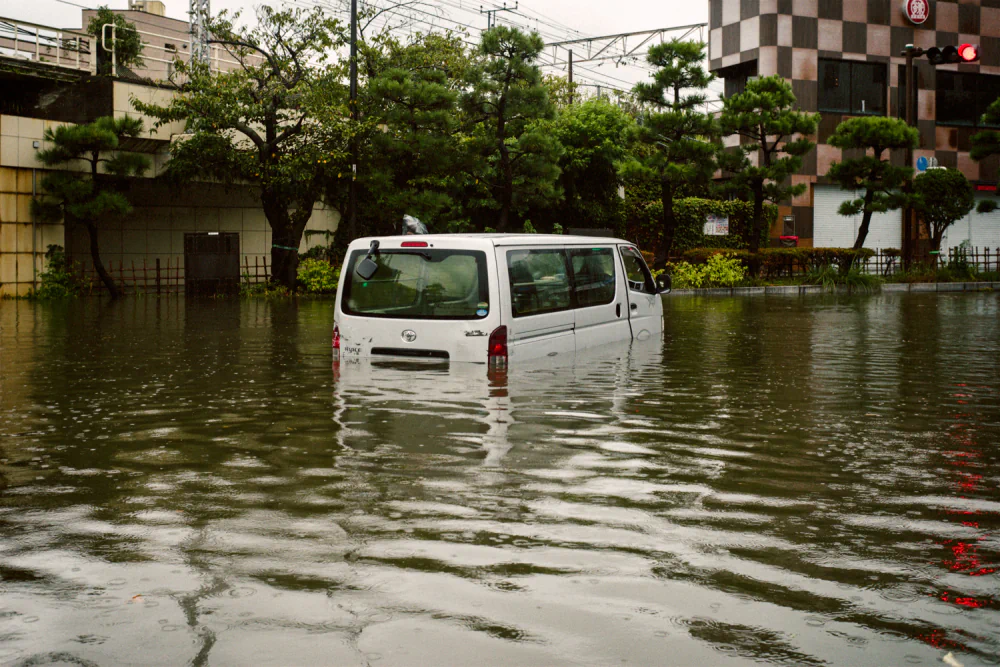
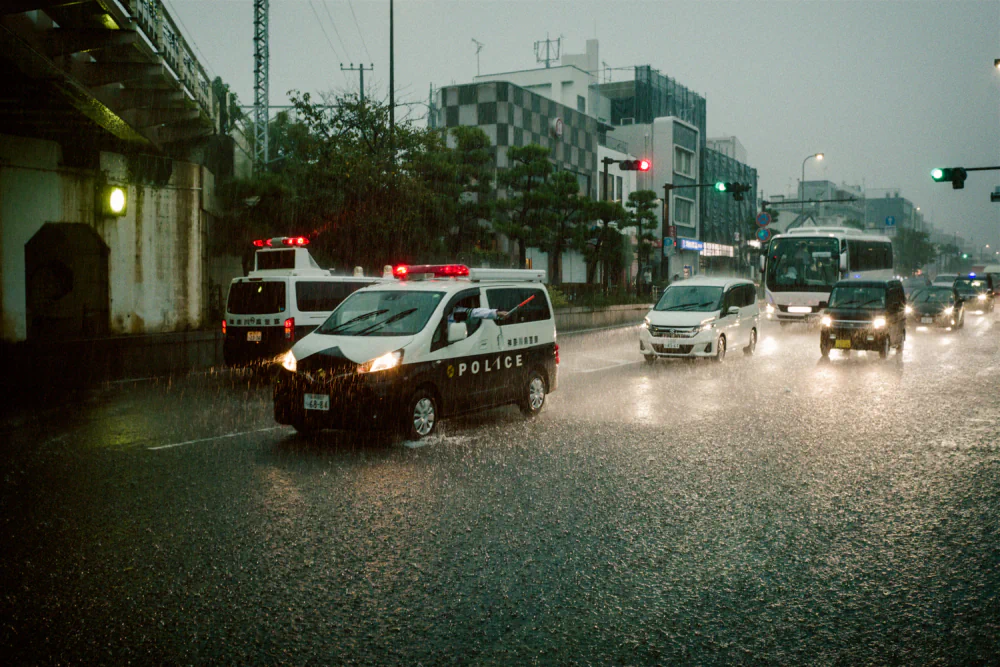
On Monday, September 21, 2026, Typhoon Dujuan slammed into Japan's Pacific coast, forcing nearly two million people under evacuation orders around the world's largest metropolitan area, killing at least two people, and leaving four more missing. With sustained winds of 130 kilometres per hour and gusts reaching 194 km/h, the storm dumped more than 12 inches of rain on the Izu Islands since September 19, cut power to more than 50,000 households, cancelled hundreds of flights at Tokyo's Haneda airport, and suspended rail services across the Kanto region — all in the middle of the five-day Silver Week holiday.
THE STORM BY THE NUMBERS
- Evacuation orders
- 1,674,084 people
- Wind
- 130 km/h sustained
- Peak gusts
- 194 km/h
- Casualties
- At least 2 dead · 4 missing
- Sustained winds: 130 km/h at the typhoon's centre; gusts up to 194 km/h (Japan Meteorological Agency).
- Evacuation orders: 1,674,084 people across Ibaraki, Chiba, Tokyo, Kanagawa and Shizuoka prefectures, per Japan's internal affairs ministry; the BBC put the figure at nearly two million.
- Dead and missing: at least two confirmed dead and four missing, according to NHK, Japan's public broadcaster. Firefighters in Kanagawa prefecture searched for a woman in her 60s believed buried alive after a landslide crushed her house, Yasuhiro Kaneko of the Yokosuka city fire department told the BBC. The Japan Times reported at least one death in Miyazaki prefecture.
- Rainfall: more than 12 inches recorded along parts of the Pacific coast since September 19, Reuters reported; forecasts called for up to 250mm across the Kanto region and up to 350mm around Tokai.
- Highest alert: a Level 5 emergency warning — the top of Japan's warning scale — issued for the island town of Oshima (3,020 residents) and for 40,000 residents of Sodegaura city in Chiba, telling people to move above the second floor and away from slopes.
- Disruption: power cut to more than 50,000 people; hundreds of flights cancelled with stranded passengers bedding down at Haneda; Monday concerts at the Rock in Japan festival cancelled; the Tokyo Game Show cancelled its Monday programme; an equestrian event at the Asian Games postponed.
WHY THIS MATTERS
This is not just another storm brushing Japan's coast. Dujuan struck the economic heart of the world's third-largest economy during one of its peak travel weeks, and the scale of the evacuation — nearly two million people told to move — makes it one of the largest single-day peacetime mobilisations of civilians anywhere on Earth this year. When the Japan Meteorological Agency warns of an "imminent threat to life" for the capital region, markets, airlines and insurers listen: Tokyo is not a peripheral outpost but a $2 trillion metropolitan economy. A storm that can shut down Haneda, strand Silver Week travellers by the tens of thousands, and pull the Japanese prime minister away from a scheduled departure to the UN General Assembly is a story with global knock-on effects, not a local weather item.
CONTEXT AND BACKGROUND: THE 25TH TYPHOON OF THE YEAR
Dujuan is Japan's 25th named typhoon of 2026 — an unusually busy season fuelled by a "super El Niño" that has warmed Pacific waters and supercharged storm formation. Japan has been here before, and the parallels are instructive. In October 2019, Typhoon Hagibis killed 98 people, breached levees across the Kanto plain, and forced the Rugby World Cup to cancel matches — the last storm to truly paralyse Tokyo. A month earlier, Typhoon Faxai blacked out nearly a million homes in Chiba, exposing how fragile the grid is where it meets the coast. And on the island of Oshima itself, now under the highest alert again, a landslide in 2013 killed more than 35 people — the same steep, saturated slopes are being asked to hold again this week. Japan built the world's most sophisticated typhoon-warning and evacuation system precisely because of this history. The question Dujuan poses is whether even the best system can keep pace as storms get wetter, slower and more frequent.
WHO LOSES, WHO WINS, AND WHAT THE CRITICS SAY
The losers are obvious first: airlines and rail operators absorbing thousands of cancelled services during a holiday peak; the Rock in Japan festival and Tokyo Game Show, two of Japan's biggest entertainment draws, losing their Monday programmes at the cost of millions in tickets, sponsorships and merchandise; and the insurers, who will be watching claims from flooded homes and businesses across Chiba and Kanagawa. Silver Week retailers and hotels in the evacuation zones lose some of their most lucrative days of the year.
The winners are subtler: disaster-prevention construction firms whose stock tends to rise with every major storm; convenience stores and hardware retailers that see panic-buying runs before landfall; and, in a perverse way, the government's own disaster bureaucracy, which gets to demonstrate its machinery. Prime Minister Sanae Takaichi walked the tightrope every Japanese leader faces — she delayed her UN General Assembly departure, posted condolences on X, and ordered her chief cabinet secretary and disaster minister to respond "with utmost preparedness," then boarded her flight to New York anyway, where she is due to speak at the UNGA on Tuesday and meet US President Donald Trump. Critics will call that optics over substance; defenders will note that a prime minister's plane leaves a functioning chain of command behind.
The deeper criticism is structural: Japan's evacuation orders are obeyed only by a fraction of those told to move. After decades of alerts, compliance fatigue is real — many elderly residents, especially on aging islands like Oshima, cannot easily self-evacuate, and "advisory" language leaves life-and-death decisions to individuals. Every storm reopens the same debate: at what point does the warning system itself need redesigning for a country whose median age is among the highest on Earth?
WHAT THE NUMBERS REALLY MEAN
Put 1.67 million evacuation orders in context: that is roughly 1.3 percent of Japan's population moved or told to move in a single day — but concentrated in the Kanto megalopolis, home to some 45 million people, the figure represents one of the densest civilian displacements of the year anywhere. The 250–350mm rainfall forecast is roughly a full September's typical rain arriving in 24 hours; when soils are already saturated from 12 inches over the preceding days, the physics are unforgiving — water has nowhere to go, which is why the JMA's linear-rain-band warnings matter more than the wind numbers. And the wind itself is deceptive: 130 km/h sustained is serious but survivable for modern Japanese buildings; the gusts to 194 km/h are what tear roofs off, topple trucks on exposed bridges, and turn debris into projectiles. Compare with Hagibis 2019 (winds of a similar order, 98 dead, damages exceeding ¥1.8 trillion): the casualty difference so far — two dead versus nearly a hundred — is a measure of how much Japan's warning and building systems have improved, and a reminder that the gap between a near-miss and a catastrophe can be one saturated hillside.
WHAT HAPPENS NEXT
As of Monday evening, Dujuan was tracking northeast along the Pacific coast with warnings being progressively downgraded — but Japanese disaster officials stress that the most dangerous phase often comes after the winds ease, when saturated slopes keep sliding and rivers keep rising. The immediate watch is on linear rain bands forming over Kanto and central Japan, which can dump lethal rainfall on very small areas with little warning. Economically, the bill will become clear over the week: transport operators tallying cancellations, insurers dispatching adjusters to Chiba and Kanagawa, and event organisers deciding whether Silver Week can be salvaged. Politically, Takaichi's UNGA speech on Tuesday now carries an unplanned theme — a leader who just ordered two million of her people to move will speak to the world's largest diplomatic gathering about a climate that keeps making such orders routine. And for Japan, the season is not over: the 25th typhoon of a record-hot year is a data point, not an outlier. The real question Dujuan leaves behind is not whether Japan can survive a storm — it manifestly can — but whether its evacuation, grid and elderly-care systems can keep surviving them at this frequency.
Sources
- Japan Meteorological Agency — typhoon warnings, wind and rainfall forecasts (official government source): JMA.
- NHK (Japan's public broadcaster) — casualty figures, via Reuters and BBC reporting.
- BBC — evacuation figures (nearly two million), Level 5 Oshima alert, Yokosuka fire department interview: BBC.
- Reuters — Izu Islands rainfall totals (12+ inches since Sept 19), landslide/flood warnings.
- USA Today — Sept 21, 2026 live report, “Landslide warnings as typhoon hits Japan; evacuations reported”: Read the report.
- The Japan Times (via weeklymail.uk) — Miyazaki fatality.
- Prime Minister's Office of Japan — Sanae Takaichi's X post on condolences and disaster response orders (official government source).
- Shin Noguchi / Dodho — earlier Typhoon No. 15 context photography: View the source essay.