new Salish Sea spider species
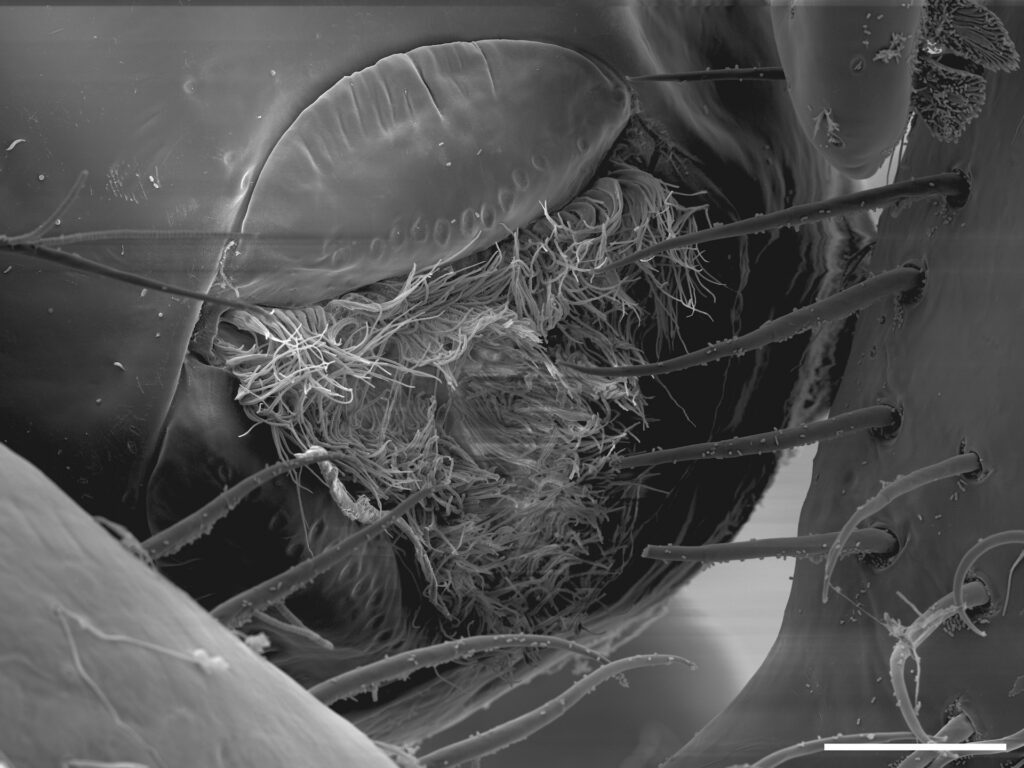
new Salish Sea spider species is the central phrase for this report because it captures the specific development readers need to evaluate. Scientists described Pycnogonum coninsulum and Pycnogonum pandion from British Columbia waters, expanding a family previously unknown from the region.
Two names added to the map
Researchers described two new sea-spider species from British Columbia waters: Pycnogonum coninsulum and Pycnogonum pandion. The discovery marks the first record of the family Pycnogonidae in the Salish Sea. The supplied image shows a close-up of mouthparts, not a full animal, which matters because sea spiders’ unfamiliar anatomy can be difficult to read without scale and context.
Not true spiders
Sea spiders are marine arthropods in the class Pycnogonida, distinct from terrestrial spiders. Many have tiny bodies and disproportionately long legs; their digestive and reproductive structures can extend into those legs. The group’s strangeness is not novelty for its own sake. It reflects an ancient evolutionary branch with biological solutions unlike those of better-known coastal animals.
How discovery happens in a studied region
The Salish Sea is close to universities, ports and dense communities, yet small benthic organisms can remain undescribed because sampling is uneven and taxonomy requires specialized comparisons. A specimen becomes a species only after morphology, measurements, location and comparisons with known relatives support the distinction. Finding two members of an unrecorded family shows that proximity to people does not equal complete biological knowledge.
Why classification matters
Taxonomy creates the baseline for conservation. Regulators cannot track decline, range shifts or habitat effects in organisms that have not been named and distinguished. The discovery benefits museums, ecological monitoring and future genetic work. It also complicates simplistic claims that a well-known coast has a finished inventory.
What remains to learn
Researchers now need broader sampling to establish range, abundance, habitat preferences and whether either species occurs beyond the original sites. Genetic data can test relationships suggested by morphology. Climate change, pollution and development may affect shallow-water communities before their composition is understood. The immediate lesson is modest but important: protecting marine diversity starts with the patient work of knowing what is there.
Related Signal Post News coverage
another unexpected Pacific wildlife record how DNA can refine spider taxonomy
Sources and reporting basis
- news.ubc.ca reporting
- blog.pensoft.net reporting
- zookeys.pensoft.net reporting
- news.ubc.ca reporting
Reporting note: This is a fixed September 25, 2026 snapshot. Attributed claims remain attributed; forecasts, polls, vendor results and early cyber findings can change as new evidence appears.