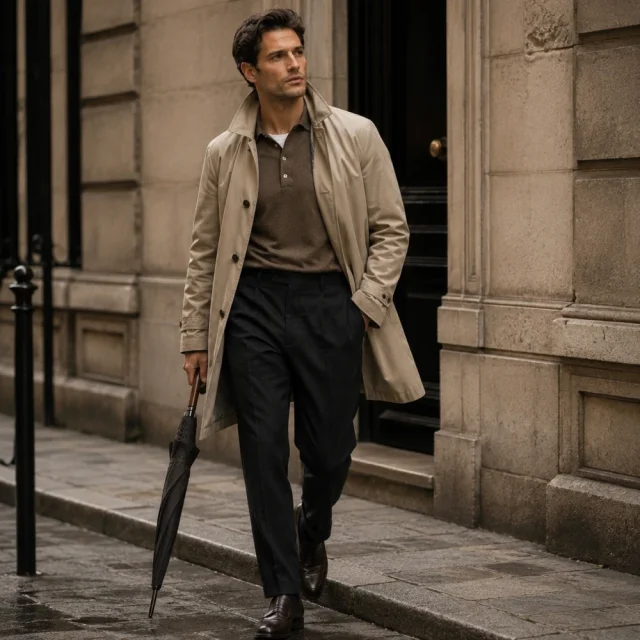
The current preppy revival arrives through cable knits, Oxford shirts, stripes, loafers and crisp collars. Who What Wear reported triple-digit search gains for argyle and roll-necks, while other fall coverage described a grown-up version of back-to-school dressing. These are directional search figures reported by a publisher, not a complete measure of global demand, but they are unusually clear evidence of interest.
Break the matching set
A literal blazer, pleated skirt, tie and loafer combination can read as costume because every item carries the same reference. Keep one or two codes and interrupt the rest. An argyle knit can sit over a fluid skirt, a button-down can be worn open over a tank, and loafers can ground relaxed denim rather than tailored trousers.
Texture is the easiest way to remove stiffness. Brushed wool, washed cotton and worn leather create a more personal effect than perfectly pressed separates. Proportion matters too: an oversized Oxford under a compact vest feels contemporary; a slim turtleneck under a broad jacket creates contrast without adding visual clutter.
Use the search spike carefully
Viral interest does not make every argyle sweater a good purchase. Before buying, test whether the pattern works with three bottoms already owned and whether the neckline layers under a regular coat. For loafers, pay more attention to heel slip, sole flexibility and sock space than to a platform height promoted on social media.
The grown-up version keeps the intelligence of a uniform and loses the obedience.
The adjacent boho-grunge revival offers a useful counterweight: lace with leather, soft skirts with heavy boots. Borrowing one of those contrasts can stop prep from becoming too polished. The larger trend is not one aesthetic defeating another; it is the return of legible styling choices after several seasons of highly optimized minimalism.
Why this matters
The preppy revival is less about nostalgia than about a renewed appetite for legibility. In uncertain periods, uniforms promise order: a collar, knit and loafer communicate competence quickly. The interesting part is the refusal to wear the code obediently, which turns an inherited status language into material for personal styling.
How we got here
Prep has cycled from campus uniform to subcultural remix for decades, repeatedly borrowed by people excluded from its original institutions. After years of sportswear and minimalist basics, structured knitwear offers a visible alternative without demanding formal dress. Social platforms accelerate the cycle by reducing a broad tradition to searchable objects such as argyle and roll-necks.
Winners, losers and the skeptical case
Knitwear brands, resale sellers and shoppers who already own shirts and loafers are positioned to benefit. Trend-led retailers can overproduce literal school-uniform combinations, leaving buyers with pieces that date quickly. Critics should question whether the aesthetic romanticizes class privilege; the strongest response is to remix the code rather than reproducing its hierarchy.
What the numbers actually imply
Reported search gains of 103% for argyle and 158% for roll-necks show acceleration from an earlier baseline, not absolute market size. The larger percentage may simply begin from the smaller search base. What the paired increases do establish is that interest spans both pattern and silhouette, making the revival broader than a single viral sweater.
What happens next
The base case is that prep settles into everyday layering rather than a head-to-toe uniform. If interest persists through winter, expect better materials and quieter patterns to outlast novelty versions; if it fades, loafers, Oxford shirts and fine knits will remain because they already function outside the trend. Buyers should favor the pieces with an independent life after the hashtag cools.
Sources: Search-change figures and trend reporting from Who What Wear; styling context from Your Coffee Break and Opulence Source.