Europe · Czech Republic · Media
The toll climbed all morning — from about 15 in the first police estimate to 46 once the hospitals had counted — but the low speed of the impact is why Prague woke to injuries rather than deaths. The open question is a red signal, and the transport minister is careful to call it only a first indication.
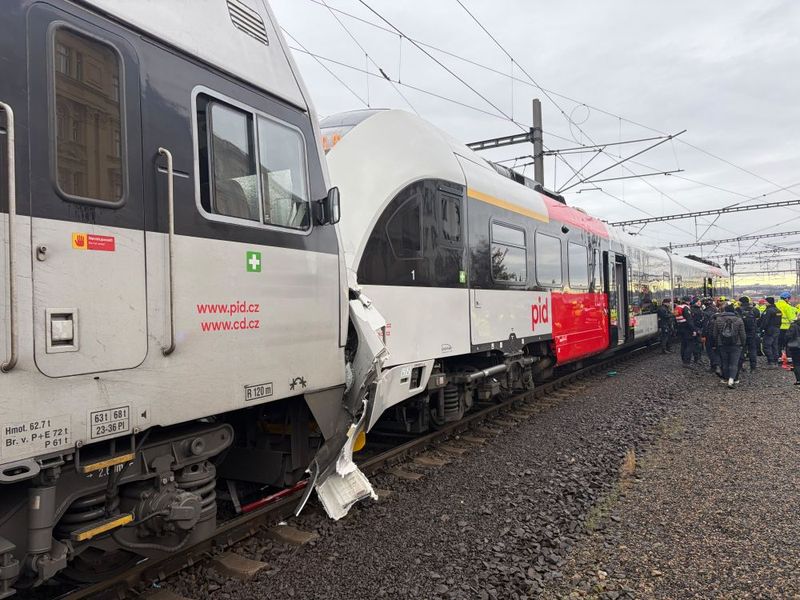
PRAGUE — Two Czech Railways passenger trains collided head-on at low speed near Prague Main Station on Tuesday morning, injuring 46 people, four of them seriously, in one of the worst Czech rail accidents of recent years. There were no deaths.
The collision happened at about 07:00 local time on the railway bridge over Seifertova Street in Prague 3, in the U Bulhara area a short distance from the main station. Reporting sourced by The Guardian identified the services as Os 9409, a CityElefant double-deck unit heading toward Milovice, and Os 9507, a RegioFox train from Mladá Boleslav. Both drivers were among the seriously injured, the BBC reported.
How the toll climbed from 15 to 46
The first figures understated the morning, as first figures usually do. Czech Police initially estimated that about 15 injured people had been taken from the scene. As hospitals across Prague received the walking wounded and the ambulance cases together, the city's emergency medical services put the total at 46 injured, including four seriously or life-threateningly hurt.
Prague EMS spokesman Karel Kirs said multiple ambulance crews, doctor-led teams and specialist resources were dispatched — ten ambulance crews in wider reporting. Fire service spokesman Miroslav Řezáč described the collision as non-destructive: the trains were damaged but not crushed, and passengers did not need to be cut out of the wreckage. Rescue operations had ended by about 09:15–10:00, with all of the injured taken to hospitals.
The red-signal question
Transport Minister Ivan Bednárik called the collision a very serious incident and told local media that, so far, it looks like a train ran a red light — while saying he would not speculate on whether the cause was a technical fault or the human factor. That distinction matters, and it is precisely what investigators now have to establish. The Rail Safety Inspection Office and railway inspectors are examining the signalling, the trains' event recorders and the drivers' actions.
Nothing about the cause is established. A passed red signal is the minister's preliminary indication, offered within hours of the crash; it is not a finding, and this article does not present it as one.
Why nobody died
Head-on collisions are the accidents railway safety systems exist to prevent, because at line speed they are usually unsurvivable. Tuesday's was different for one reason: speed. Kinetic energy rises with the square of speed, so a collision at shunting pace carries a small fraction of the destructive energy of one at full line speed — and the fire service's account, of trains that struck without being destroyed and passengers who walked or were carried out rather than cut out, is what that physics looks like in practice. Modern Czech Railways stock is also built with crashworthiness in mind, with cabs and couplers designed to absorb and deflect impact energy. Four people were nevertheless seriously hurt, including both drivers, who sat at the very front of their trains.
Disruption across the capital
Services around the main station were disrupted on lines toward Praha-Libeň, Praha-Vysočany, Praha-Holešovice, Milovice, Lysá nad Labem, Kolín and Ústí nad Labem, České dráhy said, and the railway allowed passengers to use selected Prague public transport services instead. The timing softened the blow in one respect: November 17 is a Czech national holiday, marking the Velvet Revolution and the 1939 student protests, so morning services were running on a holiday pattern with fewer commuters than a normal Tuesday — though the trains involved were still carrying passengers, 46 of whom ended the morning in hospital.
What happens next
The inspection office's work will run from the signal gantry to the timetable: whether the signals were set and obeyed, whether the trains' safety systems intervened, and what the two drivers — now among the most seriously injured, and likely to be witnesses as much as patients — can tell investigators. Czech railways have invested heavily in modern safety systems, including the European Train Control System rollout on main corridors; whether the Seifertova bridge section was covered, and what that coverage did or did not do on Tuesday, is among the questions the investigation is expected to answer. Signal Post News will update this article when the inspectors publish their first findings.
Sources
BBC News, November 17 — bbc.com/news/world-europe. The Guardian, November 17 — theguardian.com/world/europe-news. RailMarket, November 17 — railmarket.com.