War · Poland · NATO
A CSX freight train carrying an unbroken line of brand-new M1 Abrams tanks down the middle of Main Street in La Grange, Kentucky, has become the defining image of one of the largest armor programs in modern Europe. The confirmed numbers behind the viral video are just as striking: Poland has taken delivery of 217 of its 250 M1A2 SEPv3 Abrams, and the manufacturer says the final 33 will arrive by the end of 2026.
Track it live: Wars — Live Global Trackers
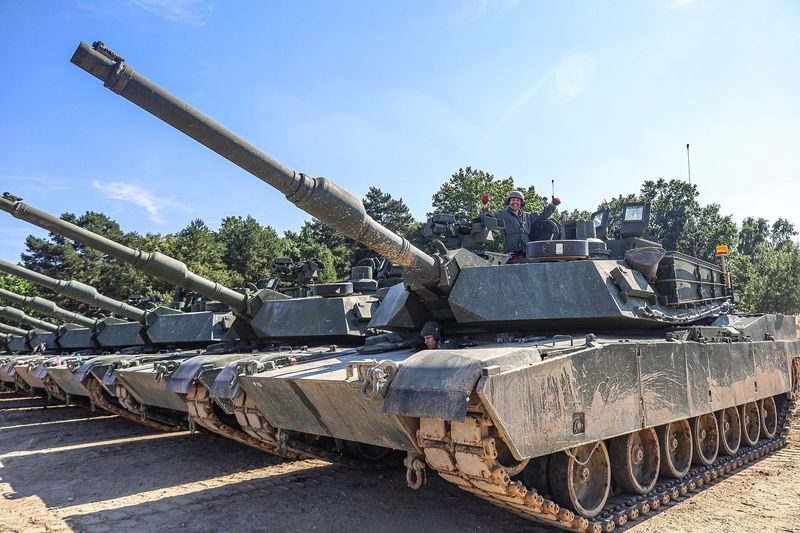
LA GRANGE, Kentucky, November 6, 2026 — The video lasts barely a minute, and almost nothing in it is ordinary. A Virtual Railfan trackside camera in La Grange, Kentucky, filmed on the morning of November 1, shows a CSX freight train easing through the center of town at walking pace — and behind the locomotives, flatcar after flatcar carries a factory-fresh M1 Abrams main battle tank, an unbroken river of armor stretching out of the frame in both directions. Defense watchers and railfans who shared the footage identify the tanks as M1A2 SEPv3 Abrams bound for Poland, part of the final production batch of Warsaw's landmark American tank purchase. That identification is the one being shared online; what is confirmed by the manufacturer, the Polish Armament Agency and trade reporting is the program arithmetic behind it — and that arithmetic says the United States has nearly finished delivering 250 Abrams tanks to Poland.
By September 2026, according to General Dynamics Land Systems, the company that builds the Abrams, 217 of the 250 M1A2 SEPv3 tanks had been delivered, with a batch of 35 tanks that month carrying the program past the seven-eighths mark. The company says the final 33 SEPv3s will be delivered by the end of 2026, completing the full order in under 24 months from the first delivery. Count in the separate, earlier purchase of 116 M1A1 FEP tanks — fully delivered under a different contract — and Poland already fielded 333 Abrams tanks of all variants by September 21, 2026, a fleet that will reach 366 when the last SEPv3s arrive. For a country that, four years ago, was still operating Soviet-designed T-72s and their Polish PT-91 descendants, it is a transformation measured in months rather than decades.
A deal signed in the shadow of invasion
The Poland Abrams program was born in emergency. Russia launched its full-scale invasion of Ukraine on February 24, 2022; six weeks later, on April 5, 2022, Poland signed a $4.75 billion agreement to buy 250 M1A2 SEPv3 Abrams tanks from the United States. The SEPv3 is the most advanced version of the Abrams in service: at roughly 66 to 70 tons it is the heaviest tank Poland has ever fielded, with improved armor, a more powerful auxiliary power unit, upgraded digital architecture and modernized sights and communications. The contract was never just about tanks. The package included 26 M88A2 Hercules armored recovery vehicles — the tow trucks, in effect, without which a 70-ton tank force cannot operate in the field — 17 M1110 Joint Assault Bridges, ammunition stocks, training and a logistics support package.
Warsaw's reasoning was stated plainly at the time and has not changed: Poland shares a border with Russia's Kaliningrad exclave to the north and with Belarus, Moscow's closest ally, to the east, and the Suwałki corridor — the narrow strip of Polish and Lithuanian territory between Kaliningrad and Belarus — is routinely described by NATO planners as the alliance's most vulnerable seam. Poland was simultaneously donating hundreds of its own Soviet-era tanks to Ukraine, and the Abrams purchase, alongside a parallel order for South Korean K2 tanks, was the centerpiece of a rearmament drive that has made Poland one of NATO's biggest defense spenders as a share of national output. The first SEPv3 batch — 28 tanks — arrived in Poland in January 2025, and deliveries have landed in batches ever since, most recently the 35 tanks in September 2026.
The Iron Division on NATO's eastern flank
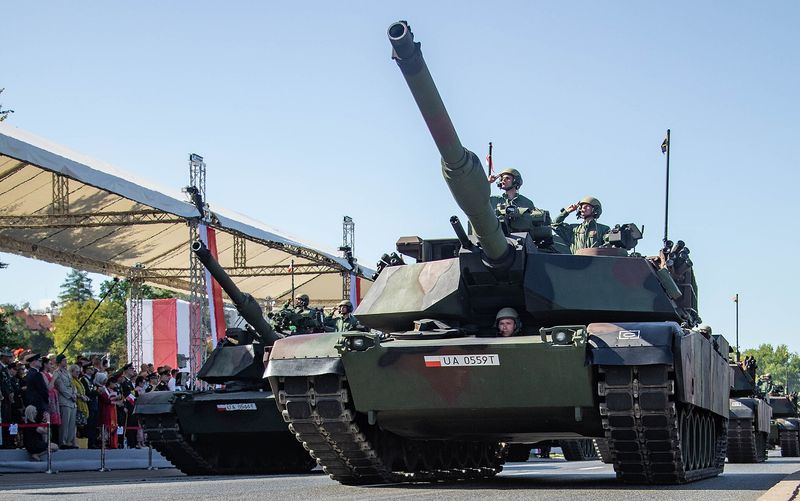
The tanks are not being spread evenly across the Polish Army. They are fielded mainly by the 18th Mechanized Division — the “Iron Division” headquartered at Siedlce, east of Warsaw — whose brigades sit astride the approaches from Belarus. Its 1st Warsaw Armored Brigade at Wesoła operates both the M1A1 FEP and the SEPv3 battalions. The geography is the strategy: the division's peacetime garrisons are close to the border crossings and road networks an attacking force would have to use, and its wartime job is to be the heavy blocking force that holds long enough for NATO reinforcements to arrive. Heavy armor is unfashionable in some defense debates, but for the specific problem of stopping an armored thrust across flat border terrain, allied planners still treat a modern tank division as the core instrument — and Poland is building the largest such force in the European Union.
The support fleet matters almost as much as the tanks themselves, and it is still arriving. Deliveries of the M1110 Joint Assault Bridge — an Abrams-chassis vehicle that lays a heavy assault bridge capable of carrying the SEPv3 itself across rivers and anti-tank ditches — continue alongside the tank batches, with the latest deliveries announced on October 29, 2026. The M88A2 recovery vehicles give Polish mechanics the ability to haul a disabled 70-ton tank off a battlefield under armor. These unglamorous vehicles are, logisticians argue, the difference between a tank fleet and a tank capability.
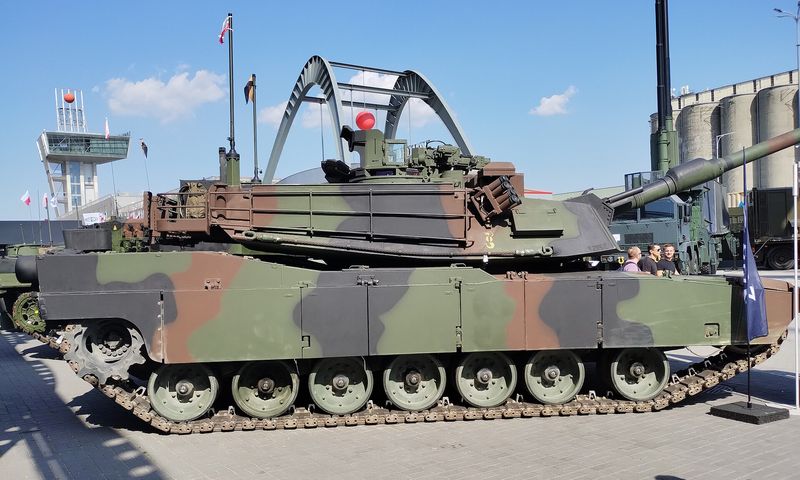
The journey those tanks are on is itself a map of the transatlantic supply line. Abrams tanks for export are completed at the Joint Systems Manufacturing Center in Lima, Ohio — the only tank plant in the United States — and heavy armor in America moves the way it has for a century: by rail, on specialized heavy-duty flatcars, exactly as the La Grange camera captured. From the Midwest, delivery convoys typically roll to a U.S. port, cross the Atlantic by ship and enter Polish service through the country's Baltic ports and rail network. It is a slow, heavy, unglamorous logistics chain, and its visibility is part of the point: a train of tanks passing through a town center in daylight is deterrence you can film on a phone. Neither Washington nor Warsaw has commented on the specific movement filmed on November 1, and the tanks' final destination has not been officially confirmed; but every confirmed element of the program — the contract, the batch rhythm, the September count of 217 — is consistent with a delivery pipeline in its final weeks of operation.
The drone debate hanging over every tank
No honest account of a 2026 tank purchase can skip the argument that has shadowed armor since 2022. Critics of heavy tank buys point to Ukraine, where first-person-view drones costing a few hundred dollars have destroyed tanks worth millions, where top-attack munitions hunt thin roof armor, and where both armies have at times treated tanks more as mobile artillery than as breakthrough weapons. On that reading, Poland is spending $4.75 billion on the defining weapon of the last war. Supporters answer that the Ukrainian evidence is more nuanced: tanks there are lost in large numbers when they operate without infantry, artillery, electronic warfare and air defense around them, and both Ukraine and Russia continue to demand, field and lose tanks precisely because nothing else combines protection, firepower and cross-country mobility in one vehicle. The emerging consensus among armor advocates is not that the tank is dead, but that it cannot survive alone — it needs active protection systems, drone screens and combined-arms support, exactly the ecosystem Poland's package of recovery vehicles, bridge layers and accompanying modernization is meant to provide. Both arguments are live, and the honest answer is that the verdict will be written by how the SEPv3 fleet is equipped and trained, not by the delivery count alone.
What completion means — and what is still missing
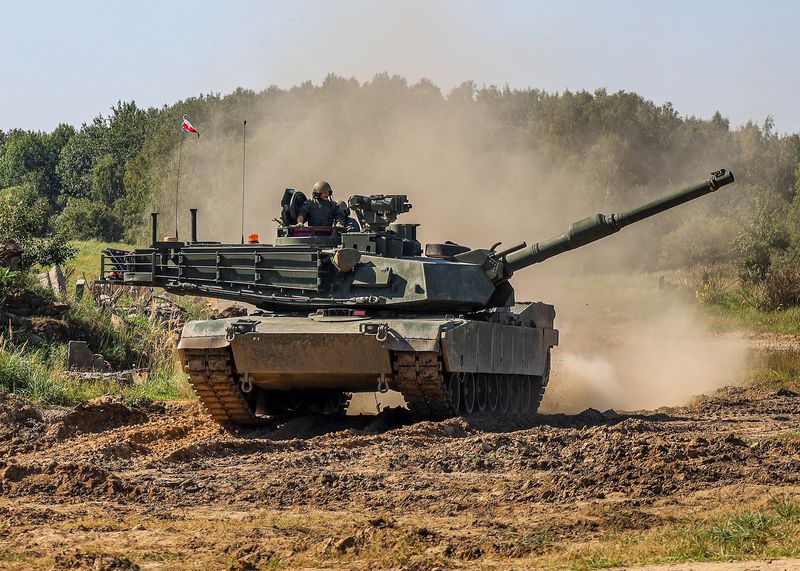
If General Dynamics Land Systems holds its schedule, the final 33 SEPv3s will be delivered by December 31, 2026, and the 250-tank program will close out in under two years from first delivery — a pace that stands in sharp contrast to the decade-long timelines European armor programs often run on. For the U.S. Army and American industry, it is also a proof of concept: the Abrams production line at Lima, Ohio, sustained for decades at low rates partly to preserve the industrial base, has demonstrated it can surge deliveries to a frontline ally at wartime speed. The Kentucky train video resonated precisely because it made that industrial story visible — a production line's output, rolling through an American small town on its way to the Vistula.
The Abrams program also does not stand alone in Poland's buildup. Warsaw is simultaneously taking delivery of South Korean K2 Black Panther tanks, American HIMARS rocket launchers, Apache attack helicopters and F-35 fighters, while sustaining defense spending above 4 percent of GDP — the highest share in NATO. The SEPv3 fleet's role in that architecture is specific: it is the alliance-standard heavy armor of the eastern divisions, interoperable with the U.S. armored brigades that rotate through Poland, sharing ammunition, parts philosophy and doctrine with the American units that would fight beside it. That interoperability is a large part of what Poland bought. A Polish SEPv3 battalion and a U.S. SEPv3 battalion can be supplied, recovered and bridged by the same support vehicles — which is why the M88A2s and M1110s in the contract, unglamorous as they are, were never optional extras.
Completion of the tank deliveries is not completion of the capability. The M1150 Assault Breacher Vehicles that clear minefields and obstacles ahead of an armored assault are not due until 2029, leaving a gap in the division's breaching capacity for several more years. Ammunition stocks, spare parts depth, active protection fits and the sheer training burden of converting an army from Soviet to American armor all remain multi-year projects. And the strategic question the purchase was meant to answer — whether a heavy Polish armored force, anchored on 366 Abrams and hundreds of Korean K2s, deters the attack it was bought to stop — will be judged in Moscow and Minsk as much as in Warsaw. What the numbers already establish is narrower and, in its way, remarkable: a deal signed in the sixth week of a war, for the heaviest tank Poland has ever operated, is about to be delivered in full, on roughly the schedule promised. The last 33 tanks are, by the manufacturer's own account, already in the pipeline. Some of them may well have been on that train.
Video of the La Grange tank train: Virtual Railfan. Delivery figures: General Dynamics Land Systems statements at MSPO Kielce, September 2026; Polish Armament Agency; Army Recognition and Defence Blog reporting. Signal Post News could not independently confirm that the specific tanks filmed in Kentucky belong to the final batch.