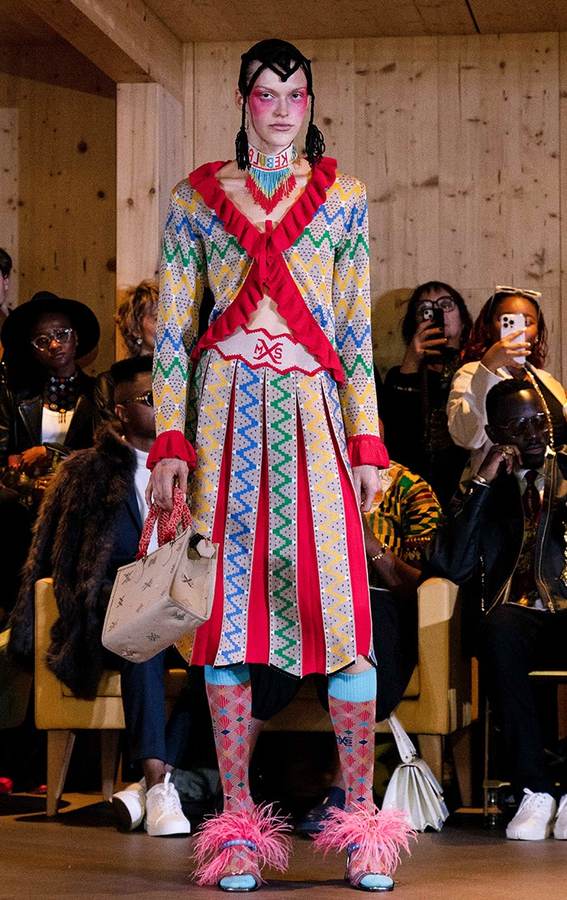
Paris Fashion Week 2026 highlights are not confined to the giant French houses. The most consequential opening-week event may have happened away from a corporate mega-set, inside the gilded residence of South Africa’s ambassador to France. There, Laduma Ngxokolo’s Maxhosa Africa became the first South African brand to stage a full runway show on the official Paris Fashion Week calendar. The September 28 presentation placed a label built around Xhosa-influenced geometry, locally sourced wool and South African manufacturing inside fashion’s most scrutinized institutional schedule.
The milestone supplies a useful thesis for the Spring/Summer 2027 season, running September 28 through October 6: Paris is testing whether the global luxury system can broaden its cultural center while its biggest brands manage another cycle of creative-director changes. On Friday, October 2, attention turns to Loewe, Casablanca, Givenchy and Victoria Beckham. Chanel follows October 5, and Louis Vuitton closes the official program on October 6. Every show is selling clothes, but the week as a whole is also selling a hierarchy — deciding whose stories, factories and aesthetics receive worldwide distribution.
Why Maxhosa Africa’s Paris debut matters
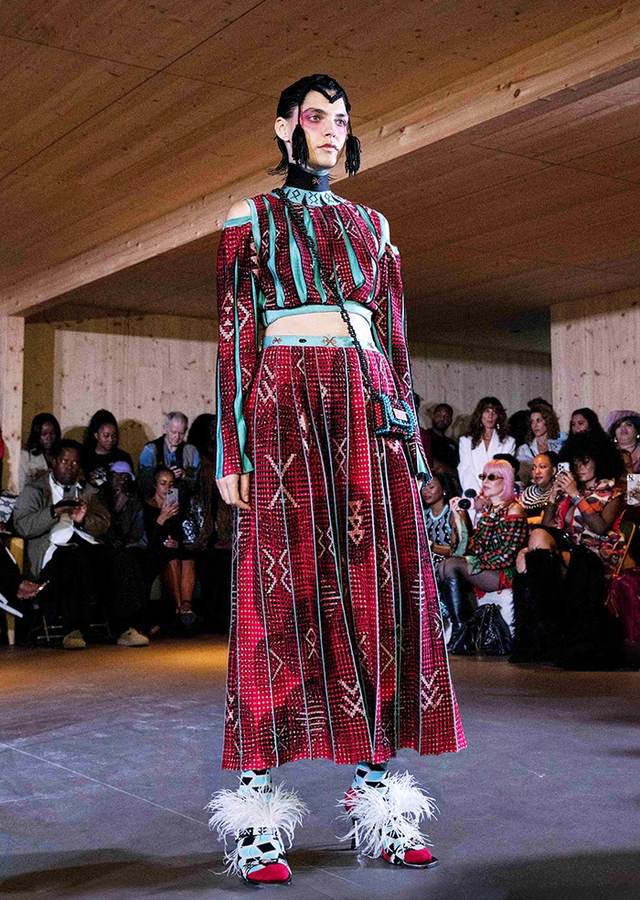
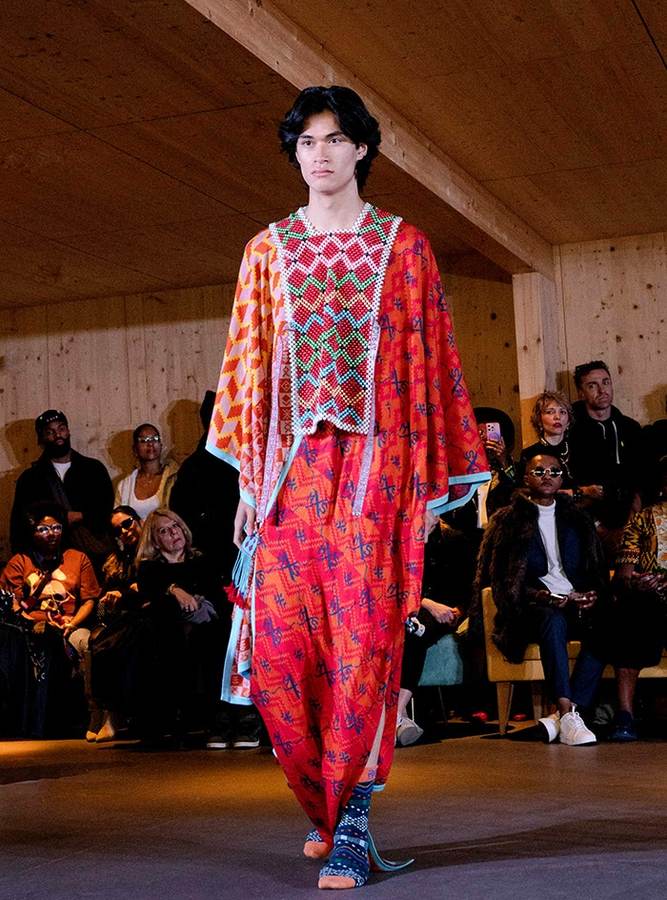
Reuters reported that Ngxokolo framed the collection around pan-Africanism and the image of an Africa where economies thrive, crime declines and governance improves. That ambition traveled through the clothes rather than appearing only in program notes. Models crossed woven straw mats in multicolored knits, geometric ensembles, formal tailoring and casual pieces. One garment carried the names of African countries; Kenyan artist Cyrus Kabiru contributed eyewear made from discarded materials; South African musician Sjava performed. The presentation treated African collaborators as makers of a complete luxury world, not as decorative references added to a European one.
The production story makes the symbolism more concrete. Maxhosa operates knitting facilities in Johannesburg and East London, near the Eastern Cape wool supply that underpins its best-known products. This is unusual in a sector where branding, design, fiber production and garment assembly can be scattered across continents. Owning manufacturing capacity gives the company more control over quality and training, though it also creates fixed costs and makes expansion harder. A Paris slot cannot solve those constraints, but it can increase wholesale interest, media attention and demand enough to make local industrial investment easier to justify.
Calling the appearance “historic” should not obscure the long path behind it. African designers have shown in Paris, influenced Paris and sold to Paris for decades. The specific breakthrough is institutional: a South African house receiving a full runway place on the Fédération de la Haute Couture et de la Mode’s official calendar. Calendars matter because editors, buyers, stylists and celebrities organize their limited time around them. Visibility compounds. A show seen by the right retailer can become an order; an order can finance production; a red-carpet placement can open another market. Inclusion in the calendar is therefore not a ceremonial ribbon but access to fashion’s attention infrastructure.
The SS27 collections trends are really business signals
Runway trend reports often reduce a season to hemlines, colors and silhouettes. The more useful reading asks what those choices reveal about risk. Luxury groups are operating in a climate where consumers have become more selective, aspirational shoppers are under pressure and the largest houses need products that work on screens and in stores. A dramatic runway idea may create attention, while a tightly merchandised bag, shoe or knit funds the experiment. SS27 therefore rewards designers who can produce a clear visual proposition without turning the collection into a costume exercise.
Maxhosa’s strength is recognizability. Its patterned knitwear can be identified without a logo, a valuable asset in an industry where many brands depend on monograms for instant recognition. Yet recognizability can become a trap if buyers demand endless versions of the same signature. The Paris test is whether the label can expand its grammar — into lighter-weight fabrics, tailoring, accessories and warm-weather categories — without losing the cultural specificity that made it distinct. That tension is shared by every heritage house in Paris, even if the heritage in question is newer and headquartered far from Avenue Montaigne.
Friday’s Loewe, Givenchy and Victoria Beckham show test
The Loewe, Givenchy and Victoria Beckham show lineup on October 2 concentrates three different business questions into a single day. Loewe must sustain the craft-and-concept authority it built during an era of unusually intense creative attention. Givenchy is still trying to convert renewed runway interest into a durable commercial identity. Victoria Beckham has evolved from celebrity-founded skepticism into a serious fashion business, but seriousness in design does not automatically produce scale or profitability. Casablanca, meanwhile, represents the newer independent end of Paris: a label whose color and leisure imagery compete against conglomerate-level budgets.
The critical audience is not only the room. Images and video reach consumers within minutes, often stripped from the sequence and context a designer intended. A single bag, dress or celebrity arrival can outrun the collection. Rihanna’s presence in Paris illustrates the conversion mechanism: star attendance turns a trade event into global entertainment, while the clothes worn entering the venue may generate as much discussion as those on the runway. For brands, the upside is reach. The downside is that celebrity spectacle can crowd out craft, fit and material — the qualities that ultimately determine whether a product survives after the post goes cold.
Dior’s Jonathan Anderson debut set the week’s early benchmark
September 29 was anchored by the Dior Jonathan Anderson debut, alongside Saint Laurent and Courrèges, where Drew Henry began his own chapter. Dior is an especially revealing assignment because it combines couture prestige, enormous retail scale, beauty revenue and a vast archive. A debut must look new enough to reset attention but familiar enough to support a global commercial machine. Anderson’s challenge is not simply designing a good collection; it is deciding which parts of Dior’s history feel useful now and which references would make the house look trapped by its own mythology.
Courrèges poses the inverse challenge. Its space-age codes are sharply recognizable, but a new designer has to keep them from hardening into a period costume. Saint Laurent, with a disciplined silhouette and powerful image-making apparatus, shows how consistency can become a competitive advantage when peers are changing leadership. The winner of a debut-heavy cycle is often the house that looks settled. Buyers can plan, customers understand the promise, and campaigns do not need to explain an entirely new identity every season.
From Chloé and Balenciaga to Margiela: four days, four models
September 30 brought Chloé, Balenciaga, Rick Owens and Schiaparelli — four brands with radically different relationships to femininity, provocation and spectacle. Chloé’s ease has to feel desirable rather than generic. Balenciaga’s scale means every styling choice becomes a referendum on the brand’s direction. Rick Owens can operate as a self-contained universe because decades of consistency have trained his audience to read incremental evolution. Schiaparelli uses surrealist craft and red-carpet visibility to make couture-adjacent fantasy legible in an image economy.
October 1 shifted the conversation to Dries Van Noten, Maison Margiela, Matières Fécales and Hodakova. That mix explains why Paris retains its gravitational pull: an established colorist’s legacy, a house built on conceptual anonymity, a provocative younger label and an upcycling-focused brand can occupy the same institutional week. The competition is unequal, but the juxtaposition produces creative friction. It also gives retailers a spectrum, from broadly wearable proposition to editorial statement.
The schedule’s absences and unusual formats matter too
Alaïa is showing as a studio without a creative director, a format that shifts emphasis from personality to atelier continuity. Carven introduces Kai Nesselrath, adding another debut to a season already crowded with first impressions. Alexander McQueen’s move to London removes a familiar Paris anchor and gives its home city a high-profile event. None of these decisions is neutral. Fashion-week geography determines staffing, production, press logistics and the symbolic community a house claims.
For an industry that often markets permanence, the calendar is remarkably fluid. Creative directors arrive faster, brands reassign cities, and independent labels calculate whether the cost of an official runway can be recovered through orders and attention. The strongest emerging houses may choose presentations, films or appointments instead. Maxhosa’s decision to invest in a runway suggests the label believed the institutional milestone was worth the expense. Its challenge now is to convert a nine-day news cycle into year-round distribution.
Who wins — and who risks being left behind
The immediate winners are designers with a sentence that buyers can repeat. Maxhosa is “the first South African brand on the official calendar,” but the clothes provide the second sentence: locally made graphic luxury rooted in Xhosa visual language and a pan-African outlook. Debuting designers gain a concentrated burst of scrutiny. Celebrity-facing houses gain vast earned media. Paris itself wins whenever a non-French label decides the city remains the place where international legitimacy is conferred.
The losers can be quieter. Smaller brands face inflated venue, model, production and travel costs. Editors have finite attention, and a presentation opposite a giant house may disappear from feeds. Garment workers and suppliers also bear risk when brands demand rapid development without predictable orders. A successful fashion week can make the system look abundant while hiding narrow margins underneath. Critics of the global schedule further question its environmental burden: international travel, temporary sets, sample production and repeated seasonal churn sit uneasily beside sustainability claims.
African designers face an additional asymmetry. They may be asked to represent an entire continent while European peers are allowed to represent only themselves. Maxhosa’s pan-African framing is intentional, but the industry should not turn one breakthrough into a substitute for many. The meaningful follow-through would be more African houses on official schedules, more long-term buying commitments, financing for production, and criticism that engages design on its own terms rather than treating origin as the sole story.
Chanel on October 5 and Louis Vuitton on October 6
The next major inflection comes with Chanel on October 5. Chanel’s scale makes every collection an economic event: fashion shapes the house’s cultural authority, while handbags, fragrance, beauty and accessories translate that authority across price tiers. The show will be read for silhouette and set design, but also for evidence that the house can balance continuity with enough surprise to sustain desire. In a cautious market, the safest products can sell; in culture, excessive safety can make a brand invisible.
Louis Vuitton closes on October 6, a position that gives the week a final punctuation mark. Vuitton can deploy architecture, travel heritage, celebrity and global distribution at a scale few rivals can match. The commercial question is not whether the house will attract attention, but what category it chooses to push. A runway that foregrounds bags tells a different strategic story from one centered on tailoring or experimental dresses. Closing-night spectacle will dominate images, yet the durable indicator will be what appears in stores six months later.
What to watch after the applause
Three outcomes will determine whether SS27 matters beyond its visuals. First, wholesale orders: do retailers commit to Maxhosa and other independent labels in meaningful depth, or place token orders that generate publicity without supporting scale? Second, product translation: can debut collections become shoes, bags, knits and dresses customers actually encounter? Third, creative continuity: do newly appointed designers receive enough seasons to build a language, or does the industry restart the cycle before audiences understand it?
Watch also for material evidence behind sustainability language. Maxhosa’s local wool and owned factories provide a traceable production narrative, though every supply chain has impacts that deserve scrutiny. Upcycling-focused designers can influence technique, but limited one-off pieces do not by themselves change mass production. The next phase is operational: repair, resale, smaller production runs, better forecasting and transparent sourcing. Paris is powerful precisely because an aesthetic idea shown there can move through the wider market. That power creates responsibility as well as glamour.
Paris Fashion Week 2026 highlights in perspective
The week’s most important contrast is between arrival and inheritance. Maxhosa arrives with a visual language built outside Europe’s traditional luxury capitals and asks Paris to recognize it without sanding away its specificity. Dior, Chanel and Louis Vuitton inherit enormous archives and must prove those archives remain generative. Loewe, Givenchy, Victoria Beckham, Carven and Alaïa occupy points between those poles, negotiating authorship, continuity and commercial pressure.
If SS27 is remembered only for a celebrity sighting or a viral set, the industry will have missed the deeper change. The official calendar has expanded its map, however modestly. A South African factory-linked label now stands inside the same schedule as the largest luxury houses in the world. The real measure of progress will come later: repeat invitations, orders, jobs, investment and a wider field of African designers able to enter on their own terms.
For readers following the broader culture business, see Signal Post News coverage of celebrity and royal media, the economics of television attention, and our fashion archive.
A buyer’s scorecard for the rest of the week
To judge the collections after the live stream ends, separate image impact from assortment strength. Look for a coherent opening statement, then ask whether the idea survives across outerwear, knitwear, dresses, shoes and bags. A collection with one spectacular look and no connective tissue may dominate social media but frustrate stores. A quieter show can be commercially stronger if color, fabrication and price architecture give buyers several ways into the brand. For Maxhosa, the scorecard includes whether warm-weather knits feel genuinely seasonal, whether tailoring broadens the customer, and whether accessories extend the pattern language without becoming souvenirs.
Also watch casting and styling. Representation is more meaningful when it is integral to the brand’s customer vision rather than a one-season headline. Styling can reveal how designers imagine garments living together, but it can also hide weak separates beneath theatrical layering. The best SS27 collections will permit both fantasy and disassembly: an editor sees an image, a buyer sees a rack, and a customer sees a garment that can enter an existing wardrobe.
Finally, watch what brands say about availability. A runway held in October 2026 is effectively a promise about spring and summer 2027 delivery. Production delays, minimum orders and wholesale caution can prevent acclaimed work from reaching stores. For an emerging global label, operational reliability is part of creative reputation. Maxhosa’s owned factories provide control, but new demand tests capacity. Growth that overwhelms training or quality would weaken the very proposition Paris is celebrating.
The wider meaning of a first
Fashion history often remembers “firsts” because they create a clean line through a messy system. The danger is that the industry congratulates itself and moves on. The more valuable response is to ask which gate opened, who still controls it and whether the opening becomes routine. An official-calendar debut should lead to recurring access, not a commemorative exception. It should also encourage institutions in Europe and Africa to fund education, manufacturing, archiving and retail links that survive changes in trend.
Ngxokolo’s achievement is therefore both complete and unfinished. The show happened; the barrier was crossed. What follows depends on editors who continue covering the work, buyers who take commercial risk, customers who evaluate the clothes, and institutions willing to admit that luxury knowledge is not geographically exclusive. Paris remains powerful, but this season’s strongest story suggests that the city’s future depends on what it is willing to recognize from beyond itself.