Jeremiah Smith Ohio State records
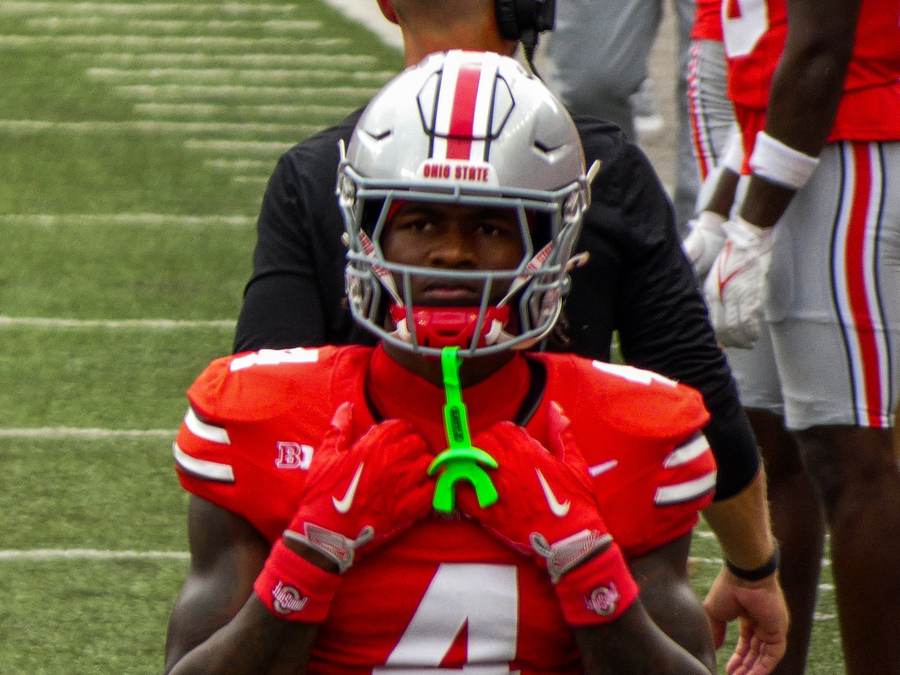
Jeremiah Smith Ohio State records now sit at 207 catches, 3,381 receiving yards and 36 touchdown receptions after a performance that was less an isolated eruption than a takeover. Smith caught 11 passes for 206 yards and two touchdowns Saturday, Julian Sayin completed 20 of 27 throws for 324 yards and three scores, and No. 5 Ohio State beat No. 14 Iowa 31-14 at Kinnick Stadium. Ohio State improved to 4-1 and 2-0 in the Big Ten; Iowa fell to 4-1 and 1-1 with its first loss of 2026.
The Ohio State-Iowa score looked competitive only at the edges. The Buckeyes outgained the Hawkeyes 484-238, held a 160-39 advantage on the ground and possessed the ball for nearly 17 minutes longer. Iowa turned the ball over twice. Ohio State did not need a flurry of short fields or a special-teams accident to create separation. It owned the line of scrimmage, stayed on schedule and gave its best player enough chances to turn a ranked road game into a record book.
How Ohio State vs Iowa 31-14 unfolded
Sayin set the tone on the opening drive with a 15-yard touchdown pass to Devin McCuin. Iowa answered with field goals rather than touchdowns, a distinction that became more expensive as the afternoon progressed. With 12 seconds left before halftime, Smith caught a 12-yard touchdown and sent Ohio State to the locker room ahead 17-6. The late score forced Iowa to abandon the version of the game it wanted: slow, field-position driven and close enough for one fourth-quarter possession to decide it.
The decisive moment arrived with 6:11 left in the third quarter. Smith turned a pass into a 57-yard touchdown, faced the Iowa crowd and struck a Heisman pose. It was theater backed by production, and LeBron James added a social-media salute. Ja'Kobi Jackson's seven-yard touchdown run early in the fourth quarter made it 31-6. Iowa's Braeden Jackson scored from two yards and the Hawkeyes converted for two late, but the 31-14 final did not flatter the winner.
Iowa quarterback Hank Brown finished 12 of 27 for 132 yards with an interception and left late in the third quarter after a hard hit. His status is a watch item, not a diagnosis. Jeremy Hecklinski completed all five of his passes for 67 yards in relief. Running back Bo Jackson finished with 70 yards on 16 carries, including 33 yards on three carries in the two-minute sequence before halftime, but Ohio State otherwise denied Iowa the rushing control its offense needs.
Why this matters: Smith moved from contender to argument
Smith did more than pass Emeka Egbuka's previous Ohio State receptions record of 205. By the Associated Press accounting, he left Iowa City as the program's career leader in receptions, receiving yards and receiving touchdowns. The three marks arrived together because his career has compressed elite volume and explosive scoring into the same timeline. At 207 catches, 3,381 yards and 36 touchdowns, Smith is no longer chasing the central Ohio State football records. He owns them.
The Jeremiah Smith Heisman case becomes harder to reduce to receiver bias after a day like this. Through five games, he has 44 catches for 823 yards and nine touchdowns, leads the FBS in receiving yards and touchdown catches, and has topped 150 yards four times. That is a pace of 164.6 receiving yards and 1.8 touchdowns per game. If maintained across a 12-game regular season, it would project to roughly 106 catches, 1,975 yards and 22 touchdowns. Projections are not accomplishments, but they show the scale of the season voters are being asked to evaluate.
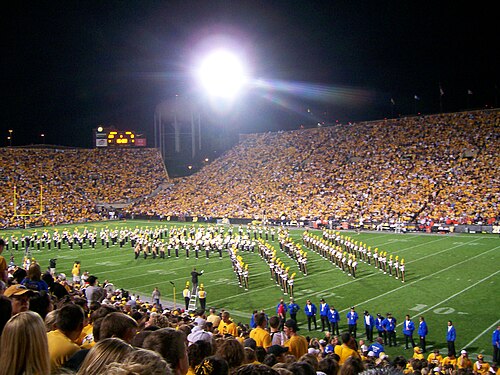
The road setting matters too. Kinnick Stadium is designed to make contenders uncomfortable: crowd pressure, a defense that forces patience and an Iowa offense comfortable turning a game into a punt exchange. Smith's 57-yard score broke that structure. A Heisman moment is not simply a pose; it is a play that changes what the opponent is allowed to believe. After that touchdown, Iowa was no longer one break away. It needed a different offense.
The Julian Sayin stats reveal the larger breakthrough
Smith's numbers were possible because Sayin repeatedly made the right decision before asking his receiver to make the spectacular one. A 20-of-27 line is a 74.1% completion rate; 324 yards on 27 attempts is 12.0 yards per attempt. Three touchdowns without an interception turned aggressive passing into low-risk football. That combination is the important part. Ohio State did not choose between efficiency and explosives.
Sayin benefits most after Smith. His emergence gives Ohio State a quarterback performance it can carry into the hardest part of the Big Ten schedule rather than merely a caretaker attached to a great defense. Smith's draft stock does not need much assistance, but this game reinforces the trait NFL evaluators value most: he changes defensive geometry even when everyone in the stadium knows where the ball should go.
The offensive line and running game belong in the beneficiary column as well. A 160-39 rushing advantage created manageable downs and kept Iowa from treating every snap as a Smith hunt. Ohio State's nearly 17-minute time-of-possession edge flowed from that balance. The Buckeyes could attack vertically, then stay on the field. That is a more durable playoff formula than relying on isolated deep shots.
The data says control, not merely star power
Ohio State produced 246 more total yards than Iowa, more than quadrupled the Hawkeyes' rushing output and won the turnover margin 2-0. Iowa lost a fumble on its opening possession and threw a third-quarter interception. Those two turnovers mattered, but they do not explain a 484-yard offense or a defense that allowed 39 rushing yards. The Buckeyes won the ordinary snaps between the highlights.
The possession gap supplies the connective tissue. Nearly 17 extra minutes means more opportunities for Smith, fewer for Iowa and accumulating fatigue for a Hawkeyes defense that had just survived a 20-19 win over Michigan. Ohio State's edge was self-reinforcing: successful early-down runs sustained drives, sustained drives expanded Smith's target volume, and Smith's explosives forced Iowa to play faster than it wanted.
Smith accounted for 63.6% of Sayin's passing yards. That concentration can be framed as dependence, and better defenses will test every secondary option. Yet Iowa knew the matchup and still could not erase it. When a defense devotes its structure to the obvious threat and the obvious threat produces 206 yards anyway, concentration becomes evidence of dominance rather than a play-calling flaw.
From the Texas loss to a 136-36 reset
Three weeks earlier, Ohio State's season had acquired an uncomfortable frame: a 24-23 loss to Texas on September 12, followed by questions about whether another talented roster could turn close-game execution into a championship path. Since then, the Buckeyes have won three straight and outscored opponents 136-36. The first two wins restored order. Iowa supplied credibility because it was the first top-25 opponent in that run and because the game was played in one of the conference's least forgiving environments.
This result improves the College Football Playoff math without solving it. A one-loss Ohio State team with a clean Big Ten record can still build a direct route through the conference championship race. The Texas defeat remains part of any seeding comparison, especially if at-large teams cluster around one loss. A ranked road win gives the committee something affirmative to weigh rather than asking it to excuse September.
The 136-36 margin across three wins is also a warning against reading the Texas loss as a permanent ceiling. Ohio State has responded by widening margins, developing Sayin and placing Smith at the center of the offense without becoming one-dimensional. The next test is repetition. Playoff résumés are not repaired in one afternoon; they are repaired when the performance becomes the standard.

Who loses — and what the critics will say
Iowa's loss is expensive because its margin for error was always smaller. The Hawkeyes entered 4-0 after beating Michigan 20-19, and a home win over No. 5 Ohio State would have transformed their playoff profile. Instead, the Iowa Hawkeyes' first loss of 2026 comes with a 246-yard deficit and an uncertain quarterback situation. An at-large path now likely requires near-perfection, while the Big Ten route demands help in the standings as well as wins.
The Hank Brown injury cloud makes the next six days more important than the final score. If Brown is not available, Iowa must decide how much of the offense Hecklinski can operate at Washington on a short week. His 5-for-5 relief line was encouraging, but a controlled late-game sample against a defense protecting a large lead is not the same as starting a road conference game. Iowa also needs a rushing plan that does not ask the quarterback to rescue third-and-long repeatedly.
Critics of Ohio State will note that this was the Buckeyes' first ranked win and that Iowa's offense is not the kind that exposes every defensive weakness. Fair. Schedule strength remains a moving target, and one emphatic result does not erase the Texas loss. Critics of Iowa will focus on the conservative plan: two early field goals kept the game visually close but did not create enough pressure on Ohio State. Against an offense with Smith, settling for three can be a temporary necessity; treating it as a sustainable strategy is how a 7-6 game becomes 31-6.
What happens next in the Big Ten standings
Ohio State returns home to face Maryland with control of its conference record. The cleanest scenario is also the least dramatic: keep winning, reach the Big Ten championship game and remove most at-large ambiguity. A stumble would return the conversation to comparative résumés, where the Texas loss and the quality of this Iowa win will be measured against other one-loss contenders.
Iowa travels to Washington on Friday, October 9, at 8 p.m. Central. The Hawkeyes need immediate clarity on Brown, a plan for Hecklinski if necessary and more first-down offense. Their defense can still keep them in the Big Ten race, but the offense cannot assume every opponent will remain within one possession. Washington will have seen how Ohio State forced Iowa away from its preferred pace.
For Smith, the next phase is not about the novelty of records. It is about turning a historic five-game opening into a full season voters can place above elite quarterbacks. For Sayin, it is about proving that 324 yards at Kinnick was an arrival, not a peak. For Ohio State, the 31-14 win created the strongest answer yet to the Texas loss: not a claim that September did not matter, but evidence that the team learned what it lacked.
Sources
Reporting basis: Game statistics, records, scoring sequence and season context are drawn from the linked reports. Brown's exit is described only as an injury watch item because no diagnosis was reported at publication.