North Carolina Senate race 2026
North Carolina Senate race 2026Michael Whatley vs Roy Cooper pollsNC Senate polls 2026Roy Cooper Senate 2026Senate Leadership Fund North CarolinaMichael Whatley pulls TV adsThom Tillis retiring Senate seat2026 midterm Senate racesNorth Carolina Senate race predictionsGOP abandons North Carolina Senate
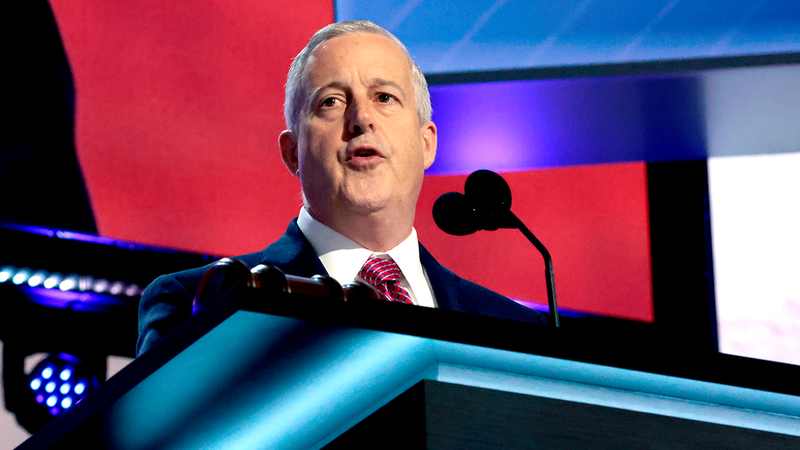
Michael Whatley's campaign for the U.S. Senate in North Carolina has temporarily pulled its own television advertisements, the Raleigh News & Observer reported Wednesday — an extraordinary step for a major-party nominee four weeks before Election Day, and the clearest sign yet that Republicans are giving up on holding the seat. Whatley, the Trump-endorsed former Republican National Committee chairman, trails former Democratic Gov. Roy Cooper by nine points, according to the RealClearPolling average, and his campaign is now “rethinking their strategy” even as outside Republican groups slash tens of millions in planned spending and redirect it to races in Kansas, Texas, and South Carolina.
Why this matters
Super PACs abandoning a struggling candidate is routine campaign triage — cold, but normal. A candidate's own campaign pulling its ads is not. Television remains the single biggest line item in a Senate campaign budget, and going dark in October is the political equivalent of a white flag: it tells voters, donors, and the press that the campaign itself no longer believes paid persuasion can close the gap.
For Republicans, the stakes go beyond one seat. North Carolina's open Senate seat — being vacated by retiring Sen. Thom Tillis — was supposed to be a GOP hold in a state Donald Trump carried three times. Losing it would narrow the party's already thin path to keeping its Senate majority, and the money fleeing the state is a public admission by the party's own strategists that the map has shifted against them.
The money exodus — by the numbers
The financial retreat from North Carolina has been swift and sweeping. The Senate Leadership Fund, the top Republican super PAC, poured more than $30 million into the race backing Whatley — then paused its spending entirely, with the New York Times reporting the group canceled all of its remaining ad time and CNN reporting $13.2 million in reservations axed.
The redirected money is flowing to races Republicans consider more salvageable: a planned $14 million in Kansas, a state that has not elected a Democratic senator since 1939, and a commitment of more than $100 million to the Texas Senate race through SLF's affiliate, Texas PAC. Americans for Prosperity Action, the Koch-aligned group, left North Carolina off its $22 million list of future spending across key Senate contests. Old North Action removed $6.5 million in ad reservations in September, Semafor first reported.
Even the Trump-aligned No Going Back PAC had no television ads planned in North Carolina for the week of Oct. 5. The National Republican Senatorial Committee is running television ads with Senate campaigns in Alaska, Iowa, Ohio, and New Hampshire — but none for Whatley, and none for Georgia's Mike Collins, either. Strikingly, the retreat is bipartisan in its own way: WinSenate, aligned with Senate Majority PAC, removed roughly $1.1 million in North Carolina ad buys of its own, a luxury Democrats can afford only because Cooper is, in their read, safely ahead.
How we got here
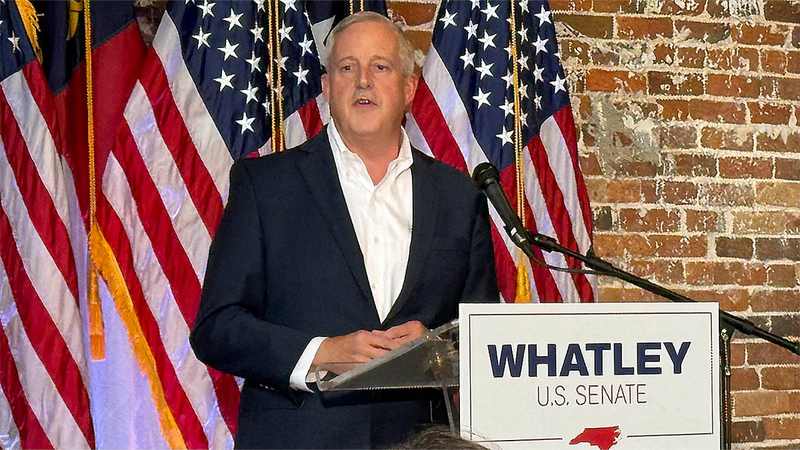
The seat opened in June 2025, when Sen. Thom Tillis announced he would not seek reelection — days after Trump threatened to back a primary challenger over Tillis's vote against the One Big Beautiful Bill. Trump endorsed Whatley early; Whatley had chaired the Republican National Committee alongside the president's daughter-in-law, former co-chair Lara Trump, during the 2024 campaign.
But the former party chairman has struggled with the transition from party operative to candidate, dogged by low name recognition in a state where his opponent governed for eight years. A PBS News/NPR/Marist poll from Sept. 23 found 53% of registered voters would vote Democratic if the election were held then, against 41% for Republicans, with independents preferring Democrats by a 25-point margin.
Trump himself has sounded the alarm: “I am worried about him,” he told reporters at the White House, while insisting Whatley is “a great man” who “would be a great senator.” The president's endorsement, once the most valuable asset in Republican politics, has looked more like a weight in North Carolina, where his approval rating has dropped sharply despite carrying the state in all three of his presidential runs.
Who benefits, who loses
The immediate beneficiary is Roy Cooper, who has led every major poll and can now husband his resources while his opponent goes dark. Down-ballot North Carolina Democrats stand to gain from depressed Republican turnout if the top of the ticket collapses.
The losers start with Whatley himself, whose political future narrows with each dollar that leaves the state, and extend to Senate Republicans' majority math: every seat written off in October is a seat that must be won somewhere else in November. Republican strategist Doug Heye called the super-PAC retreat “a blow to the [Whatley] campaign and a tangible recognition that we haven't seen any real tightening in the polls.”
Whatley's camp pushes back: “We are confident we have the resources to target our late-breaking supporters and win on Election Day,” a source told the News & Observer. Democrats, for their part, are warning against overconfidence — North Carolina operatives note that Cooper still needs to run up the score to lift down-ballot races, and that a demoralized GOP base can still turn out.
What happens next — three scenarios
First, the scorched-earth scenario: with limited funds, Whatley's campaign could abandon persuasion advertising and pour everything into late negative attacks on Cooper, betting that a brutal final two weeks can do what months of positive ads could not.
Second, the managed-decline scenario: the pause becomes permanent, the campaign conserves cash for get-out-the-vote, and both parties quietly reallocate the race to the “likely Democratic” column — freeing Republican money for Kansas and Texas and Democratic money for offense elsewhere.
Third, the late-break scenario the campaign is publicly betting on: undecided voters, who have barely engaged with a race overshadowed by the presidential campaign, break disproportionately for Whatley in the final days. History offers cold comfort for that hope — nine-point polling deficits this late have rarely been overcome in North Carolina Senate races — but the state has a habit of polling tighter than it votes.
Either way, the ad pull has already done its damage: in politics, nothing depresses donors like the sight of a campaign retreating from the airwaves.
The bottom line
Four weeks from Election Day, the North Carolina Senate race 2026 has become a case study in how modern campaigns die — not with a scandal, but with a spreadsheet. The Republican Party's money has spoken, and it is speaking from Kansas and Texas now. Whatley's campaign insists it can still win with the supporters it has yet to reach. The polls, the pollsters, and the party's own checkbook all say otherwise.
Sources
- Daily Caller — Oct. 7, 2026 reporting on the Raleigh News & Observer scoop that Whatley's campaign pulled its television ads while rethinking strategy.
- WRAL — reporting on the Senate Leadership Fund's pause in North Carolina and the redirection of spending to other races.
- Semafor reporting, via Newsmax — Old North Action's removal of $6.5 million in North Carolina ad reservations.
- New York Times and CNN reporting, via Morning Digest — the cancellation of remaining SLF ad time and $13.2 million in reservations.
- Reason — Sept. 23, 2026 background on the Whatley-Cooper contest and North Carolina's shifting race.
- PBS News/NPR/Marist poll — Sept. 23, 2026 findings on the generic ballot and independent voters.