Mistral Large 4 Le Chonk

Mistral Large 4 Le Chonk arrived in public preview on October 6 carrying two numbers designed to command attention: one trillion total parameters and roughly 49 billion activated for each token. France's best-known model maker is not merely announcing a larger system. It is trying to prove that Europe can field frontier-scale technology, price it aggressively and eventually give customers the weights needed to run it on their own terms.
That last promise is why this release matters more than the inevitable leaderboard contest. The API preview is available now in Mistral Studio; the downloadable weights are scheduled for October 27 after about three weeks of testing with developers, cybersecurity teams and government authorities. The checkpoint can process text and images, includes a 1.6-billion-parameter vision encoder, spans more than 160 languages and offers a one-million-token context window.
The model is not yet a finished verdict. Reinforcement learning was still continuing when Mistral opened the preview, the expected license is a custom Mistral license rather than an automatically permissive open-source grant, and the strongest benchmark claims come from the company or selected evaluators. October 27 will be the date when independent developers can begin testing whether the headline survives contact with deployment.
What Mistral actually announced
Preview live now, weights October 27
Mistral announced the staged rollout on October 6. Customers can call the preview through Mistral Studio while invited security specialists, public authorities and outside developers probe the model before its parameters are released. The interval is short enough to preserve momentum but long enough to address a central objection to powerful open weights: once a checkpoint is downloaded broadly, a lab cannot recall it like a hosted API.
The Mistral Large 4 release date therefore comes in two parts. The service is live now; the Mistral Large 4 weights October 27 deadline is the consequential one. Mistral says the full model will follow under a custom license. Commercial users should read those terms closely. “Open-weight” means the numerical parameters can be obtained and operated; it does not guarantee that training data, code or every commercial right will be open.
The native multimodal design combines text with images rather than bolting vision onto a text-only core. A one-million-token window is meant for long codebases, document collections and enterprise records, while support for more than 160 languages — including every official European Union language — makes multilingual public-sector and corporate deployment part of the product rather than an afterthought.
What “one trillion parameters” really means
Sparse mixture-of-experts changes the cost equation
A trillion parameters sounds like a trillion calculations on every word. That is not how this one trillion parameter AI model operates. Mistral uses a sparse mixture-of-experts architecture: specialized portions of the network are routed to each token, leaving most weights idle for any single step. The company describes approximately 49 billion active parameters per token, so inference behaves much more like serving a 49-billion-parameter model than a dense trillion-parameter one.
There is a small discrepancy worth recording rather than sanding away. Public summaries describe one trillion total parameters and roughly 49 billion active. Mistral's technical documentation lists the preview checkpoint at 1.05 trillion total and 52 billion active. Rounding, checkpoint revision or accounting conventions may explain the difference; independent documentation around the final weights should clarify it.
Sparsity does not make the full model small. Hosting still requires storing and moving an enormous collection of weights, and expert routing adds systems complexity. But it separates knowledge capacity from per-token compute. That is the architectural proposition behind Mistral's price and its claim that customers can obtain frontier breadth without paying dense-trillion-model costs on every request.
Trained in Europe, on Europe's terms
Efficiency, not parameter theater, is the sharper claim
Mistral trained Le Chonk from scratch in roughly two months on about 4,000 Nvidia Grace Blackwell GPUs housed in its own European data centers. Pierre Stock, Mistral's vice president of science, said the compute cost was two to three times lower than what Chinese competitors spent and significantly below the outlay of closed laboratories. Those comparisons are company claims, not audited ledgers, but they identify the performance metric that matters: capability produced per unit of scarce compute.
Chief scientist Guillaume Lample expects capabilities to improve as reinforcement learning concludes. The organization behind that work has changed radically. Mistral's science operation grew from about three researchers to roughly 300, transforming a compact French challenger into a lab that can run overlapping training, post-training, safety and product programs.
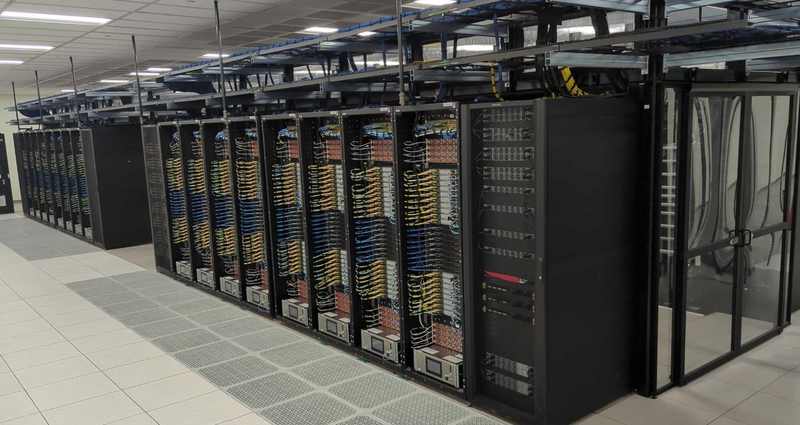
For the open-weight AI model 2026 field, efficiency is strategic rather than cosmetic. A lab that trains more cheaply can refresh models faster, preserve margin at lower API prices and offer sovereign deployments without making each national or corporate customer replicate the cost structure of the richest American labs. The 160-plus-language coverage broadens the addressable market, but the Blackwell fleet and short training run explain how Mistral hopes to serve it economically.
The benchmarks — where it leads, where it lags
Cybersecurity is the standout, but the general gap remains
Mistral says Large 4 is the strongest open-weights model produced in the United States or Europe on its aggregated tests and state of the art among openly available systems for enterprise work in cybersecurity, finance and manufacturing. It also claims the model beats some closed frontier systems on visual grounding. Independent reproduction will determine how broadly those advantages travel beyond the selected suites.
The cybersecurity numbers are the most striking. Le Chonk completed 93% of 40 Cybench challenges and entered the top five on the Artificial Analysis Cyber Index, ahead of every non-Chinese open-weight model. On the broader Artificial Analysis Intelligence Index, it scored 38, up sharply from Large 3's 9. Yet leaders such as Claude Opus 5.5 remained roughly 20 points ahead. That makes the Mistral Large 4 vs Claude GPT conversation workload-specific, not a declaration of overall parity.
One exploit-reproduction-and-patching test produced an 82% score, the highest reported result, while Claude Opus 5.5 and GPT-6 Astra scored near zero because they refused to attempt the task. That comparison measures two different policy choices as much as two capability levels. A model willing to execute dual-use security tasks can score higher and assist defenders, but it can also lower the cost of offensive experimentation. Refusal-heavy systems sacrifice usefulness in that evaluation to reduce misuse risk.
The correct reading is neither that 82% proves universal superiority nor that refusals reveal incapacity. It shows that open deployment, safety policy and capability cannot be separated. Mistral's three-week security window is an attempt to test those interactions before an irreversible release.
How a Reddit joke became a model name
“Le Chaton Fat” crossed from parody into the lab
In June, fans on Reddit and X invented a fictional Mistral system called “Le Chaton Fat” — “the fat kitten” — with a made-up 30 trillion parameters and fabricated benchmark tables defeating Claude. Arthur Mensch joined the joke on X, correcting the imaginary French to “it's actually le gros chaton.” Four months later, Lample used “Le Chonk” for a real frontier model.
The nickname does not change the engineering, but it says something about Mistral's culture. The French company has often presented itself with more irreverence than the closed laboratories whose launches arrive through polished safety briefs and corporate product names. That informality can build a community around downloadable models. It can also sit awkwardly beside the gravity of a system that performs advanced cyber work, which is why the serious release process matters more than the meme.
Why this matters — Europe's sovereignty play
Control, continuity and price are becoming procurement questions
The European AI sovereignty Mistral case rests on a simple operational promise: a government or enterprise that holds the weights can keep running, adapting and auditing a model even if a foreign provider changes prices, policies or access. The launch followed months after the U.S. government temporarily restricted international distribution of selected proprietary OpenAI and Anthropic systems over cybersecurity concerns. Lample's warning was blunt: “If you use a closed model, there is no guarantee it will still be there tomorrow.”
Open weights allow organizations to host the model on sovereign infrastructure, customize it to specialist work and use zero-data-retention configurations without routing sensitive material through another company's general service. Mistral explicitly frames the race it must win not as the closed-frontier contest against the most capable American APIs, but as the open-weight contest with China, where downloadable models have built powerful developer ecosystems.

Price intensifies that pressure. The reported Mistral Large 4 price API is $1.36 per million input tokens and $4.18 per million output tokens, compared with $10 and $50 for OpenAI's GPT-6 Astra. Feature quality, latency and reliability still determine total value, and self-hosting adds hardware and operations costs. Even so, that gap attacks the closed-API price umbrella and gives regulated buyers leverage in negotiations.
The same week, OpenAI introduced textGrain invisible watermarking for ChatGPT and Codex outputs in the European Union under the EU AI Act. Watermarking and open weights are different mechanisms, but their timing is instructive: European policy is demanding more traceability just as European industry argues for more control over the underlying systems.
Who wins, who loses, what critics say
Sovereign buyers gain options; dual-use risk travels with the weights
European governments, regulated enterprises and self-hosted security teams are the immediate potential winners. They gain another credible system to evaluate for workloads where data control, continuity and customization outweigh the convenience of a fully managed API. Nvidia also wins if the Blackwell training story becomes a repeatable template for national and corporate deployments.
Closed providers do not suddenly become obsolete. They retain advantages in managed reliability, integrated tools and the strongest general-purpose performance. What they lose is the assumption that frontier-adjacent capability can command any price simply because customers cannot run an alternative. A capable France AI model Mistral Large 4 can pressure pricing even when many customers continue buying American APIs.
Critics have a substantial case. Open weights combined with high cyber capability create dual-use risk: defenders can reproduce exploits and patch them, while attackers can adapt the same abilities. Mistral's answer is the staged release — red-teaming with developers, cybersecurity teams and government partners, plus continued reinforcement learning before the final checkpoint. Whether three weeks is sufficient will depend on what those testers find and what mitigations survive after the model leaves Mistral's servers.
What happens next
The license and final checkpoint will matter more than the preview
October 27 is the first decisive date. Developers should watch the custom license for commercial-use limits, redistribution rules and restrictions on sensitive applications. They should also compare the final checkpoint with the preview to see whether continuing reinforcement learning improves general intelligence without simply tuning toward published tests.
The second question is institutional. If European procurement rules, regulators or national infrastructure programs begin favoring models that can be hosted under local control, Mistral could convert a technical release into a durable market position. If buyers remain satisfied with managed foreign APIs, sovereignty may stay a persuasive slogan without equivalent revenue.
The third test is adoption inside security and compliance stacks. Le Chonk's cyber results make it unusually relevant to teams that need models to inspect code, reproduce vulnerabilities and draft patches behind their own firewalls. They also make its safeguards unusually consequential.
Mistral has supplied Europe with a credible experiment, not a settled triumph. If the weights arrive on time, the license permits serious deployment and independent evaluators confirm the price-performance story, Le Chonk will widen the open-model race. If any of those pieces fail, the trillion-parameter headline will shrink quickly. The next chapter belongs to the people who can finally download it.
Sources
- VentureBeat — preview, architecture, benchmark, pricing and planned weights-release details.
- WebProNews — European sovereignty, open-weight competition and dual-use analysis.
- Techstrong — model scale, release schedule and U.S.–China competitive context.
Reporting note: Benchmark, training-cost and price comparisons are attributed to Mistral or the cited reporting unless stated otherwise. Final performance, licensing and deployment economics require independent testing after the weights are released.