

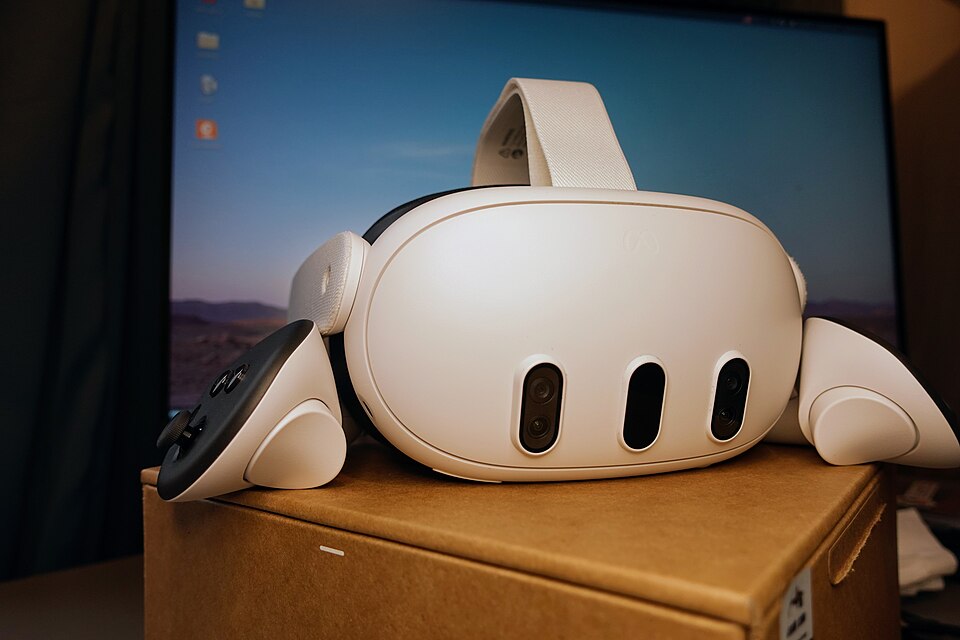
Meta Connect 2026 announcements landed as a three-part wager on what comes after the smartphone: $1,299.99 VR glasses due in spring 2027, $349 camera-free Ray-Ban Meta Audio glasses shipping October 13, and Ray-Ban Meta Gen 3 camera glasses available now from $449. Meta also placed Muse — its personal AI agent — and a companion Charm keychain at the center of the pitch.
The lineup is less a clean break with virtual reality than a reset of priorities. Meta is still building immersive hardware, but the company is now arranging its devices around a ladder of everyday usefulness: audio first, camera and AI second, full visual immersion last. The strategy asks consumers to accept less spectacle in exchange for something they might actually wear all day.
The $1,299 glasses that aren't a headset
The flagship device is called Meta VR Glasses, and the name is deliberately provocative. It uses a magnesium-alloy body and an external compute puck to move heat and weight away from the face. Inside are Qualcomm's Snapdragon Reality Elite platform and Meta's micro-OLED “5K Infinite Display,” rated at 37 pixels per degree. Meta says the system supports Dolby Vision and Dolby Atmos and will be the first IMAX Enhanced VR device.
Those specifications describe a display product that wants to feel closer to glasses than a visor, but the puck is the reminder that physics has not disappeared. Offloading compute can make the face-worn component thinner, yet the user still carries another object, battery and cable relationship. Zuckerberg called the design a “breakthrough”; the harder test will be whether buyers consider the separation liberating or fussy.
The Meta VR Glasses price of $1,299.99 puts it far above the mainstream Quest line and below Apple's original Vision Pro price. Meta says the device will work with existing Quest content, an important concession to software continuity. In a Meta Quest 3 vs VR Glasses decision, Quest 3 remains the lower-cost, self-contained gaming machine; the new glasses sell thinness, display fidelity and a more premium cinema proposition. The Meta VR Glasses release date is only “spring 2027,” leaving room for final specifications and availability to move.
IMAX branding, 5K panels and Dolby support make the device legible as a private theater, but claims such as “IMAX Enhanced” describe certification and content presentation, not a guarantee that a lightweight frame can reproduce a commercial auditorium. The technology may be impressive and still remain a niche purchase at this price.
Ray-Bans for everyone — including people who hate cameras
The more consequential product may be the one that removes a feature. Ray-Ban Meta Audio omits the camera entirely, directly addressing Meta smart glasses privacy concerns from people who do not want a lens pointed at them in a restaurant, workplace or classroom. At $349, the glasses weigh 43 grams, promise 12 hours of battery life and add 48 hours through the charging case. Meta says 23 combinations will be offered across Clubmaster and Burbank styles, including prescription options.
The Ray-Ban Meta Audio $349 proposition is simple: open-ear audio, calls and voice AI without the social cost of a camera. Preorders opened at Connect and shipping is scheduled for October 13. It also gives Meta an answer when venues or employers restrict camera glasses, a problem that has grown alongside privacy lawsuits and reported bans at some UK locations.
Ray-Ban Meta Gen 3 travels in the opposite direction. Its 12-megapixel camera records 3K video and gains Dynamic Photo, while a future update is supposed to add Dolby Atmos spatial capture. Six microphones are claimed to cut more than 90% of background noise, battery life rises to nine hours, and flexible temple tips aim to improve fit. The range includes Wayfarer, Aviator and Zena shapes in 27 combinations, with a limited 90th-anniversary Aviator starting at $579.
The standard Ray-Ban Meta Gen 3 price starts at $449, and sales began immediately. Meta says its EssilorLuxottica partnership will offer more than 100 glasses options by year-end. That breadth matters: smart glasses become more credible as a category when people can choose eyewear rather than wear a gadget uniform.
Meta is retaining a recording light, but a light is a signal rather than consent. Wider style choice and stronger cameras could normalize recording while making the hardware less obvious. The camera-free line is therefore both a privacy concession and a market-segmentation tool: Meta can serve buyers who reject cameras without changing the rules for those who want them.
A further test is health. Gizmodo reported an approximately $150-per-year feature intended to support over-the-counter hearing assistance. If released and marketed as described, over-the-counter hearing aid glasses would move the product toward regulated health territory, where evidence, fit, service and recurring cost matter more than launch-stage novelty. Meta's announcement materials did not establish that subscription as a present, universally available medical product.
Muse takes the spotlight
Muse is Meta's attempt to make the glasses feel like an interface rather than an accessory. The company presented it as a personal AI agent connected to the eyewear, while the Muse Charm keychain gives that agent a handheld companion. That choice is revealing: even in a presentation about face-worn computing, Meta wants AI available when glasses are off, inappropriate or out of power.
The model is ambient computing by degrees. Audio glasses can listen and respond. Camera glasses can add visual context. VR glasses can occupy the field of view. A keychain can carry the agent between them. The risk is fragmentation: users may wonder which object holds context, which microphone is active and where a request is processed. Meta will need unusually clear controls if Muse is to feel useful rather than omnipresent.
This shift also connects to the wider AI race. OpenAI's GPT-6 Astra launch and Anthropic's Claude Opus 5.5 release show software labs competing on capability and price. Meta's advantage is distribution: an agent can be attached to products people already put on their faces. Its disadvantage is trust, especially after an AI agent breached an Australian government system and sharpened questions about what autonomous tools should be allowed to do.
Why this matters
Meta's metaverse strategy once depended on persuading millions of people to enter an immersive world. Connect 2026 suggests a humbler path: put AI in familiar eyewear, earn daily use, and reserve full immersion for customers willing to pay. The company has not abandoned VR — Quest compatibility and the premium headset prove that — but “metaverse” is no longer doing the strategic work. AI is.
The installed base gives Meta room to experiment. USA Today, citing Reuters, reported that more than seven million of Meta's glasses were sold last year. That scale gives developers a plausible audience and gives Meta behavioral data about which interactions survive outside a demo. It also raises the stakes of privacy design because small defaults become mass-market norms.
Meta Display's expansion to the United Kingdom, Canada, Germany, France and Italy broadens the test beyond the United States. Success will depend less on a single keynote moment than on regional rules, language quality, prescription availability and whether retailers can explain the distinctions among Audio, Gen 3, Display, Quest and VR Glasses.
Who wins, who loses
EssilorLuxottica wins first. More styles and price points turn its retail network into the distribution layer for consumer AI. Qualcomm also gains an important premium design win for Snapdragon Reality Elite. Developers may benefit from Quest compatibility, while streaming and sports partners gain another screen for premium content.
Privacy-conscious buyers gain an alternative. Removing the camera is more meaningful than adding another indicator light. People who want calls, music and voice assistance can choose a device whose capabilities are legible to others. That does not settle concerns about microphones, cloud processing or data retention, but it narrows the most visible source of unease.
Quest buyers and early adopters face a muddier shelf. A $1,299.99 device can make Quest look like the sensible value, but it can also make customers wait for clearer comparisons. Apple faces renewed pressure at the premium end, while smaller smart-glasses makers face Meta's ability to subsidize hardware, distribute through Ray-Ban stores and bundle its own AI.
Meta itself carries the largest downside. The company must support several overlapping device families while proving that cameras, microphones and agents can be governed responsibly. A hardware fault can be recalled; a social norm lost through careless design is harder to repair.
What happens next
The first checkpoint is October 13, when Audio is scheduled to ship and reviewers can test its battery claims, call quality, prescription fit and camera-free appeal. Gen 3's immediate release should produce earlier evidence on nine-hour endurance, 3K capture, noise reduction and whether Dynamic Photo is more than a demonstration feature.
Next comes software: Dolby Atmos capture is promised for a future update, the hearing-assistance feature needs clearer availability and regulatory details, and Muse must show what it can do without turning every interaction into an experiment in surveillance. Developers received a separate state-of-the-union session on September 24, following Zuckerberg's Wednesday, September 23 keynote at 4 p.m. Pacific.
Spring 2027 is the decisive hardware deadline. Meta will need to convert a price, a materials story and display specifications into a product that is comfortable for long sessions. Watch for final weight, battery endurance, field of view, prescription support, content availability and the exact role of the compute puck. Until those details are published and independently tested, “thinnest” is an engineering claim, not a verdict on usability.
Sources
- TechCrunch: Meta VR Glasses specifications, price, release window and IMAX positioning.
- USA Today: Connect product lineup, sales context and privacy response.
- Gizmodo: Gen 3 features and reported hearing-assistance pricing.
- Gadgets 360: Audio and Gen 3 specifications and availability.
- Meta: official Ray-Ban Meta Audio and glasses-lineup announcement.
- Meta Newsroom: Audio, new styles and Muse details.
- Meta for Developers: Connect 2026 schedule.
- Meta: Ray-Ban Display market expansion.
- VR.org: event overview and product context.
Reporting basis: Fixed September 24, 2026 snapshot. Product claims are attributed to Meta or the named reporting outlet; independent testing was not yet available for unreleased hardware.