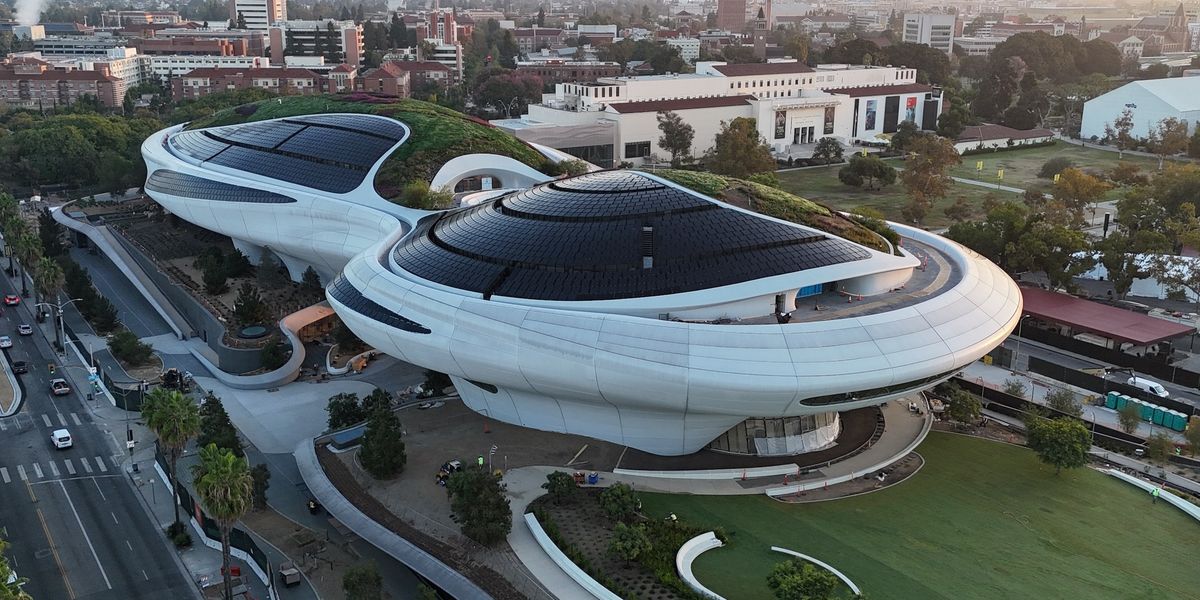
A new institution with an old question
The Lucas Museum of Narrative Art opens September 22 in Exposition Park after an investment of about $1 billion. The building spans roughly 300,000 square feet, with more than 100,000 square feet of galleries and an opening display of about 1,200 to 1,300 works drawn from a much larger collection. Its premise is expansive: illustration, comics, cinematic design, painting and popular imagery belong in one conversation because they all shape how societies tell stories.
Why this matters
Museums organize prestige as much as objects. By placing commercial illustration and film design beside established fine-art forms, the Lucas Museum challenges hierarchies that have often treated narrative popularity as evidence of lesser seriousness. The experiment could broaden museum audiences and scholarship. Critics will ask whether a founder-driven collection can avoid becoming a monument to taste or franchise. The answer will be found in curatorial argument: how rigorously the museum connects objects, histories and power rather than simply celebrating recognition.
Tickets and reservations
Adult admission is $25 and senior admission $21. Visitors under 18, active-duty military members, EBT holders and qualifying residents of ZIP code 90037 are eligible for free admission. A timed reservation is required; walk-ins are not accepted. Because opening-week demand is likely to be high, reserve before traveling and confirm eligibility documentation. A free ticket still needs a time slot. Build flexibility around entry rather than assuming late arrival will be absorbed.
Hours and the opening-day exception
Regular hours are Monday, Wednesday and Thursday from 10 a.m. to 5 p.m.; Friday from 10 a.m. to 9 p.m.; Saturday from 9 a.m. to 9 p.m.; and Sunday from 10 a.m. to 5 p.m. The museum is normally closed Tuesdays, but opens on Tuesday, September 22 for its debut. Always verify the date-specific calendar before departure, especially around the opening period and holidays. Late Friday or Saturday hours may offer more breathing room after the first rush.
Getting there
Exposition Park is served by Los Angeles public transit, including the E Line’s Expo Park/USC area. Transit avoids event-day parking competition from nearby institutions and venues. Drivers should reserve extra time for freeway variability and parking searches, particularly on weekends. Rideshare drop-offs can also slow around major openings. The practical rule is to plan arrival at the park at least thirty minutes before the ticket time, then allow for security, wayfinding and the walk through the grounds.
Best time, length and what to expect
For quieter galleries, choose the earliest weekday entry after the opening surge; for schedule flexibility, use the extended Friday or Saturday window. Plan three to four hours for a first visit, longer if you read labels closely or explore the landscape. Expect a broad visual-culture museum, not a Star Wars attraction. Famous cinematic objects may be present, but the curatorial frame is storytelling across media. Families should decide on a few priority galleries rather than attempting every room.
Safety, etiquette and what to bring
Bring the reservation, qualifying ID for discounted or free admission, a fully charged phone and a light layer for cool galleries. Wear comfortable shoes; the scale of the building and park adds distance. Follow posted photography rules, keep flash off where prohibited and avoid blocking works for extended photo sessions. Food and large-bag policies should be checked before arrival. Exposition Park is a busy urban destination: keep belongings secure and use well-trafficked routes after late hours.
Winners, losers and critics
Los Angeles gains another major cultural anchor, Exposition Park institutions may benefit from shared visitors, and scholars gain access to a large narrative-art collection. Nearby businesses can gain traffic, while residents may experience congestion. Traditionalists may question the canon; popular-culture fans may be disappointed if they expect a franchise shrine. The productive middle is a museum confident enough to treat popular images critically. Its success will depend on repeat visits, rotating exhibitions and access—not opening-week spectacle alone.
What happens next
The first months will test timed-entry capacity, gallery circulation and whether the collection’s breadth reads as coherent. Watch how frequently works rotate and how the museum collaborates with schools and neighboring institutions. A strong opening can create curiosity; a durable museum must convert that curiosity into public habit. Visitors should treat the first trip as an introduction, not a completion exercise. With more than 100,000 square feet of galleries, selectivity will make the visit richer.
The evidence test
This report separates the dated facts from the interpretation built around them. For “George Lucas’s $1 Billion Museum Opens Tuesday in Los Angeles: Your Complete Visitor Guide,” the strongest evidence is specific: official decisions, published results, dated market or schedule figures, and reporting that identifies what is known. A headline can be directionally accurate while still overstating certainty. Readers should therefore distinguish a confirmed event from a forecast, and a forecast from a scenario. That discipline is especially important in travel / los angeles, where a single update may change the practical outlook without changing the underlying structure.
What would change the conclusion
Good analysis should be falsifiable. The argument here would need revision if later primary records contradict the reported figures, if the timetable moves, or if the actors behave differently from the incentives described above. Pay particular attention to a new institution with an old question, why this matters, tickets and reservations. These are not decorative subthemes; they are the mechanisms connecting the headline to consequences. An update that changes one of those mechanisms deserves more weight than a new quotation that merely repeats an established position.
Who has agency
Events are often described as if they happen to a passive public, but institutions, firms, officials, workers, consumers and communities make choices within constraints. The powerful can set rules and timing; less powerful groups can adapt, organize, substitute or refuse. Evaluating agency prevents two errors: assuming leaders control every outcome, and assuming nobody can alter the path. In this story, the distribution of bargaining power matters as much as the most visible announcement, because implementation happens through many smaller decisions after attention moves elsewhere.
First-order and second-order effects
The first-order effect is the immediate change described in the headline. Second-order effects arrive through confidence, prices, staffing, regulation, supply chains, habits or institutional precedent. They are harder to measure and easier to exaggerate. The responsible approach is to identify the transmission channel and then look for evidence that it is operating. A plausible chain is not yet an observed result. This distinction keeps analysis useful without turning possibility into prediction, and it helps explain why some dramatic announcements fade while modest procedural changes compound.
The comparison problem
Numbers acquire meaning only against a baseline. The relevant comparison may be the previous year, a prior cycle, a peer institution, the size of the affected market or the share exposed rather than the headline total. Nominal levels can sound historic while representing a small percentage change; averages can conceal a few extreme observations. For this reason, the report uses comparisons to test scale instead of presenting figures as self-explanatory. When future updates arrive, compare like with like and preserve the original cutoff date.
What critics get right
Criticism is most useful when it identifies a missing mechanism, an excluded group or a cost shifted out of view. It is less useful when it simply predicts failure without conditions. Skeptics of the developments covered here are right to ask who verifies claims, who bears transition costs and whether short-term success can last. Supporters are right to ask what the realistic alternative would be. Holding both questions together avoids false balance: evidence can favor one conclusion while still acknowledging trade-offs and uncertainty.
Three scenarios, not one forecast
A base case assumes announced rules and schedules broadly hold. An upside case requires implementation to improve, uncertainty to fall and participants to respond constructively. A downside case begins when deadlines slip, trust weakens or a secondary shock compounds the first. Scenario thinking is not a way to avoid judgment; it clarifies which assumptions carry the conclusion. The most informative future report will identify which path is becoming more likely and why, rather than treating every new detail as a reversal.
The editorial judgment
The central conclusion is that the headline matters because it changes incentives, not because it guarantees an outcome. The facts reported today establish a new starting point. They do not erase history, settle criticism or make projections certain. Readers should keep the scale of the event in proportion, watch the actors with power to implement it and resist narratives built only from momentum. That is the difference between following a story and merely following its noise.
How to follow the next update
Return to the dated facts in this report before treating a new headline as a changed story. For “George Lucas’s $1 Billion Museum Opens Tuesday in Los Angeles: Your Complete Visitor Guide,” the decisive update will be one that changes implementation, scale or the distribution of costs—not another round of commentary about the same event. Check whether later reporting uses the same definitions and time period, whether it cites a primary record, and whether a projected effect has actually appeared. That approach preserves room for surprise while preventing a fast-moving news cycle from turning uncertainty into contradiction. We will revise the assessment when evidence changes the mechanism, not simply when attention moves.
Sources: FOX LA ticket and opening details; Travelers Today visitor information; The Post cultural overview; Travel and Tour World overview. Figures and schedules are a fixed September 18, 2026 snapshot and do not update live.