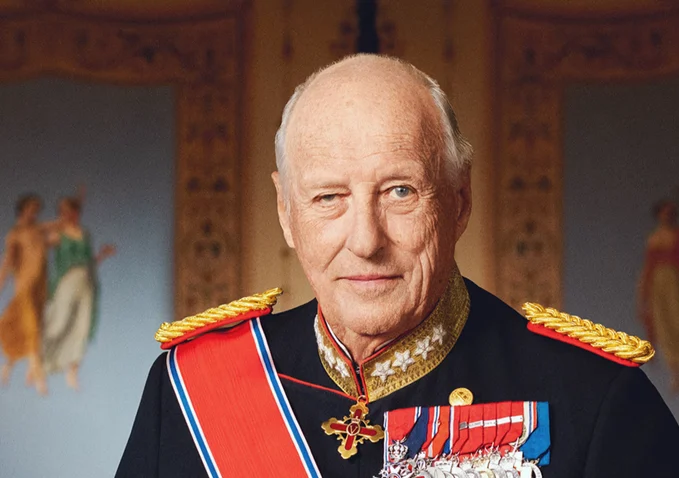
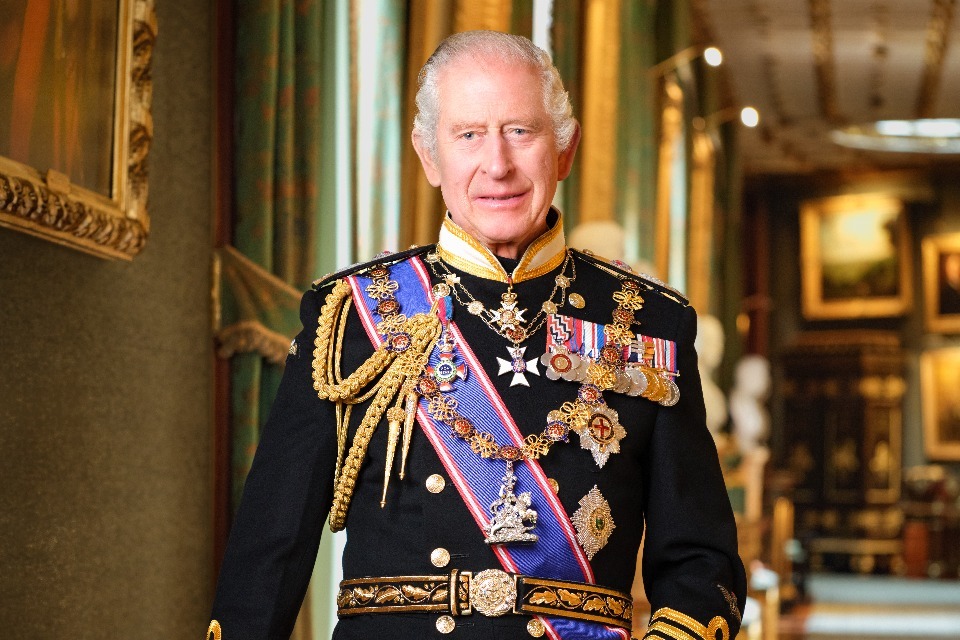
Harald died at Oslo University Hospital on August 28, aged 89, after admission for a rare blood condition. Under Norway’s constitutional order, Crown Prince Haakon became king immediately. On September 1 he swore the oath before the Storting, a parliamentary act rather than a coronation; Norway abolished coronations in 1908.
The state funeral at Oslo Cathedral brought together Norway’s political institutions and a wide group of royal and state representatives. Reuters and CNN reported attendance by Prince William, Princess Anne, Denmark’s King Frederik X and Queen Mary, Japan’s Crown Prince Akishino and Crown Princess Kiko, and Jordan’s King Abdullah, among others.
A public farewell
The coffin, draped in the royal standard, traveled from the Royal Palace after a service led by Presiding Bishop Olav Fykse Tveit. A 21-gun salute and an F-35 flyover marked the procession. Reporting citing the BBC estimated about 200,000 people along the route; the figure should be understood as an estimate, not a turnstile count.
The burial at the Royal Mausoleum at Akershus Fortress was private. That separation—public constitutional ritual followed by family burial—mirrored a reign often described as accessible but institutionally careful.
The new reign
Haakon inherits strong but not universal support. A Norstat poll reported on September 1 found 72% support for retaining the monarchy and 20% preferring a republic. Queen Mette-Marit missed the oath because of complications following a June lung transplant; coverage should stay within official medical statements rather than speculate about her prognosis.
Succession was automatic. Public trust will be earned over time.
Harald’s death also underscored the close links among Europe’s royal houses. The Danish royal couple postponed a Belgium state visit to attend, while William represented King Charles. Those gestures are ceremonial, but they are also diplomatic: royal funerals are rare moments when personal kinship and state representation occupy the same room.
Why this matters
A royal funeral is both mourning and a constitutional stress test. Norway’s seamless succession showed that the institution can transfer authority immediately while allowing ritual to unfold later. That distinction reduces uncertainty at the very moment emotion is highest.
How we got here
Norway abolished coronations in 1908, making the parliamentary oath—not a crowning ceremony—the central constitutional act. Harald’s 35-year reign built a style of accessible continuity; Haakon inherits that expectation rather than a blank office. The historical parallel is modern monarchy’s broader shift from sacred installation toward legal continuity and public consent.
Winners, losers and the skeptical case
The state benefits from procedural clarity, and Haakon begins with the sympathy attached to national mourning. Republicans can argue that hereditary succession remains incompatible with democratic equality, while monarchists point to the institution’s nonpartisan continuity. The family loses the privacy ordinary grief would receive, especially as attention turns immediately to the new king and queen’s health.
What the numbers actually imply
A reported 72% favored retaining the monarchy and 20% preferred a republic, a 52-point gap. That is strong support, not unanimity, and it represents one poll at the beginning of a new reign. The estimated 200,000 people along the funeral route measures participation in a historic farewell; it should not be treated as a referendum or compared directly with polling.
What happens next
Haakon’s first year will be judged on tone more than policy because the monarch does not govern. A stable scenario preserves support through careful visibility and constitutional restraint; a weaker one allows health concerns or family controversy to dominate. The most important long-term question is whether younger Norwegians experience the crown as useful civic continuity rather than inherited spectacle.
Sources: Succession and polling from Reuters, September 1; funeral details from Reuters, September 9 and CNN.