The Coronation of King Charles III took place on Saturday, May 6, 2023, at Westminster Abbey. The Archbishop of Canterbury conducted the service. It was the first British coronation in seventy years, but it did not mark the moment Charles legally became King. That happened immediately upon Queen Elizabeth II’s death on September 8, 2022.
A coronation is therefore an act of recognition and dedication rather than a condition of sovereignty. It places the monarch inside a religious, legal and historical tradition. The 2023 service retained the sequence that gives a British coronation its distinctive meaning while adjusting the scale and participation for a contemporary audience.
The procession to Westminster Abbey
The King and Queen traveled from Buckingham Palace to the Abbey in the Diamond Jubilee State Coach. The route moved through central London, and the service began at 11 a.m. Afterward, the larger Coronation Procession returned to the Palace with military participation from the United Kingdom, the Commonwealth and British Overseas Territories.
The coaches were more than transportation. They framed the service as a public event, linking the Palace, Parliament Square and the Abbey. The outbound journey used a modern state coach; the return used the historic Gold State Coach, turning travel through the city into part of the ritual.
Recognition and oath
Early in the service, the King was presented to the congregation and recognized as sovereign. The coronation oath then placed obligations before splendor. The monarch promised to govern according to law and to maintain the established religious settlement. In a constitutional monarchy, these words are not a personal platform. They express a Crown bounded by law.
The ceremony also emphasized service. The Church of England described the coronation as, at its heart, a service of Holy Communion. That context matters because the regalia are not simply luxury objects; they are used within a Christian liturgy about duty, justice and stewardship.
The anointing at the center
The anointing is the most sacred part of the ceremony and was screened from public view. The Archbishop anointed the King with holy oil, drawing on biblical traditions of setting a ruler apart for service. Its privacy created a pause between the public recognition of the sovereign and the visible presentation of regalia.
That sequence changes the meaning of the spectacle. The crown comes after promises and anointing, not before them. The theology places responsibility ahead of status, even when the visual memory of the day is dominated by gold, uniforms and jewels.
The crown is the climax of the service, but the oath and anointing explain what the ceremony says the Crown is for.
Orb, sceptres and St Edward’s Crown
During the investiture, the King received objects representing different dimensions of sovereignty. The Sovereign’s Orb evokes the Christian world. The sceptres point to authority, justice and spiritual responsibility. The coronation ring signifies commitment, while the robes and spurs connect the service to older traditions of chivalry and office.
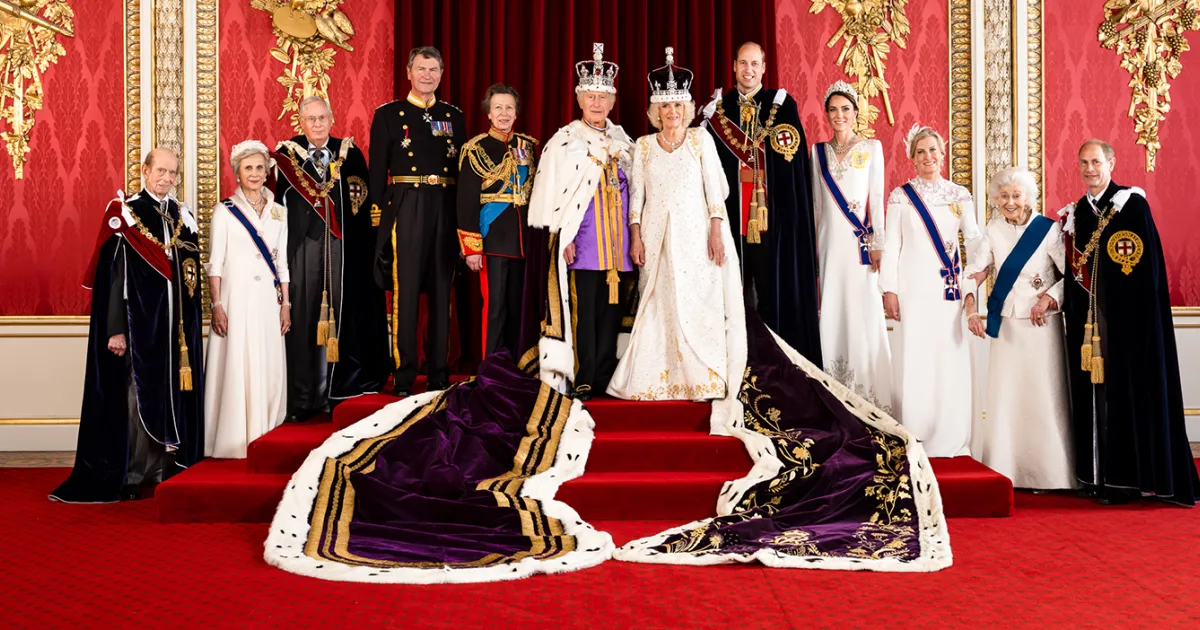
St Edward’s Crown was placed on the King’s head for the crowning itself. It is the ceremonial crown reserved for coronations. The Imperial State Crown, more familiar from the State Opening of Parliament, was worn later. Keeping the two distinct helps explain why official portraits may show different crowns and robes.
Queen Camilla’s crowning
Queen Camilla was also anointed and crowned. She wore Queen Mary’s Crown, adapted for the service. The joint coronation connected her public role to the King’s while preserving a distinct sequence for the consort.
The official portraits made after the service were taken by Hugo Burnand in Buckingham Palace’s State Rooms. In the group portrait, the King and Queen stand with members of the working Royal Family. It is both a family image and an institutional one, identifying the smaller group carrying out public duties in the new reign.
What was modern about the 2023 ceremony?
The coronation remained explicitly Christian and rooted in longstanding forms, but its presentation widened the circle of participation. Representatives of communities and public service were visible alongside hereditary and ceremonial figures. The weekend also extended beyond the Abbey through a concert, community lunches and volunteering.
Modernization did not erase the ceremony’s constitutional tensions. A hereditary sovereign was crowned in a democratic country with growing religious diversity and active debate about monarchy. The service responded by centering service, legal obligation and community, while retaining symbols whose meanings come from a much older settlement.
Why the coronation still matters
For supporters, the ceremony joins continuity with public promise. For critics, it raises questions about privilege, cost and the place of an established church. Both readings are part of the event’s significance. A coronation is not only pageantry; it is a country showing itself how authority is imagined and limited.
King Charles III’s coronation will ultimately be read against the reign that followed. The service supplied a vocabulary — law, duty, faith, stewardship and service. History will judge how convincingly the institution lived by it.
Why this matters
A coronation converts inherited succession into public ritual. It does not create the monarch, but it tells the country what the institution claims to represent. Every change in language, guest list and ceremony therefore becomes a negotiation between sacred continuity and contemporary legitimacy.
How we got here
British coronations preserve medieval symbols while repeatedly adapting to political and religious change. The 2023 ceremony followed a much longer televised predecessor and took place in a more plural, skeptical society. Historical parallel matters here: tradition survives not by remaining untouched, but by being edited carefully enough that continuity still feels recognizable.
Who benefits, who loses and what critics say
The state and tourism economy gain a global civic spectacle, and supporters gain a shared ritual. Taxpayers bear costs, faith minorities may question inherited Anglican centrality and republicans see ceremony legitimizing unequal power. Defenders argue that constitutional symbolism cannot be valued only as a commercial transaction; critics respond that symbolism is exactly where accountability matters.
What the comparison implies
A shorter, more inclusive ceremony than 1953 signals adaptation, but visual scale can still communicate distance. Comparing length or attendance alone misses the question of meaning: which elements were retained, which voices were added and what obligations the service placed on the sovereign. Change at the margins may be symbolically important without altering the constitution.
What happens next
Future coronations will face stronger pressure for interfaith inclusion, lower cost and clearer public purpose. The institution can either use ritual to explain service or rely on inherited spectacle. The 2023 model is likely to become a bridge rather than a final template, especially as broadcasting and national identity continue to change.
Primary sources: The date, setting and public weekend are documented by The Royal Family’s Coronation Weekend record. The religious structure is explained by the Church of England. Portrait details come from the official Coronation portraits release.