Science / Environment — Coral reefs face collapse by 2075 almost everywhere on Earth: the first global IUCN assessment of reef ecosystems classifies 96 percent of them as critically endangered once future warming is counted, up from 24 percent on the damage already done.
Coral reefs face collapse by 2075 — not in one ocean, not in the worst-hit regions, but across almost the entire planet. That is the conclusion of the first global assessment of coral reef ecosystems by the International Union for Conservation of Nature (IUCN), released on Thursday, October 22, on the sidelines of the United Nations COP17 biodiversity summit in Yerevan, Armenia. The assessment examined 127 tropical and subtropical reef regions covering 188,362 square kilometres of reef in more than 80 countries, drawing on more than 250 researchers worldwide. Judged only on the past 50 years of damage, 24 percent of those reef ecosystems are already critically endangered, the IUCN's highest risk category. Add the expected impacts of global heating, and the figure rises to 96 percent — 122 of the 127 ecosystems assessed.
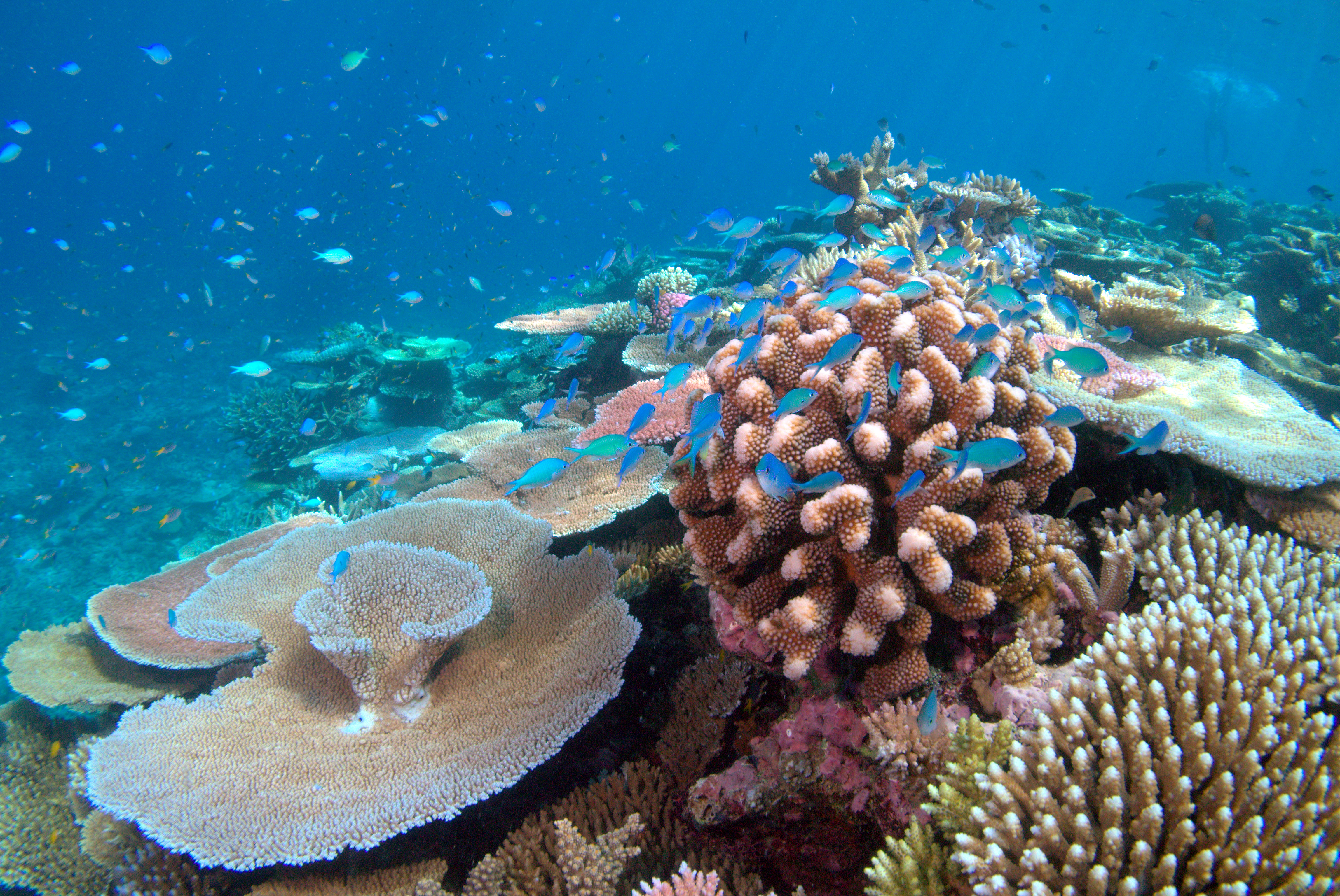
The names on the critically endangered list are the reefs the world knows best: Australia's Great Barrier Reef, the Coral Triangle of Southeast Asia and the western Pacific, the Caribbean's Mesoamerican Barrier Reef System, and the Red Sea reefs. All 17 Australian reef ecosystems assessed were classified as critically endangered. The remaining ecosystems were not evaluated for lack of data, but are probably just as vulnerable, IUCN's Marcos Valderrábano told New Scientist. In other words, 96 percent is not a worst case. It is the share of the reefs scientists could actually measure.
What "collapse" actually means
An ecosystem collapse is not a metaphor in the IUCN's Red List of Ecosystems framework; it is a defined end state. A reef collapses when its hard corals — the animals that build the reef's living foundation — largely disappear and are replaced by algae, rubble and sponges. The structure that took centuries to grow stops growing. The fish communities, invertebrates and larger animals the structure sheltered lose the architecture their lives are organised around. What remains is still wet, still blue, and still called a reef on the map — but it no longer functions as one.
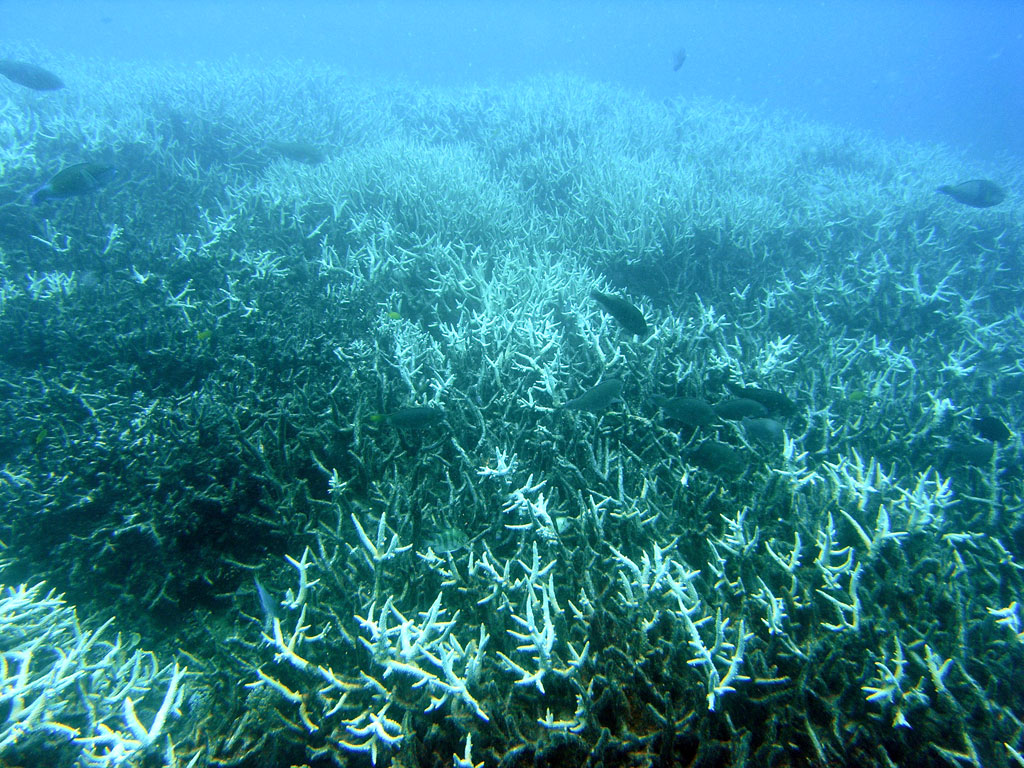
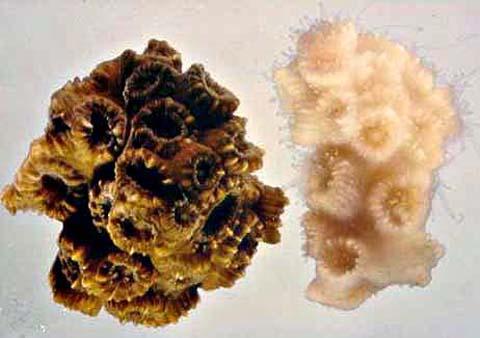
The driver is not mysterious. "Heat stress from climate change is the single most consistent threat driving coral reef decline worldwide," the IUCN said. Corals are heat-sensitive animals; when ocean temperatures spike, they expel the algae that feed them, turn white — bleaching — and can starve. The assessment used the UN climate panel's "middle-of-the-road" scenario, projecting warming of about 2.7°C above pre-industrial levels by 2100 with moderate emissions reductions. That matters for how the headline number should be read: this is not the runaway-emissions future. It is roughly the future the world is currently signed up for — the United Nations warned on Wednesday that existing commitments put the planet on track for about 2.6°C of warming this century.
The local threats that decide which reefs survive
Heat is the global driver, but it is not the only one, and the others are the levers governments actually control this decade. The overexploitation of parrotfish, groupers and other reef fish threatens 63 percent of reef ecosystems, the IUCN found: those fish graze the algae that would otherwise smother recovering coral, so a fished-out reef bleaches and then cannot come back. Coastal development, pollution and tourism pressure, and more frequent and intense storms compound the damage. Valderrábano said the assessment shows countries exactly where they need to protect reefs — by cutting fishing pressure and pollution — because a reef with its local stresses removed is a reef with a fighting chance of surviving the heat it cannot escape.
Why this matters
Start with the arithmetic of disproportion. Coral reefs cover about 1 percent of the ocean floor and support roughly 25 percent of all marine species. Up to a billion people depend on them — for fish protein, for tourism income, and for the storm and erosion protection a living reef gives a coastline for free. No other ecosystem on Earth carries that much life and that many livelihoods on that little area. Losing reefs is not losing scenery; it is removing the nursery habitat of a quarter of ocean life and the natural sea wall of hundreds of millions of coastal residents in the same event.
Then consider the timing. The ecosystem assessment lands one week after a companion IUCN reassessment, published in the journal Nature, found 44 percent of reef-building coral species — 340 of 774 assessed — threatened with extinction. That species study's data end in 2020, before the fourth global bleaching event of 2023–2025, the worst on record, which bleached 84 percent of the world's reefs. And it lands as the strongest El Niño on record builds toward 2026–27, the very pattern that supercharges marine heatwaves — a risk we have been tracking as the UN warns El Niño could act as a "wrecking ball" and in the research on a super El Niño's human toll. Read together, the three findings describe a system being squeezed from both ends: the long trend of warming raising the baseline, and the sharp El Niño spikes delivering the killing blows to reefs already weakened.
Who wins, who loses
There are no real winners in a reef collapse, but the losses are unevenly distributed, and that distribution is the politics of this story. The heaviest losses fall on tropical coastal nations — Pacific island states, Caribbean countries, Southeast Asian fishing communities — that did least to cause the warming and can least afford engineered sea defences or imported protein. Tourism economies built on reef diving, from Queensland to the Red Sea, face an asset that degrades on a schedule no marketing budget can reverse. Wealthier temperate nations lose fisheries and biodiversity too, but later and more diffusely. That asymmetry is precisely the argument now playing out at COP17 in Yerevan, where governments are under pressure to deliver on the global pact to halt and reverse biodiversity loss by 2030 — a deadline that arrives, on the IUCN's own numbers, with a quarter of reef ecosystems already in the highest risk category on past damage alone.
The case against despair — and its limits
The scientists who wrote this assessment are unusually insistent that it is a warning, not an obituary. "The risk of coral reef collapse is escalating, but this must be a wake-up call rather than a cause for despair," said Dr Mishal Gudka, the assessment's scientific lead, who is also research director at CORDIO East Africa. "Coral reefs have shown a remarkable ability to bounce back from devastating bleaching events. Pockets of surviving, resilient coral reefs can remain in the future — but we must do everything within our reach to set them up for success." IUCN Director General Grethel Aguilar made the same point from the other direction: reefs in most parts of the world "are not yet lost," but saving them "requires decisive action to tackle climate change and halt further ocean warming," alongside stronger protection, restoration and sustained investment in reef communities.
There is real biology behind the hope. Research in Palau, in the Pacific, suggests some corals are gaining heat tolerance at roughly 0.1°C per decade — adaptation is happening, measurably. But the scientists attached to the assessment are equally clear about the limit: a severe heatwave can outrun that adaptation in a single season, which is why local protection is best understood as buying time for emissions cuts to work, not as a substitute for them. Interventions such as shading reefs or brightening clouds over them get mentioned in the scientific debate; none operates at anything like the scale of 188,362 square kilometres.
What happens next
Three things to watch. First, Yerevan: whether COP17 turns the assessment into named national commitments — fishing quotas, marine protected areas, pollution controls — or files it as another alarming report delegates praised and parked. Second, the El Niño now building: the 2026–27 event will be the first full-scale test of how much resilience the world's reefs have left after the 2023–2025 bleaching, and reef monitoring agencies will be reporting bleaching alerts in near-real time. Third, the gap between the two headline numbers: the distance between 24 percent (already critically endangered) and 96 percent (critically endangered with projected warming) is, in effect, the remaining decision space. Every tenth of a degree of warming avoided, and every local stress removed in the meantime, moves individual reef systems from the second column back toward the first.
The IUCN has now done the thing science can do: it has measured the cliff edge and published the distance. One percent of the ocean holds a quarter of its species and the livelihoods of up to a billion people — and on the world's current trajectory, almost all of it is at extreme risk of collapse within the lifetime of a child born today. Whether 2075 arrives as a date in a warning that worked, or as the answer to one that didn't, is the part of this story that is still being written.
Sources: AFP, October 22, 2026; The Guardian, October 22, 2026; New Scientist, October 22, 2026; University of Melbourne, October 22, 2026; IUCN press release, October 15, 2026.