Tropical Depression Nine is forecast to become the 2026 season's first hurricane and strike the northern Gulf Coast this weekend — just as No. 2 Georgia visits No. 6 Alabama, with President Trump in the stands.
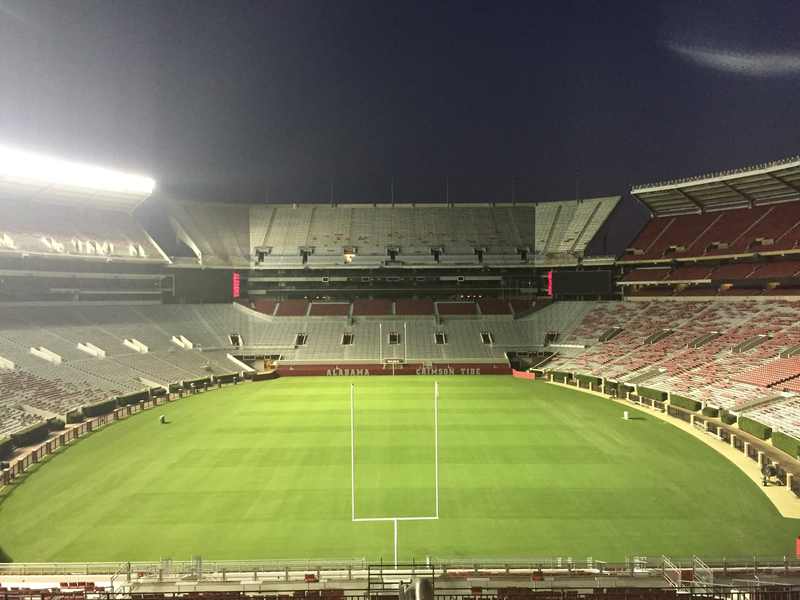
Tropical Depression Nine is churning in the southwestern Gulf of Mexico, and the Hurricane Isaias Alabama Georgia game question now hangs over Saturday's top-10 showdown in Tuscaloosa: could the Atlantic season's first hurricane force college football's biggest game of the year off the field — with President Donald Trump planning to watch from the stands?
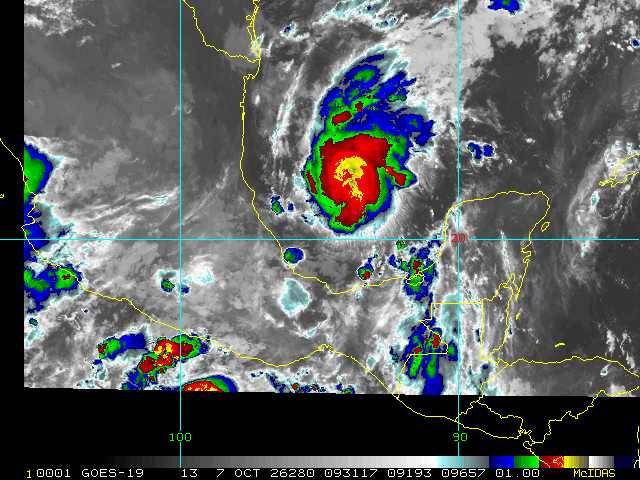
The National Hurricane Center's first discussion on the system, issued at 4:00 p.m. CDT Tuesday, placed the depression nearly stationary over the Bay of Campeche with winds of 35 mph and a central pressure of 1007 millibars. Forecasters expect it to become a tropical storm by Wednesday and a hurricane by Thursday, then turn sharply northeast on Friday and accelerate toward the northern Gulf Coast. Landfall looks most likely between southeast Louisiana and the western Florida Panhandle, and the early NHC outlook calls for a hurricane strike — possibly a Category 2 near 100 mph. The agency also stressed significant uncertainty in both the track and intensity forecasts. A NOAA Gulfstream jet was sampling the storm's environment Tuesday, with Hurricane Hunter flights scheduled to follow — the data gathered over the next 48 hours will decide how confident anyone can be about Saturday.
By Wednesday morning, the system had strengthened into Tropical Storm Isaias, with 40-mph winds about 600 miles south of the mouth of the Mississippi River, and the Hurricane Center forecast it to become the season's first hurricane on Thursday and reach Category 2 strength by Friday, CNN reported.
Why this matters
Three storylines are converging on one Saturday in one corner of the Gulf Coast, and each would be a major story on its own.
First, the football. No. 2 Georgia at No. 6 Alabama is the biggest regular-season game of the college football year — a collision of two playoff contenders that will shape the SEC race and the national bracket. A primetime ABC window, tens of millions of viewers, and ESPN's College GameDay on campus Saturday morning: this is the sport's center of gravity this weekend.
Second, the presidency. Trump announced last week that he will attend the game, and the Secret Service was on Alabama's campus Tuesday doing advance work. A presidential visit turns a football Saturday into a security operation — motorcades, airspace restrictions, a hardened perimeter — and every one of those plans now needs a hurricane contingency attached.
Third, the weather itself. If this system reaches hurricane strength, Isaias will be the first hurricane of the 2026 Atlantic season — the latest-developing first hurricane in more than a century. The season that refused to produce a hurricane is now threatening to aim one at the biggest weekend of the college football calendar.
The decision window is brutally short. Landfall is projected for Friday night into Saturday — essentially game day. By the time the forecast is confident, most of the 100,000-plus people involved will already be in motion.
How we got here: the quietest loud season on record
The 2026 Atlantic season has been a meteorological oddity. Through the first week of October, it had not produced a single hurricane. The main culprit, forecasters say, is a likely record-strong El Niño, which increases vertical wind shear across the Atlantic basin and makes it harder for tropical cyclones to organize — the same pattern that kept disturbance after disturbance from closing off a circulation all summer.
Tropical Depression Nine closed one off anyway. The system organized over the southwestern Gulf — the Bay of Campeche, a notorious hurricane nursery where warm, shallow water can spin up a storm in a hurry — and by Tuesday afternoon the Hurricane Center was writing its first discussion: 35-mph winds, 1007 millibars, barely moving.
What happens next follows a classic Gulf script with an unusual twist. The depression is expected to drift, strengthen into a tropical storm and then a hurricane, and then get picked up by an approaching trough and slung northeast — sharply, and fast — toward the northern Gulf Coast on Friday. That sharp turn is the whole ballgame: a few dozen miles of difference in where the turn happens decides whether the core comes ashore near New Orleans, near Mobile, or near Pensacola. The current Isaias hurricane forecast favors a hurricane-strength landfall somewhere between southeast Louisiana and the western Florida Panhandle, possibly as a Category 2 near 100 mph. But the Hurricane Center is explicit that confidence is low this far out — and if Isaias reaches hurricane strength after Thursday, it will break a record that has stood since October 8, 1905, the latest date on record for a season's first Atlantic hurricane, according to the National Weather Service.
Saturday in Tuscaloosa: what the storm could do to the game
The facts of Saturday are fixed — for now. No. 2 Georgia visits No. 6 Alabama at Bryant-Denny Stadium in Tuscaloosa, and kickoff for Alabama vs Georgia on October 10 is set for 7:30 p.m. ET on ABC. ESPN's College GameDay will broadcast from campus Saturday morning — College GameDay Tuscaloosa is officially on, for now. It is, by every measure, the game of the year in college football so far.
The threat is not that a hurricane strikes Tuscaloosa directly — the city sits roughly 200 miles inland — but that a Gulf landfall on Friday night or Saturday morning turns game day into a mess. Veteran Alabama meteorologist James Spann laid out the scenario to AL.com: a Category 1 or 2 landfall near Mobile Bay on Saturday morning would be, in his words, a "nightmare scenario," with 50-mph wind gusts, torrential rain, and isolated tornadoes all possible in the Tuscaloosa area. A soggy, gusty night game is one thing; tornado-warned tailgates and a stretched emergency-response picture are another. Spann said moving the game is "on the table."
Nor is football the only thing in the storm's path. Country star Zach Bryan is scheduled to play Auburn's Jordan-Hare Stadium on Saturday, and the National Shrimp Festival in Gulf Shores runs Thursday through Sunday. The entire northern Gulf Coast has a crowded weekend that a hurricane would not politely work around.
What officials are saying — and what they're not saying
Read Tuesday night's statements carefully, because the wording is doing a lot of work. Alabama Athletics said it is "closely monitoring the weather forecast for the weekend," adding: "At this time, there are no plans to alter the contest. We remain in communication with the Southeastern Conference office." The SEC said it is "keeping an eye on forecasts and staying in communication with schools."
Translation: the game is on, until it isn't. Nobody with authority will commit before the forecast firms up — and the forecast won't firm up until the reconnaissance data and the next model cycles weigh in over the next 48 hours. That is the rational posture, and an agonizing one for everyone trying to plan travel.
In Florida, Gov. Ron DeSantis declared a state of emergency for 25 counties on Tuesday, with emergency teams staging generators, fuel, food, water, and flood barriers around the Tallahassee and Santa Rosa areas, CNN reported. And the one concrete step reported out of Tuscaloosa: Fox News reported that the Secret Service was on Alabama's campus Tuesday doing advance work for the presidential visit. Whatever Saturday holds, the security footprint is already being built.
The Trump factor
Trump announced the trip himself on October 2, on stage at the Mitchell Center at the University of South Alabama in Mobile: "I'll be here again next Saturday to watch a football game between Georgia and Alabama," he told the crowd, according to Reuters. It fits a pattern — he attended the Texas-Tennessee game in Knoxville on September 26, and he was in the stands at Bryant-Denny for the Alabama-Georgia classic on September 28, 2024, a 41-34 Crimson Tide win. A White House release last month framed his college-football attendance as part of a broader push around college sports.
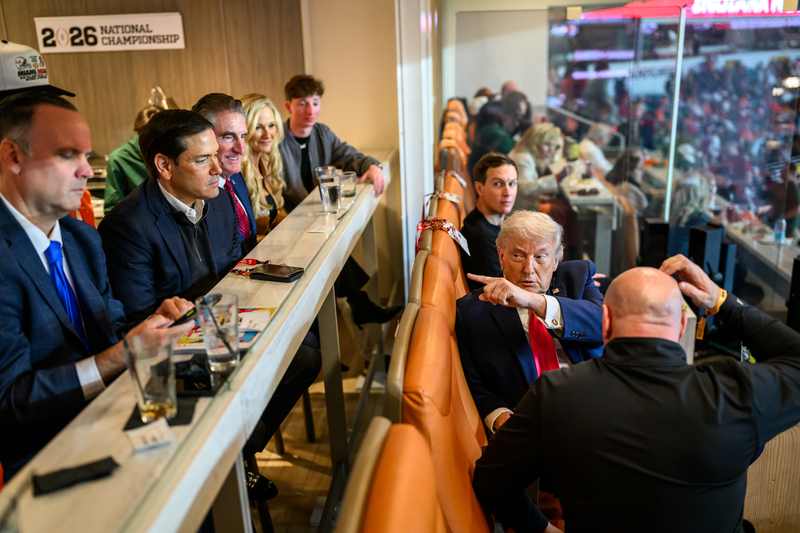
The Trump Tuscaloosa visit is the latest stop on a busy midterm-season travel schedule — one that recently included a San Antonio rally appearance alongside Senate candidate Ken Paxton.
There is one more wrinkle, reported here without embellishment: Knox News reports that Trump is also expected at an event at the F&M Bank Arena in Clarksville, Tennessee, on October 10 — the same day as the game — alongside Republican candidates. Both plans have been reported; no one has said which takes priority if the day's logistics compress. That is a fact about the schedule, not a prediction about it.
Strip away the politics, and the analysis is logistical, not ideological. A presidential visit converts a football game into a national-security event, with a perimeter, airspace controls, and a motorcade plan. Layer hurricane emergency management over the same geography on the same day, and the number of parties that must agree on a single plan — university, conference, city, state, federal security, broadcasters — becomes very large, very fast.
Who wins, who loses — and what the skeptics say
If the game moves, the losses stack up quickly. Tuscaloosa's game-day economy — hotels booked solid for months, restaurants, bars, merchandise — takes a direct hit. Tens of thousands of Georgia fans with flights, hotels, and tickets face a scramble. ESPN and ABC lose, or must rebuild, a primetime window built around the season's marquee matchup. The playoff picture absorbs chaos either way.
If the game stays put and the storm underperforms, the winners are everyone who kept their plans — and the skeptics get to say they told you so. The skeptics deserve a fair hearing: it is only Wednesday. The forecast cone is wide. Gulf storms wobble, and a 50-mile jog in either direction at landfall changes everything for Tuscaloosa. Acting too early strands 100,000 plans for a storm that never comes; acting too late strands 100,000 people in one that does. Both errors are expensive, and the people paid to choose between them know it.
The SEC has been here before. The conference has moved four games for hurricanes in the last ten years, and that history is the closest thing to a playbook anyone has.
The numbers behind the decision
Put the figures in context. The system started Tuesday at 35-mph winds; the early outlook has it near 100 mph — Category 2 — at landfall. That is nearly a threefold increase in wind speed, which means roughly a ninefold increase in destructive potential, in about 72 hours. Rapid intensification over the Gulf's warm waters is the scenario forecasters lose sleep over, and it is explicitly on the table.
Timing is the other number that matters. A Friday-night-into-Saturday landfall with a 7:30 p.m. ET Saturday kickoff leaves almost no margin: even the better version of the Spann scenario — the core stays well south — still puts Tuscaloosa in bands of heavy rain and tropical-storm-force gusts on game day. The Saturday-morning outdoor GameDay set, tens of thousands of tailgaters arriving at dawn, and a night kickoff each become separate go/no-go decisions.
The precedent numbers: in 2016, Hurricane Matthew pushed Georgia-South Carolina to Sunday and postponed LSU-Florida outright; in 2022, Hurricane Ian moved South Carolina-South Carolina State to Thursday and Florida-Eastern Washington to Sunday. The SEC hurricane contingency playbook exists, and it has been used at every scale from a day-shift to a full postponement.
Three scenarios for Saturday
If you're asking whether the Alabama Georgia game moved — as of Wednesday morning, it had not. Here is how that could change, and what each path means.
1. The game goes ahead as scheduled
The storm jogs east toward the Florida Panhandle or weakens on approach; Tuscaloosa gets rain and gusts but nothing that forces anyone's hand; 7:30 p.m. ET arrives with GameDay having done its morning show and the presidential visit proceeding as planned. This remains the base case: the game is on, and the burden of proof is on the forecast to change that.
2. The kickoff moves
A time shift — earlier Saturday, or a slide to Sunday — preserves the game while dodging the worst weather. Television windows get rebuilt, GameDay adjusts, and tens of thousands of travel plans bend without breaking. The 2016 and 2022 precedents show the conference will do this when the forecast demands it. For the playoff race, a moved game is a logistical headache but a competitive non-event — as long as it gets played.
3. Postponement
The LSU-Florida 2016 route: the game doesn't happen this weekend at all. Rescheduling a top-10 SEC game mid-season is a calendar nightmare — open dates are scarce, and where the game lands could shape playoff seeding for both teams. This is the last resort, and everyone involved will exhaust the first two options before touching it.
What happens next
Watch the next 48 hours. The Hurricane Center issues full advisories every six hours; the reconnaissance data flowing in Wednesday and Thursday will either tighten the forecast or blow it open. Alabama and the SEC will stay noncommittal until the models converge — expect the real decision window to run Thursday into Friday. If the storm stays on its current track, expect hurricane watches on the northern Gulf Coast as early as Wednesday.
If you have tickets, hotel rooms, or a tailgate plan: don't cancel anything yet, but know exactly what your backup is. As of Wednesday morning, the game is on. But from here on, the forecast — not the calendar — is in charge of Saturday in Tuscaloosa.
Sources
- Reuters: Trump says he will attend Georgia-Alabama game
- Fox News: Hurricane Isaias threatens Georgia vs. Alabama showdown as Trump plans Tuscaloosa visit
- New York Post: Possible hurricane threatens Alabama-Georgia game Trump is slated to attend
- Sports Illustrated: Alabama ready for storm, external factors surrounding Georgia game
- On3: SEC releases statement on potential Hurricane Isaias
- WTUG: Kickoff time unchanged for Alabama-Georgia; Alabama statement, NWS webinar, SEC precedent
- Naples Daily News: NHC forecast detail on the Gulf system
- CNN: Tropical Storm Isaias forms, Gulf Coast on alert; DeSantis emergency declaration
- Gizmodo: The Atlantic's record-late first hurricane may be brewing in the Gulf
- The White House: President Trump calls on Congress to save college sports