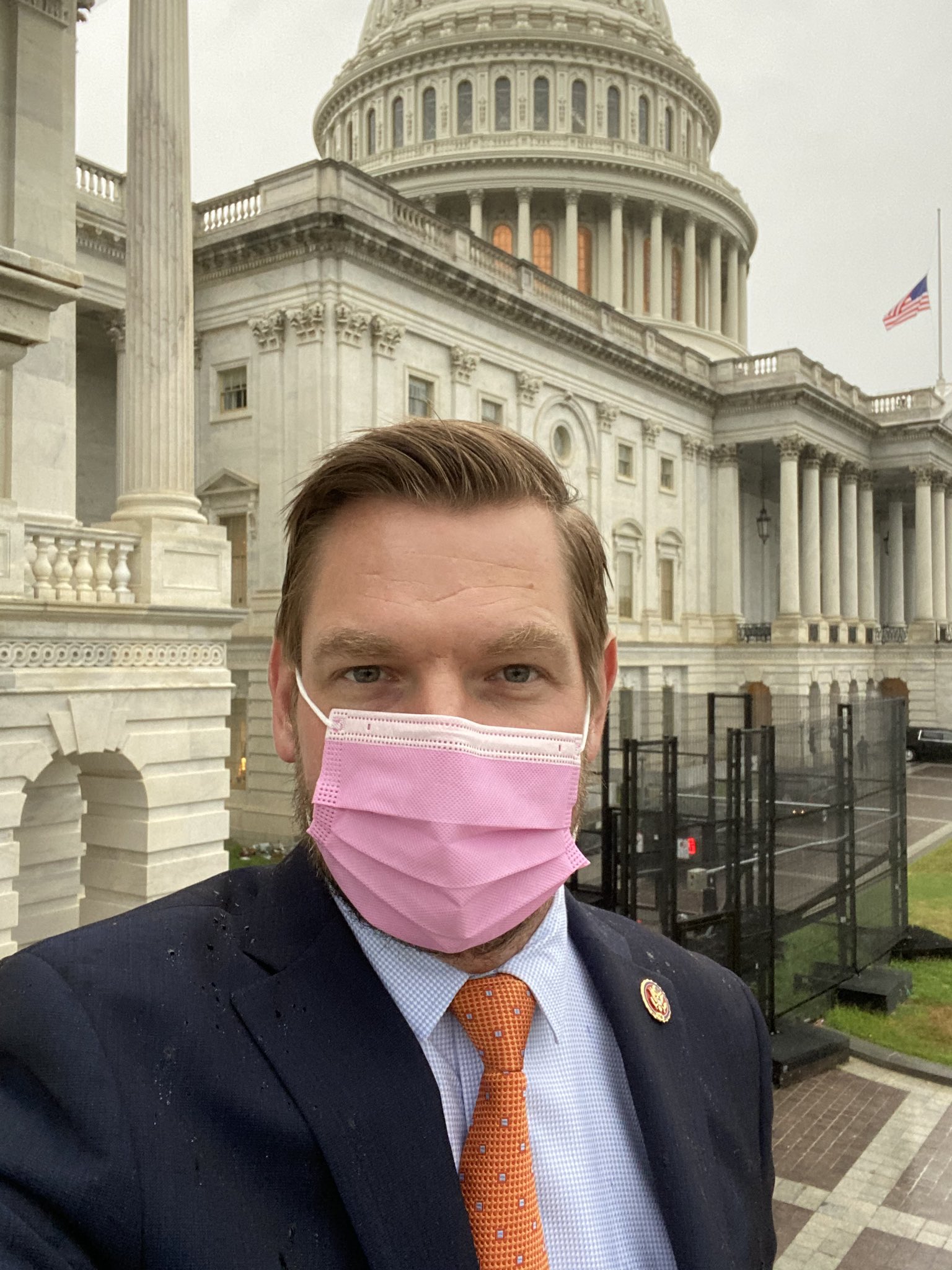
The FBI raids Swalwell donor mansion story that broke over Los Angeles on Tuesday morning is, on its surface, a single search warrant executed at a single expensive address. Federal agents arrived at around 7 a.m. at a mansion on North Roxbury Drive in Beverly Hills, near Benedict Canyon Drive, and searched the home of Stephen Cloobeck — the billionaire timeshare magnate who was, until April, one of the most important financial backers of former Rep. Eric Swalwell. Nobody was arrested. Cloobeck was not home. And the FBI, in its only public words on the operation, said it had conducted "an operation in the Los Angeles region related to an ongoing criminal investigation" and had no further comment.
But a search of a donor's home is never just a search of a donor's home. According to a senior law enforcement official who spoke to Reuters, agents were looking for electronic devices and records pertaining to prostitution, as part of the ongoing federal investigation into Swalwell — the former Democratic congressman who resigned his House seat and abandoned his campaign for California governor in April after four women accused him of sexual misconduct. Swalwell has denied the allegations, apologised for what he called "mistakes in judgment," and vowed to fight them. Nothing about Tuesday's search changes his legal position on its own. What it changes is the shape of the investigation: it is no longer only about what is on Eric Swalwell's own phone. It is now about the houses he stayed in, the people who bankrolled him, and the records they kept.
What happened on Roxbury Drive
The basic facts are confirmed by multiple independent news organisations. The FBI searched the Beverly Hills mansion on Tuesday morning, October 27, in connection with its investigation into Swalwell, according to Reuters, CNN, USA Today, People and the New York Post. CNN, citing two people familiar with the probe, identified the homeowner as a Swalwell donor; USA Today, citing the Los Angeles Times and Fox News, named him as Stephen Cloobeck and placed the search on North Roxbury Drive. People, citing KABC, put the arrival at around 7 a.m. Beverly Hills police were visible alongside federal agents outside the property.
What agents were seeking is known only in outline. Reuters' law-enforcement source said the search targeted electronic devices and records pertaining to prostitution. The New York Post, citing its own senior law-enforcement source, reported the raid was connected to a sex worker, without further detail. Neither Cloobeck's attorneys nor Swalwell's responded to requests for comment, Reuters reported — a silence that is normal at this stage of a federal investigation and proves nothing either way, but which leaves the public record, for now, entirely in the hands of anonymous officials and the agents seen going through the door.
Who is Stephen Cloobeck?
Cloobeck, 64, built his fortune as founder and chief executive of Diamond Resorts International, the timeshare company he sold to Apollo Global Management in 2016 for a reported $2.2 billion. He briefly ran for California governor himself last year, never rose above roughly 1 percent in public polling, withdrew, and threw his money and his mansion behind Swalwell instead. California campaign-finance records show he gave $1 million on March 13 to an independent expenditure group supporting Swalwell's gubernatorial campaign, CNN reported. During the campaign, Swalwell stayed at the Beverly Hills home repeatedly and used it for political events. When the allegations against Swalwell became public, he retreated to the house — and recorded one of his last videos denying them there.
The alliance did not survive the scandal. "I am no longer associated with a man that takes advantage of women," Cloobeck said when he cut ties in April. "I support women's rights." Nor is Cloobeck himself a stranger to law enforcement this year: in May, the Los Angeles County Sheriff's Department arrested and charged him with attempting to prevent or dissuade a victim from testifying, the New York Times reported — a detail, noted by USA Today, that gives Tuesday's search a second, uncomfortable dimension. A donor under his own legal cloud, whose home hosted a candidate now under federal investigation, is exactly the kind of node in a political network that federal agents eventually reach.
How the Swalwell investigation got here
To understand why a donor's mansion matters, rewind six months. Swalwell — a former prosecutor, a fixture of cable news during the Trump impeachment era, and a one-time presidential candidate — was running in California's crowded Democratic primary for governor when reporting by CNN and the San Francisco Chronicle detailed allegations of sexual misconduct against him, including a former staffer who said he had raped her. In total, four women accused him of conduct ranging from sexual assault to sending unsolicited explicit images. In April, he suspended his campaign and resigned his congressional seat.
The criminal machinery followed. Local law-enforcement agencies in New York and Los Angeles announced investigations into the alleged assaults. The Department of Homeland Security said it had looked into an allegation that Swalwell illegally employed a Brazilian nanny. And in August, the federal investigation became unmistakably visible: FBI agents served Swalwell with a search warrant as he deplaned at San Francisco International Airport and seized his electronic devices, including his cell phone and laptop. The next day, agents entered his Washington, D.C. home — the family was not there — and searched it as well.
Tuesday's search is the third public escalation, and the first aimed at someone other than Swalwell himself. That is the detail investigators, defense lawyers and political operatives will all read the same way: when the FBI stops searching only the target's property and starts searching the property of the target's associates, the investigation has usually moved from establishing what happened to establishing who knew, who kept records, and what those records say.
Why this matters
There are three distinct reasons this raid reaches beyond one mansion. The first is legal, and it is about evidence. Modern federal investigations run on devices and records, and campaigns run on them too. A candidate who lived part-time in a donor's house, staged events there and filmed a denial video there has, in effect, distributed the documentary trail of his campaign — and possibly of the period under investigation — across someone else's servers and filing cabinets. The Post reported, citing a source, that Cloobeck kept company servers at the home. If agents were indeed hunting for devices and records pertaining to prostitution, they were hunting for the kind of material that either corroborates an allegation or dismantles one. Both outcomes are possible; a search warrant is a tool for finding evidence, not a finding of guilt, and it should not be reported — or read — as one.
The second reason is political. California's governor's race lost its most famous candidate in April, but the Swalwell case has remained a live wire in state politics: a sitting congressman felled not by voters but by allegations, a billionaire donor who first housed him and then denounced him, and now federal agents at that donor's door a week before the midterm elections. Every Democrat who shared a stage, a fundraiser or a donor with Swalwell will spend the coming days recalculating what "association" means when the FBI is doing the associating. Cloobeck's own trajectory — kingmaker in March, repudiator in April, arrestee in May on a witness-related charge, searched in October — is a case study in how quickly money's proximity to power becomes money's proximity to a probe.
The third reason is institutional. This investigation now runs on at least four tracks — federal agents in California, local prosecutors in New York and Los Angeles, and a Homeland Security inquiry into an employment allegation. Multi-track investigations are hard to contain and harder to predict: a document produced to one set of investigators can surface in another's courtroom, and a witness interviewed about a mansion can end up answering questions about a campaign. Swalwell's position — that the allegations are false and that he will fight them — has not been tested in any courtroom yet. Tuesday does not test it either. It widens the arena in which it will eventually be tested.
What we do not know
A responsible account has to end with the gaps, because right now the gaps are most of the story. We do not know what, if anything, agents seized from the Cloobeck home. We do not know whether the "prostitution" records described by Reuters' source relate to Swalwell directly, to the mansion, or to a thread of the investigation that has not yet been reported. We do not know whether Cloobeck is a witness, a subject, or simply the owner of a house the FBI needed to search — three very different positions that a single morning's raid cannot distinguish. We do not know whether charges will follow for anyone. And we do not have either man's response: attorneys for both Cloobeck and Swalwell did not reply to Reuters' requests for comment, and the FBI declined to say anything beyond confirming an operation in the Los Angeles region.
What happens next
The next developments will arrive, if past form holds, in documents rather than statements: an unsealed warrant return listing what was taken, an indictment or a declination, or a courtroom filing in Cloobeck's own May case that clarifies why a donor's home became evidence in a congressman's investigation. Until then, the verified core of the story is narrow and should stay narrow: the FBI searched the Beverly Hills home of Eric Swalwell's biggest donor on Tuesday morning, looking — on the word of a senior law-enforcement official — for devices and records pertaining to prostitution, in a probe that has already cost Swalwell his seat, his campaign and his phone. Everything beyond that is allegation, inference or advocacy, and Signal Post News will keep it labelled that way as this story develops.
Sources: Reuters (search scope, no arrests, attorneys' non-response, April resignation background); CNN (donor identification, $1 million March 13 donation, FBI statement); USA Today (Los Angeles Times and Fox News reporting, North Roxbury Drive, Cloobeck's May arrest via the New York Times); People / KABC (7 a.m. timing, FBI statement verbatim, August airport seizure background); New York Post (Cloobeck's April statement, sex-worker link as reported by its law-enforcement source). Reporting on the underlying allegations: CNN and the San Francisco Chronicle (April 2026), as summarised by Reuters.