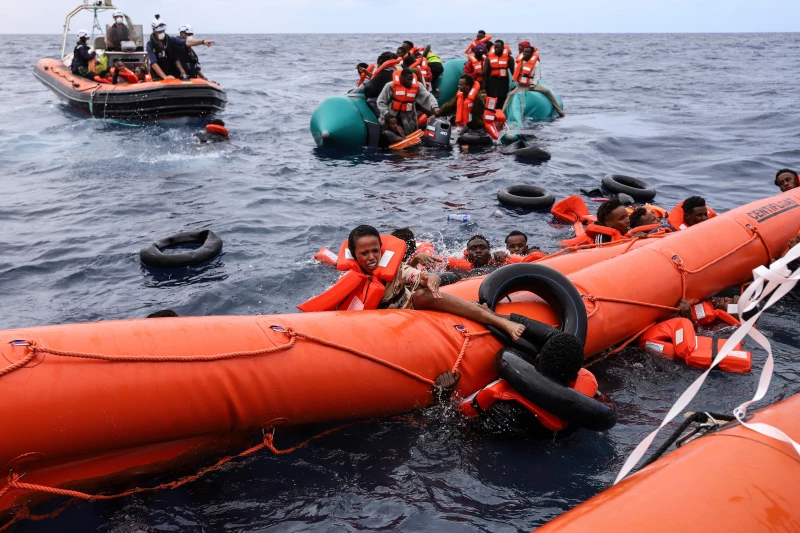

About 60,000 migrants and refugees reached Europe by sea through September 15, down from roughly 98,000 at the same point last year — a decline of 39%, according to IOM data.
The danger did not fall with the number of crossings. At least 2,292 people died or went missing on Mediterranean and Atlantic routes, up from 1,999 during the same period of 2025. The IOM cautions that the real toll is likely higher because some shipwrecks and disappearances are never recorded.
Fewer crossings do not mean safer routes
The Central Mediterranean route to Italy recorded the steepest fall in arrivals, but deaths on that route still rose. Crossings toward Greece also became more deadly even as the number of arrivals declined.
The figures show why border-arrival totals and human safety must be measured separately. IOM called for international cooperation to save lives, counter trafficking and expand legal pathways so fewer people are pushed toward overcrowded and unseaworthy boats.
The key numbers, side by side
The 39% fall in recorded arrivals is substantial: roughly 38,000 fewer people reached Europe by sea than during the same period in 2025. Yet the reported number of deaths and disappearances rose by 293. Put another way, the observed movement became smaller while the known human cost grew.
Those totals should not be treated as a precise fatality rate. The denominator counts people who arrived, while the death figure includes people known or believed to have been lost on different journeys. Some departures are never documented, some boats vanish without witnesses and some bodies are never recovered. IOM says the real toll is likely higher.
Why crossings can fall while deaths rise
Several mechanisms can produce this pattern. Boats may take longer or more remote routes to avoid interception. Weather, vessel condition and overcrowding can make a smaller number of journeys more dangerous. Search-and-rescue capacity, delays in assistance and the tactics of smuggling networks can also affect outcomes.
No single factor should be assumed from the headline data alone. The route-level findings matter because conditions vary across the Central Mediterranean, eastern routes toward Greece and Atlantic crossings. A decline in one corridor can coincide with greater danger in another.
An arrival count measures movement. A death count measures human loss. One cannot be used as a shortcut for the other.
The Central Mediterranean remains critical
The route from North Africa toward Italy has long been one of the world’s most dangerous migration corridors. Long distances, rapidly changing weather and the use of vessels unfit for open water leave passengers exposed. When a boat becomes disabled, the difference between rescue and catastrophe can be measured in minutes.
People taking these routes are not a single group. Some are fleeing conflict or persecution and may seek asylum; others are escaping economic hardship, family insecurity or a combination of pressures. Their legal claims are assessed individually, but the obligation to protect life at sea applies before those claims are decided.
What policy choices can change
IOM’s response points to a policy package rather than one intervention. Rescue coordination can reduce immediate loss of life. Anti-trafficking investigations can target networks that profit from unsafe journeys. Legal pathways — including family reunification, humanitarian admission and regular labor routes — can reduce reliance on smugglers.
Border enforcement affects the number and direction of crossings, but its safety impact must be evaluated separately. A policy may reduce arrivals at one point while displacing journeys to a longer route. That is why route-level data, missing-person records and independent monitoring are essential.
How to read migration statistics responsibly
- Compare the same dates. A partial-year figure should not be compared with a full-year total.
- Separate arrivals from attempts. People who turn back, are intercepted or disappear may not appear in arrival data.
- Look for undercount warnings. Missing-person totals are minimum estimates when journeys go unrecorded.
- Avoid treating people as a trend line. Each number represents an individual whose safety and legal rights still matter.
The 2026 figures do not support a simple success-or-failure headline. They show fewer recorded arrivals and a higher known death toll at the same time. Any serious assessment of European migration policy has to account for both.
Why this matters
Fewer arrivals alongside more deaths means deterrence cannot be evaluated by volume alone. A policy can reduce crossings while making the remaining journeys more lethal or pushing people onto less visible routes. The moral and analytical unit must include survival, rescue capacity and the conditions that drive departure.
How we got here
European migration policy has repeatedly shifted between rescue, border enforcement and agreements with transit countries. Smuggling networks adapt to each change, often by using more dangerous routes or less seaworthy boats. The historical parallel is displacement rather than resolution: pressure on one corridor can move movement elsewhere without removing its causes.
Who benefits, who loses and what critics say
Governments may claim lower arrivals as operational success, while smugglers exploit scarcity and danger. Migrants and rescue crews bear the direct risk; coastal communities face both humanitarian and administrative strain. Critics of rescue worry it encourages crossings, while critics of deterrence argue abandonment raises deaths. Serious analysis requires evidence about behavior, not moral slogans alone.
What the numbers actually imply
A 39% decline in arrivals paired with at least 2,292 dead or missing indicates worsening lethality relative to the number reaching Europe, though a precise rate requires departures and route-level data. The figures do not prove one policy caused the change. They do show that arrival counts alone are an incomplete measure of human outcome.
What happens next
Without safer legal pathways, conflict reduction or stronger rescue coordination, movement is likely to reroute rather than end. A constructive scenario combines enforcement against smugglers with monitored rescue and lawful access; a darker one produces fewer visible arrivals and more unrecorded deaths. Route-level transparency will be essential to tell the difference.
Sources: The September totals were reported by Reuters on September 17, 2026. Earlier route-level findings are available from the International Organization for Migration. The image is a credited file photograph and does not depict every route or event discussed.