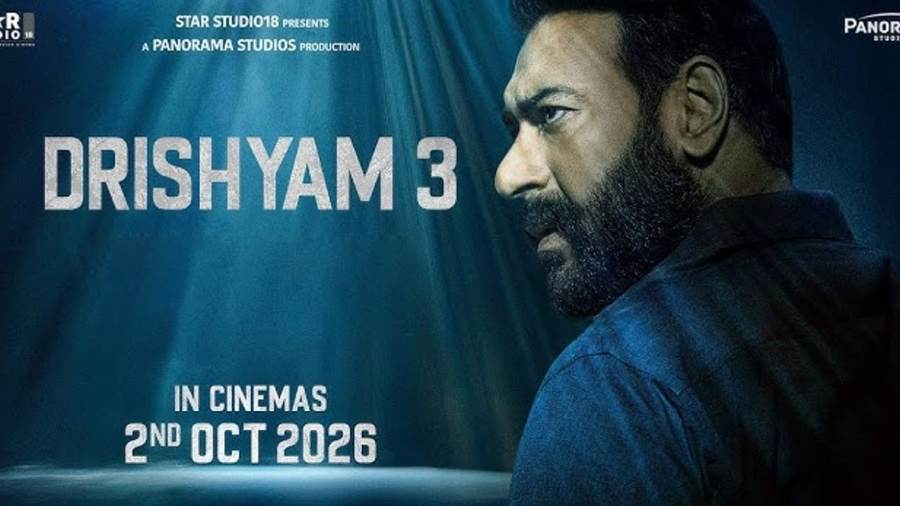
The Drishyam 3 box office collection opened at event-film speed on Friday, October 2. HerZindagi reported an estimated ₹33 crore net in India by 3 p.m., while morning occupancy was around 40 percent nationally and stronger in some tier-two and tier-three centers. Those numbers were preliminary rather than a final audited day-one total, but they established the scale: Drishyam: The Conclusion was not merely benefiting from franchise familiarity. It was converting the Gandhi Jayanti holiday into one of the year’s biggest cinema-going occasions.
The advantage began before opening morning. Advance sales opened September 27, and published trackers put pre-release business in the tens of crores. HerZindagi cited ₹27 crore in advance booking before release, more than ₹50 crore across dates by release day and roughly 13 lakh tickets sold. Sacnilk’s live tracker used a different methodology and reported ₹31.65 crore gross for opening-day advance sales including blocked seats, or ₹27.92 crore excluding them, from about 8.82 lakh tickets. The gap is not necessarily a contradiction: Indian box-office figures often mix net and gross revenue, real sales and blocked inventory, one day and all dates.
Drishyam 3 day 1 collection: what the figures do and do not prove
Day-one headlines are useful as momentum indicators, not final accounts. “Net” typically refers to ticket revenue after indirect taxes, while “gross” includes them. Advance-booking dashboards may include cinema-held seats that do not represent ordinary consumer purchases. Time-stamped estimates change as additional shows report. A ₹33 crore net figure at 3 p.m. therefore should not be added mechanically to an advance total. Much of that business overlaps: advance purchasers are attending the same opening-day shows counted in the live collection.
The strongest conclusion is comparative. The original Hindi Drishyam opened at ₹5.85 crore in 2015, according to figures summarized by later trade coverage. Drishyam 2 began with ₹15.38 crore in 2022 and reached ₹104.66 crore in its first week. Even allowing for inflation, wider release patterns and reporting differences, the third film’s early pace shows how the property has grown from a well-regarded thriller remake into a mass-market franchise. The audience is paying not only for suspense but for resolution after eleven years of Hindi continuity.
That distinction matters because holiday openings can exaggerate demand. Gandhi Jayanti gave Friday the behavior of a weekend day: families and groups had more freedom to attend, and exhibitors could schedule dense show patterns. The true test arrives after the extended opening frame, when school and work routines resume. If occupancy remains strong on Monday and Tuesday, the film will have demonstrated durable word of mouth. If it falls sharply, the opening will look more like concentrated anticipation than broad repeatable appeal.
Why the final chapter label is commercially powerful
“The Conclusion” converts narrative closure into a sales proposition. Viewers who remember the first two films have an incentive to see the ending before social media reveals it. Spoiler sensitivity compresses demand into the first days, much as it does for superhero finales and mystery adaptations. That compression improves screens, showtimes and cultural visibility. It can also create a misleading opening-to-lifetime ratio if many committed fans attend immediately and the remaining audience is smaller.
Ajay Devgn’s Vijay Salgaonkar is the franchise’s central asset: an ordinary family man whose ability to manipulate memory, evidence and institutional assumptions turns him into an unusually cerebral mainstream hero. Tabu’s Meera Deshmukh gives the conflict emotional legitimacy from the opposing side, because her pursuit is rooted in a mother’s loss as well as police authority. Shriya Saran returns as Nandini, while Jaideep Ahlawat adds a new pressure point. That ensemble allows the final chapter to market familiarity and escalation simultaneously.
The franchise’s deeper appeal lies in moral discomfort. Audiences are invited to admire Vijay’s ingenuity while confronting the cost of protecting his family through deception. A weaker sequel could reduce that tension to a contest of tricks. A successful conclusion must make the accumulated choices matter: trauma, suspicion, compromised institutions and the possibility that cleverness cannot indefinitely erase consequence. Reviews and word of mouth will depend less on how many twists arrive than on whether the ending feels earned.
Ajay Devgn Drishyam 3 advance booking shows sequel economics
Advance demand reveals the value of remembered intellectual property. Marketing does not have to explain who Vijay is or why the police case matters; years of television, streaming and repeat viewing have done part of that work. The studio can spend on reminding and escalating rather than introducing. This lowers the communication risk compared with an original thriller, even if production and star costs are higher.
The first two Hindi films reportedly generated about ₹453 crore worldwide together, according to trade summaries. Their trajectories were different: the 2015 film built from a modest opening, while the 2022 sequel arrived with franchise status and demonstrated that theatrical suspense could thrive after the pandemic. The third film inherits both lessons. A known property can open large, but the Drishyam brand was built on audience satisfaction rather than opening-day spectacle alone.
For exhibitors, a strong thriller has practical advantages. It can attract adult audiences, families and regional markets without depending entirely on premium large formats. The reported 2-hour-30-minute runtime, however, limits daily show frequency compared with a shorter film. High occupancy helps compensate. Premium screens and higher average ticket prices also lift gross revenue, but they complicate comparisons with older installments whose tickets were cheaper.
A holiday is a launchpad, not an insurance policy
Gandhi Jayanti is a valuable release date because it offers national leisure time and a patriotic-calendar marketing marker without the same travel patterns as some festival periods. Studios compete intensely for such dates. The reward is a larger first-day audience; the risk is that several films or languages can crowd the corridor. Drishyam 3 secured a strong Hindi position, but October’s schedule becomes busier quickly.
Holiday business also redistributes attendance. A viewer who would have gone Saturday may go Friday instead. Analysts should therefore evaluate the four-day or extended weekend rather than celebrating one timestamp. The advance total across several dates — Sacnilk listed ₹60.13 crore gross including blocked seats through Day 6 at one snapshot — suggests demand extends beyond Friday. But advance purchase behavior itself has become more common, so historical comparisons require caution.
Drishyam The Conclusion review conversation will decide the hold
Opening-day estimates are partly a marketing achievement. The weekend multiplier is a quality judgment. Early reports described positive audience response, but a thriller finale faces unusually strict scrutiny. Continuity errors, an implausible reversal or an ending that merely reserves another sequel could damage the very promise contained in “The Conclusion.” Conversely, a decisive ending can create urgency among undecided viewers and revive both earlier films on streaming.
The spoiler problem changes review culture. Useful criticism should explain performance, pacing and thematic payoff without revealing the mechanism of the final turn. Studios often lean into “do not spoil” campaigns because secrecy itself becomes community participation. That can protect the experience, but it should not shield a film from analysis. Once the opening weekend passes, the conversation will shift from surprise toward whether the story’s moral ledger actually closes.
October 2026 movie releases create a crowded second act
The wider October calendar means Drishyam 3 has a window, not an empty month. Tom Cruise’s Digger and Verity also open October 2 in international markets. Aaron Sorkin’s The Social Reckoning follows October 9. In India, Jailer 2 is scheduled for October 15, followed by Ranabaali and OM on October 16. These films do not all chase identical audiences, but they compete for premium screens, media attention and discretionary spending.
The Jailer 2 release date is especially relevant to exhibitors planning the second half of the month. A major South Indian sequel can command screens nationally and overseas, particularly if dubbed versions and advance sales are strong. Drishyam 3 therefore benefits from building as much cumulative revenue as possible during its first two weeks. A robust weekday hold protects screens; a steep fall encourages theaters to reallocate them.
Hollywood releases add another layer. Cruise remains a global theatrical brand, while a Verity adaptation can mobilize the large readership around Colleen Hoover’s work. Sorkin’s title targets adult audiences interested in politics, media and technology. The result is not a single winner-takes-all contest. Multiplexes segment by language, age and genre, but every additional release raises the opportunity cost of keeping a lightly attended show.
Who wins if Drishyam 3 sustains
Ajay Devgn strengthens one of his most reliable dramatic franchises and demonstrates reach beyond action spectacle. Tabu and Shriya Saran benefit from a series in which female characters are not incidental to the central conflict, though marketing attention remains star-led. Jaideep Ahlawat gains exposure to a wider commercial audience. Panorama Studios and distribution partners can monetize theatrical rights, streaming, television and international markets, while exhibitors gain a film capable of filling daytime as well as evening shows.
The broader Hindi industry would gain evidence that audiences will still attend a plot-driven film at scale. That matters after years of debate about whether streaming has permanently absorbed adult dramas and thrillers. The more precise lesson, however, is not that any thriller can open this way. Drishyam 3 arrives with years of accumulated trust, recognizable stars and a promised ending. New stories still face the harder task of creating that trust from zero.
Who bears the risk
Smaller releases scheduled near a franchise event can lose showtimes before reviews have a chance to work. Audiences face rising ticket and concession costs, especially in premium venues. Producers face the danger that public expectations — amplified by large reported advance figures — turn a merely successful result into a perceived disappointment. And trade reporting itself risks credibility when early estimates are repeated without clarifying net, gross, blocked seats or geographic scope.
The industry should resist treating every intermediate number as final. HerZindagi’s ₹33 crore by 3 p.m. was a live estimate. Sacnilk’s advance dashboard was a changing snapshot. Final producer figures, distributor shares and audited tax data can differ. Responsible coverage reports the basis and timestamp, then updates. Inflated precision may create a louder headline today but makes historical analysis weaker tomorrow.
Data-driven scenarios for the weekend
A strong scenario would combine a high final Friday with steady Saturday and Sunday attendance, followed by a moderate weekday decline. That pattern would indicate the film reached beyond pre-sold fans. A middle scenario would produce a huge holiday opening and respectable weekend but a sharper Monday correction; still profitable, but heavily front-loaded. A weak scenario would see mixed audience response reduce evening walk-ins and accelerate screen loss once new releases arrive.
The original film’s growth from ₹5.85 crore opening day to ₹37.95 crore first weekend illustrated word-of-mouth expansion. The sequel’s ₹15.38 crore opening and ₹104.66 crore first week showed a larger base with sustained demand. The third film begins far ahead on nominal opening pace. To match the earlier films’ cultural durability, it must do more than multiply a holiday crowd; it must convince viewers that the final answer was worth waiting for.
What happens next
By Saturday morning, the first full-day estimate should replace the 3 p.m. figure. By Monday, the extended-weekend shape will be visible. The most informative metrics will be occupancy outside major cities, changes in average ticket price, the ratio of advance to walk-up sales and the number of screens retained ahead of October 9. Overseas markets will show how far the franchise travels beyond its domestic Hindi base.
Longer term, “final chapter” creates both discipline and temptation. A successful ending can preserve the trilogy as a complete story and make ancillary rights more valuable. A blockbuster total can also invite spin-offs, remakes or another continuation. The creative winner would be a conclusion strong enough that the property does not need immediate resurrection. The commercial winner may be the company that finds a way to extend it anyway.
For related entertainment analysis, read Signal Post News on the Big Brother 28 finale economy, celebrity media cycles, and the culture archive.
The regional remake legacy behind the Hindi blockbuster
The Hindi series is part of a wider Indian and international remake ecosystem built around Jeethu Joseph’s Malayalam original. That lineage matters because the core story proved portable across languages while each adaptation reshaped performance, pacing and local texture. The property’s value comes from an unusually strong narrative engine: viewers can know the premise and still want to watch how a particular cast executes it. Remakes are often criticized as evidence of creative risk aversion, but Drishyam demonstrates the difference between copying a recognizable title and translating a dramatic structure for another star system and audience.
That portability also expands the market for the finale. Some ticket buyers arrive through the Hindi films alone; others compare them with Malayalam versions or remakes elsewhere. The overlap creates intense online debate but also free publicity. Producers benefit from a story that already has cultural memory across regions. The creative obligation is to make the conclusion feel specific to this continuity rather than a mechanical endpoint dictated by franchise accounting.
A checklist for reading the final numbers
When opening-weekend totals arrive, readers should ask five questions. Is the figure India net, India gross or worldwide gross? Does it include previews? Are blocked seats included in advance-sales numbers? What is the timestamp? And is the source a producer, distributor or independent tracker? Two figures can both be accurately reported yet describe different baskets. The most reliable analysis preserves those labels instead of collapsing them into a single “collection.”
Admissions are also more useful than revenue alone for historical comparison. Ticket prices and premium formats have risen since 2015, so rupee growth overstates audience growth if it is treated as a direct proxy. Screen count, show count and occupancy help complete the picture. A larger release can earn more with a lower percentage of seats filled; a smaller release can post high occupancy but less total revenue. The early 40 percent morning occupancy and dense national show count together indicate breadth, but final admissions will tell the clearer story.
Why this opening reaches beyond one franchise
The theatrical market is negotiating a new division of labor with streaming. Spectacle draws crowds, but suspense can also create urgency when spoilers matter and a communal audience heightens tension. If Drishyam 3 holds, studios may invest in adult thrillers with disciplined scripts rather than assume that only visual-effects franchises deserve wide releases. The wrong lesson would be to manufacture endless sequels without the narrative trust that made this opening possible.
For audiences, the healthiest outcome is not simply a record. It is competition on story quality. A finale that pays off long-term attention proves that continuity can be an artistic resource, not only a marketing tool. The weekend’s rupee totals will dominate headlines, but the film’s lasting commercial value will be measured by whether people keep recommending the ending after the opening-day excitement fades.