Child swept away by waves: in a beach video shared millions of times this week, a toddler is knocked off her feet in the surf while her parents film a selfie-stick reel a few steps away — and the person who reaches her first is a stranger, who takes her hand and leads her back.
World / Viral Video — eighteen seconds of surf, a toddler in a red top, and the bystander who moved while the camera kept rolling
What the video shows, second by second
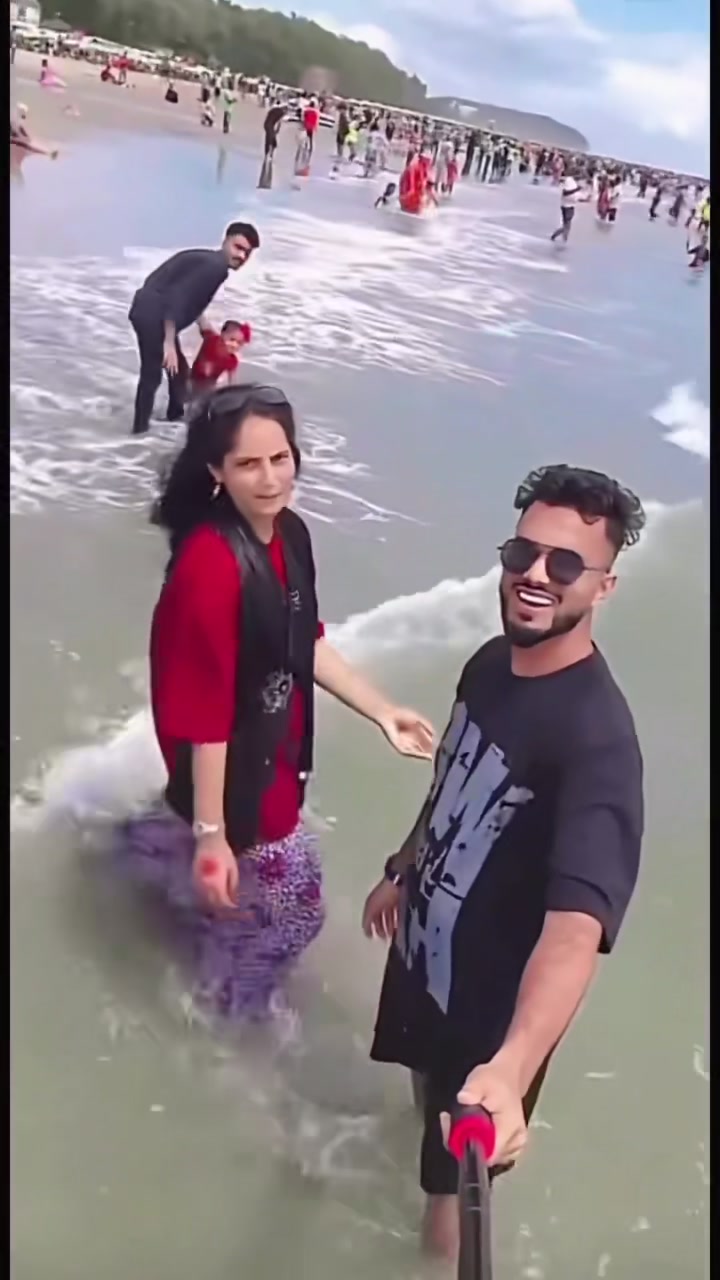
The clip runs about eighteen seconds and appears to be the couple’s own selfie-stick footage. A man holds the stick at arm’s length and smiles into the camera; beside him, a woman walks through the shallow wash at the edge of a crowded beach — hundreds of bathers are visible up and down the shoreline. Between and just behind the couple, at the water’s edge, is a small girl in a red top.
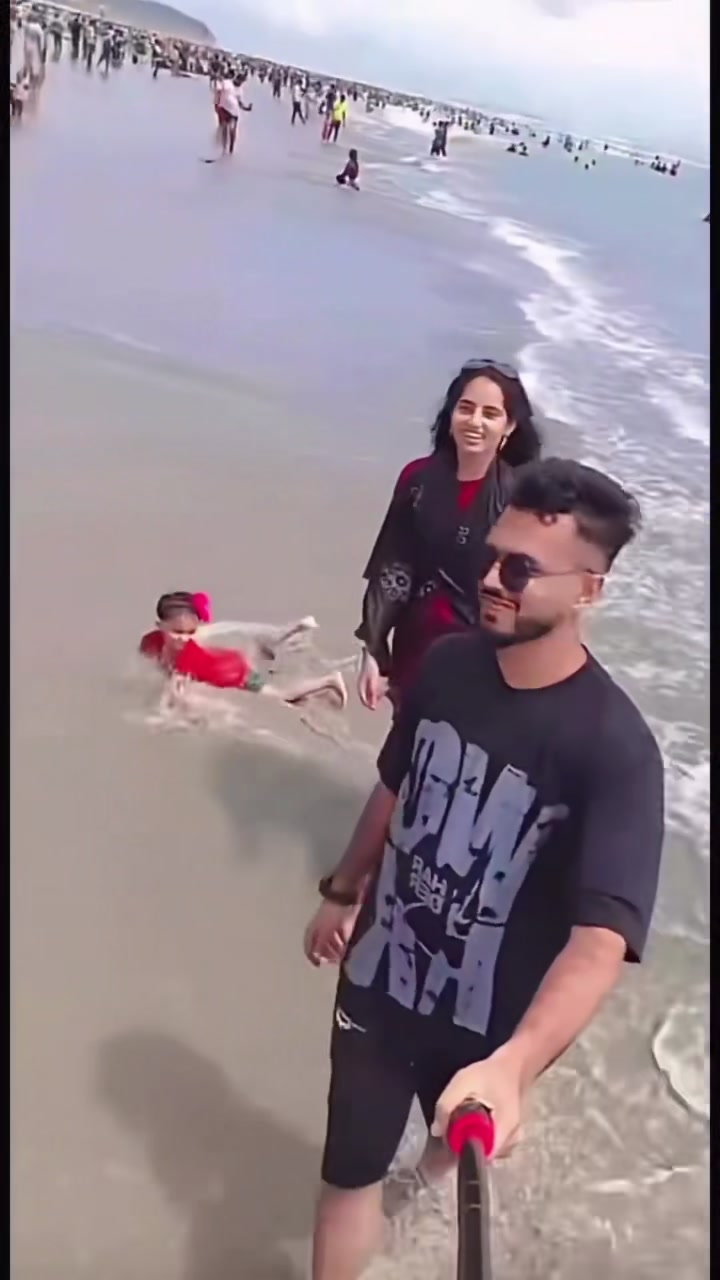
As the couple walk and pose, the toddler slips from the woman’s loose hold and goes down onto her front in the shallows. A wave washes over her. She stays down, in water that is only ankle-deep on an adult, while the broken surf pushes her one way and then pulls at her the other. The woman glances back once — the moment is there in the footage — and then turns back to the camera. The man keeps filming. A second wave rolls through the child.
Then the frame changes. A man in dark clothes, a stranger, comes quickly through the water from the left of the frame, bends over the toddler, takes her by the hand and brings her upright, leading her back toward the couple and calling out to them. The parents’ expressions change; the woman’s smile is gone. The clip ends with the family turning toward the man who reached their daughter first.
That is the whole of the footage. It does not show what happened in the minutes before the camera rolled or after it stopped, it does not identify anyone in it, and it carries no location or date stamp. Everything beyond those eighteen seconds has to be labelled as what it is: allegation, context, or unknown.
How the clip spread
The video surfaced on X on October 19, posted by a user, Mariyam (@Mariyam_MBD), who wrote — in Hindi — that she had gone to the seaside with her husband and watched a couple so absorbed in making a reel that they left their little girl in the water; that the girl was nearly swept away by the waves; that a man noticed and saved her; and she asked whether making reels had become so important that people were beginning to neglect even their own children.
From there it moved the way these clips now move. Times Now shared the video on October 20. NDTV 24x7 carried it as a news segment under the headline “Parents Film A Reel On Beach As Their Child Struggles In Sea Waves, Stranger Rescues Her.” Inshorts, drawing on Asianet Newsable, summarised it the same day. LatestLY published its account on October 20 — and attached an unusual degree of candour to it, rating the story “unverified” and stating that it could not independently verify the authenticity of the video or the circumstances surrounding the incident. Particle News, aggregating the coverage, noted the same gap: the exact location, date and identities of those involved have not been independently verified. The clip has also been reposted repeatedly to YouTube Shorts and discussed across Indian social media, where much of the reaction has focused on the parents and on the stranger in roughly equal and opposite measure.
What is confirmed — and what is not
Because this story is a viral clip before it is anything else, the honest version of it is a short list of facts and a longer list of unknowns.
Confirmed: the video exists, was posted to X on October 19, 2026, and has circulated widely since — carried by Times Now, NDTV 24x7, Inshorts/Asianet Newsable, LatestLY and others. Its content matches the descriptions above, frame for frame. The child in it is a toddler girl, per every outlet that has described her. She is led out of the surf by the hand, upright, by the bystander. No news outlet has reported any injury to her, and no lifeguard, police or hospital statement about the incident has appeared in any coverage we could find.
Not confirmed: the beach. Claims about where this happened circulate with the clip, but no reputable outlet has verified a location, and several say explicitly that they cannot. The date the footage was filmed — as opposed to posted — is likewise unestablished. The couple’s identity, their account of the moment, and anything that happened outside the eighteen seconds are all unknown. The poster’s claim that the couple were too absorbed in filming to notice is her allegation, made in the post that launched the clip; the footage itself shows something a degree more complicated — a child who slipped from a loose grip, a mother who did glance back once, and a camera that kept rolling through two waves too many. Readers should hold both of those things at once.
Why the surf takes toddlers so fast
Strip away the argument about phones, and the physics of the clip are stark enough on their own. The water that knocks the toddler down would barely wet an adult’s calves. That is precisely the point that lifeguards and drowning-prevention bodies repeat every season: for a small child, the danger zone at the beach is not the deep water. It is the wash.
A breaking wave carries energy far out of proportion to its depth. When it breaks at the shoreline it runs up the sand as a sheet of water, knocks a toddler off balance, and then — the part adults consistently underestimate — drags back out to sea as undertow, pulling at anything light enough to move. A two- or three-year-old who goes face-down in that wash cannot simply stand up against it: the next wave arrives in seconds, the child is disoriented, and the instinctive drowning response in young children is silent. There is usually no shouting and no waving. A child can be in serious trouble in water that looks, to a standing adult, trivially shallow.
The World Health Organization has long identified drowning as one of the leading causes of death for children aged one to four worldwide, and the standard guidance from lifeguard and drowning-prevention organisations is built around exactly the failure mode in this video: touch supervision — a toddler near or in the water stays within arm’s reach of a designated adult, whose eyes are on the child and nothing else. Swim where lifeguards are on duty and between the flags where they are marked; treat every trip to the water’s edge as a job one adult owns at a time, handed over explicitly, never assumed; and treat a phone in the hand as what it measurably is in the research on supervision lapses — a break in attention measured in the same seconds a wave needs.

The stranger is the story
It is worth pausing on the person the argument online keeps skating past. Beaches are full of people who see a small thing go wrong a few metres away and reasonably assume someone closer has it in hand; psychologists call the paralysis the bystander effect, and crowded shorelines are built for it — this beach was packed. One man in the frame did the opposite of all of that. He saw a toddler being worked over by the surf, understood in about a second that the adults nearest her were facing the wrong way, and moved — not toward the parents, but straight to the child, which is the order that matters. He took her hand, brought her up out of the wash, walked her back, and made sure the parents understood what had nearly happened before he let go of the situation.
Almost everything that has been written about this clip is about blame. The rescue is the part with something to teach: on a crowded beach, the difference between a frightening video and a tragedy was one stranger deciding that a child in the water was his business.
A familiar debate about reels, again
The clip has landed in the middle of an argument that Indian media, in particular, have been having in public for several years: about the risks people now take — and impose on others — for short-form video. The poster’s question, whether reels have become more important than children, was always going to travel further than the footage. LatestLY’s coverage itself linked the beach clip to a separate and far grimmer incident reported in Odisha, in which a boy filming a reel near railway tracks was struck by a train. The two stories are not the same — one ended with a stranger’s hand and a frightened family; the other did not end that way — but they are being read together, as entries in a single ledger about attention.
The fair reading of this one sits between the outrage and the shrug. Eighteen seconds cannot carry a judgement about two people’s parenting; children slip from hands on beaches every day, and most of those moments end in a parent’s arms a second later, unfilmed and unjudged. What these eighteen seconds do show, plainly, is a gap — a handful of seconds in which a toddler was down in moving water and the two nearest adults were looking into a lens. The stranger closed that gap. That, and not a verdict on a family nobody can name, is the part of the story sturdy enough to build on.
Why this matters
Stories like this one matter twice over, and the two reasons pull in opposite directions — which is exactly why they need care. The first is practical. Beaches will be full again this weekend, on every coast, and some fraction of the adults on them will be watching their children through a phone screen, because that is simply how family days are documented now. If eighteen seconds of somebody else’s bad moment buys one parent a habit — designated watcher, arm’s reach, eyes up when the child is in the wash — it has done more measurable good than most safety campaigns manage.
The second reason is about the clip economy itself. This video reached millions of people carrying a location nobody had verified, a date nobody had established, and a verdict on two unnamed people already written into its caption. Much of the coverage repeated the verdict and skipped the verification. The clip is real, and what it shows is genuinely alarming — but the distance between “a video shared widely this week shows” and “this happened, there, then, to them” is the distance between reporting and rumour, and it does not close itself just because the footage is vivid. A toddler was in danger and a stranger helped her: that much is on tape. The rest is still, honestly, unknown.
What happens next
Probably nothing official. Unless the beach is firmly identified and a local authority chooses to comment, there is no investigation to follow and no statement expected; the family in the video has not been identified in any coverage, and their account of the moment — the single most useful addition to the record — may never be published. If a location is verified by a reputable outlet, or the family or the bystander speaks, this article will be updated and the update marked. Until then, the story stands where the evidence leaves it: a child is fine tonight because a stranger on a crowded beach was watching the water instead of a screen.
Read next: a very different rescue, also caught between seconds — our report on the toddler pulled back from a 12th-floor window ledge in Zhangping, where the margin between a fall and a rescue was a neighbour’s grip on a tiny ankle.
Sources
LatestLY, “Viral Video: Parents Film Beach Reel As Passerby Rescues Toddler Pushed by Waves,” October 20, 2026 (includes the original X post by @Mariyam_MBD, October 19, 2026, and LatestLY’s note that it cannot independently verify the video or its circumstances): latestly.com. Inshorts via Asianet Newsable, “Parents make reel as sea waves sweep child away, man rescues,” October 20, 2026: inshorts.com. Particle News, “Viral Beach Video Shows Stranger Saving Toddler While Parents Film Reel,” October 20, 2026 (noting location, date and identities unverified): particle.news. HIT TV English, “Social Media Fame vs Child Safety Sparks Debate,” October 20, 2026: hittvenglish.com. NDTV 24x7 carried the clip as a news video, “Parents Film A Reel On Beach As Their Child Struggles In Sea Waves, Stranger Rescues Her,” October 20, 2026; Times Now shared the video on X the same day. Signal Post News has reviewed the footage frame by frame; we have not independently confirmed the beach or the date the footage was filmed, and no report of injury to the child appears in any coverage cited here.