Economy · United Kingdom · Markets
The Bank of England rate hike announced on Thursday — a quarter-point rise to 4%, backed by eight of the nine members of its Monetary Policy Committee — is the first increase in borrowing costs since August 2023. The lone dissenter did not want to hold rates steady. She wanted to raise them twice as far.
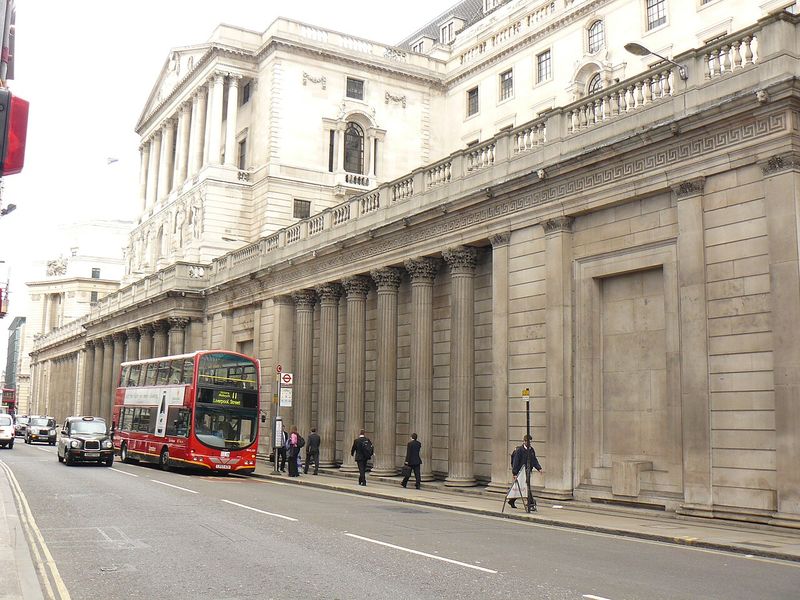
London’s central bank has spent three years walking interest rates down from their peak, or holding them still while it waited for inflation to behave. On Thursday it turned around. The Bank of England raised Bank Rate by 0.25 percentage points, from 3.75% to 4%, ending a run of six consecutive meetings on hold and delivering the first increase since August 2023 — the month rates peaked at 5.25% during the last inflation crisis.
Track it live: Live markets tracker · Live oil price tracker
The reason is written across the Bank’s own summary of the decision. The conflict in the Middle East is now in its ninth month, global energy prices have kept rising from an already elevated level, and UK consumer price inflation climbed to 3.5% in September, up from 3.1% in August. Worse, the Bank now expects inflation to keep climbing to around 5% by the middle of next year — two and a half times its 2% target. Governor Andrew Bailey was careful to frame Thursday’s move as conditional rather than the start of a campaign. “Today’s increase shouldn’t be seen as the first in an inevitable long sequence of hikes,” he said, in remarks reported by Reuters. “But unless the conflict in the Middle East is resolved, neither does it seem likely to be the last increase.”
An 8–1 vote — and the dissent pointed up, not down
Rate decisions are usually read through their splits, and this one’s split is the story. Eight members of the Monetary Policy Committee — Bailey, Sarah Breeden, Swati Dhingra, Megan Greene, Clare Lombardelli, Huw Pill, Dave Ramsden and Alan Taylor — voted for the quarter-point rise. The ninth, external member Catherine Mann, voted to raise Bank Rate by half a point, to 4.25%. A Reuters poll before the meeting had expected any dissent to come from a member wanting to keep rates on hold. Instead, the only argument inside the room was about whether a quarter point was enough.
Mann’s reasoning, set out in the minutes, is that Britain may have crossed into what she called a high-inflation, tight-labour-market regime, in which households and firms react to price rises in ways that make inflation feed on itself. With CPI at 3.5% in September, she said she was concerned about “non-linear inflation risks” and about the Bank’s credibility if it waited. Her recent votes for quarter-point rises, she wrote, had been a “down payment” to lean against those second-round effects. Other members were moving in the same direction at different speeds: Deputy Governor Clare Lombardelli said a further rate increase was likely to be needed in the near term, while Chief Economist Huw Pill described Thursday’s rise as a significant step towards the stance needed to deal with threats to price stability, including those coming from the Middle East and energy prices.

Why this matters: a war in the Gulf is now setting British mortgage rates
Step back and the decision marks a strange and consequential reversal. At the start of this year, the widely expected path for UK rates in 2026 was downwards — forecasters anticipated cuts as the post-pandemic inflation wave faded. Instead, a war-driven energy shock has pushed the Bank, like the US Federal Reserve and the European Central Bank before it, back into tightening mode. The chain of causation runs from the Strait of Hormuz to a tracker mortgage in Manchester: fighting and shipping disruption keep oil and gas prices high, energy bills and fuel costs push headline inflation up, and the central bank raises the price of credit for everyone to stop that one-off shock becoming a permanent wage-price spiral.
The Bank’s language shows how reluctantly it is doing this. Its summary stresses that there is still only limited evidence of knock-on effects from higher energy prices into other prices and wages — but that the amount of inflationary pressure now in the pipeline is sufficient to warrant a rise anyway. In other words, this was a precautionary hike aimed at a forecast, not a response to an economy that is overheating. Indeed, the Bank simultaneously revised its growth forecasts up, to 1.6% for this year and 1.3% for next — stronger than the Office for Budget Responsibility predicted last week, according to Reuters — which undercuts any claim that it tightened because the economy is booming. It tightened because it fears what energy prices do next.
There is a political edge, too. Inflation heading towards 5% is a blow for Prime Minister Andy Burnham, who came to office promising relief on the cost of living, and it lands weeks after a UK budget built around energy payments and bank taxes — the fiscal package we examined in our coverage of the 2026 budget. A government can subsidise bills; it cannot set interest rates. When the two pull in opposite directions, households feel the central bank’s lever more directly than the Treasury’s.
The numbers, in context
Put the decision on the longer timeline and its scale comes into focus. Bank Rate sat at 0.1% in 2021, climbed to a 5.25% peak in August 2023, and was then cut in steps to 3.75% by December 2025, where it stayed for six straight meetings. Thursday’s rise to 4% reverses only the last of those cuts; it does not return Britain to peak tightness. But direction matters more than level for expectations, and the direction has flipped for the first time in over three years.
The inflation path the Bank published alongside the decision is the part that should worry borrowers most. On its central projection, inflation peaks at an average of 4.8% in the second quarter of 2027 — about one and a quarter percentage points higher than the Bank forecast as recently as July — and does not return to the 2% target until well beyond that. In a more adverse scenario the Bank modelled, in which oil prices peak at around $130 a barrel against roughly $100 now, inflation reaches 6.2% in the third quarter of 2027. That scenario is a stress case, not a prediction — but the fact that Threadneedle Street is publishing it tells you what the committee is actually debating. For comparison, the Federal Reserve has already walked this road once this year; we tracked its own split decision in our report on the Fed’s October meeting, and the energy shock driving both banks is the same one repricing crude markets, as in the recent jump in oil prices after China halted fuel exports.
Who pays, who gains
The immediate losers are the roughly 510,000 households on tracker mortgages, whose payments follow Bank Rate automatically: UK Finance calculates that a quarter-point rise adds about £31 a month to a typical tracker payment, in figures reported by the BBC. Another roughly 470,000 borrowers on standard variable rates face an estimated £14 a month if their lenders pass the rise on in full. The much larger group on fixed-rate deals — about 87% of mortgage customers — feel nothing today, but they are not insulated: lenders had already priced an expected November rise into new deals, with average two-year fixed rates around 5.96% and five-year fixes around 5.99% in early November, and a further rise in December or February would push the next round of remortgage offers higher still. Around 800,000 fixed deals priced at 3% or below are due to expire each year on average through the end of 2027, so a large cohort of households will refinance into this higher-rate world whether the Bank moves again or not.
Savers sit on the other side of the ledger. A higher Bank Rate usually means better deposit returns, if banks pass the rise on — which they are not obliged to do, and historically do more slowly for savers than for borrowers. Easy-access accounts were paying an average of roughly 2.6% on a £10,000 balance in early November, while one-year fixed savings accounts averaged around 4.5%, so the gap between the best and laziest home for cash remains far wider than anything Thursday’s quarter point will close. Markets, for their part, took the decision calmly: sterling edged up to about $1.3477 in the minutes after the announcement and yields on rate-sensitive two-year government bonds rose, according to Reuters’ instant market coverage — the signature of a decision that was expected, with the argument now shifting to what happens next.
What happens next: December 17, and the price of oil
The committee’s next decision is scheduled for December 17, and the Bank insisted on Thursday that policy is “not on a pre-set path”: it will judge, meeting by meeting, how likely high energy prices are to feed into pay, pricing behaviour and the wider economy. Three scenarios now branch from here. If the Middle East conflict ebbs and energy prices fall back, Thursday’s rise can stand alone as insurance, and the conversation returns to cuts sometime next year — Bailey’s “not an inevitable long sequence” framing leaves that door deliberately open. If energy prices stay where they are and inflation tracks towards 5% on schedule, the Lombardelli view — at least one more rise, plausibly to 4.25%, the level the Bank’s own survey of market participants already expects by February — becomes the base case. And if oil spikes towards the $130 of the Bank’s adverse scenario, Mann’s half-point argument stops looking hawkish and starts looking early.
The critics’ case deserves its hearing in all three. Raising rates cannot produce a single extra barrel of oil or reopen a shipping lane; it works only by making British households and firms poorer, so that they spend less and bid prices down — a blunt and regressive tool against a supply shock, which falls hardest on borrowers with the least cushion. The Bank’s answer is the one central banks always give, and it is not frivolous: let an energy shock pass through into wages and expectations once, and you spend years, not quarters, squeezing it back out. What is genuinely unusual about November 2026 is that both sides of that argument can point to the same forecast — growth revised up, inflation revised up faster — and see vindication. The data will arbitrate, one monthly inflation print at a time, starting well before the committee sits down again in December.
Reporting based on the Bank of England’s November 2026 Monetary Policy Summary, minutes and Monetary Policy Report (bankofengland.co.uk, November 5, 2026); Reuters reporting on the decision, the individual policymakers’ stated views and the immediate market reaction (November 5, 2026); and BBC reporting of UK Finance and Moneyfacts figures on mortgage and savings rates.