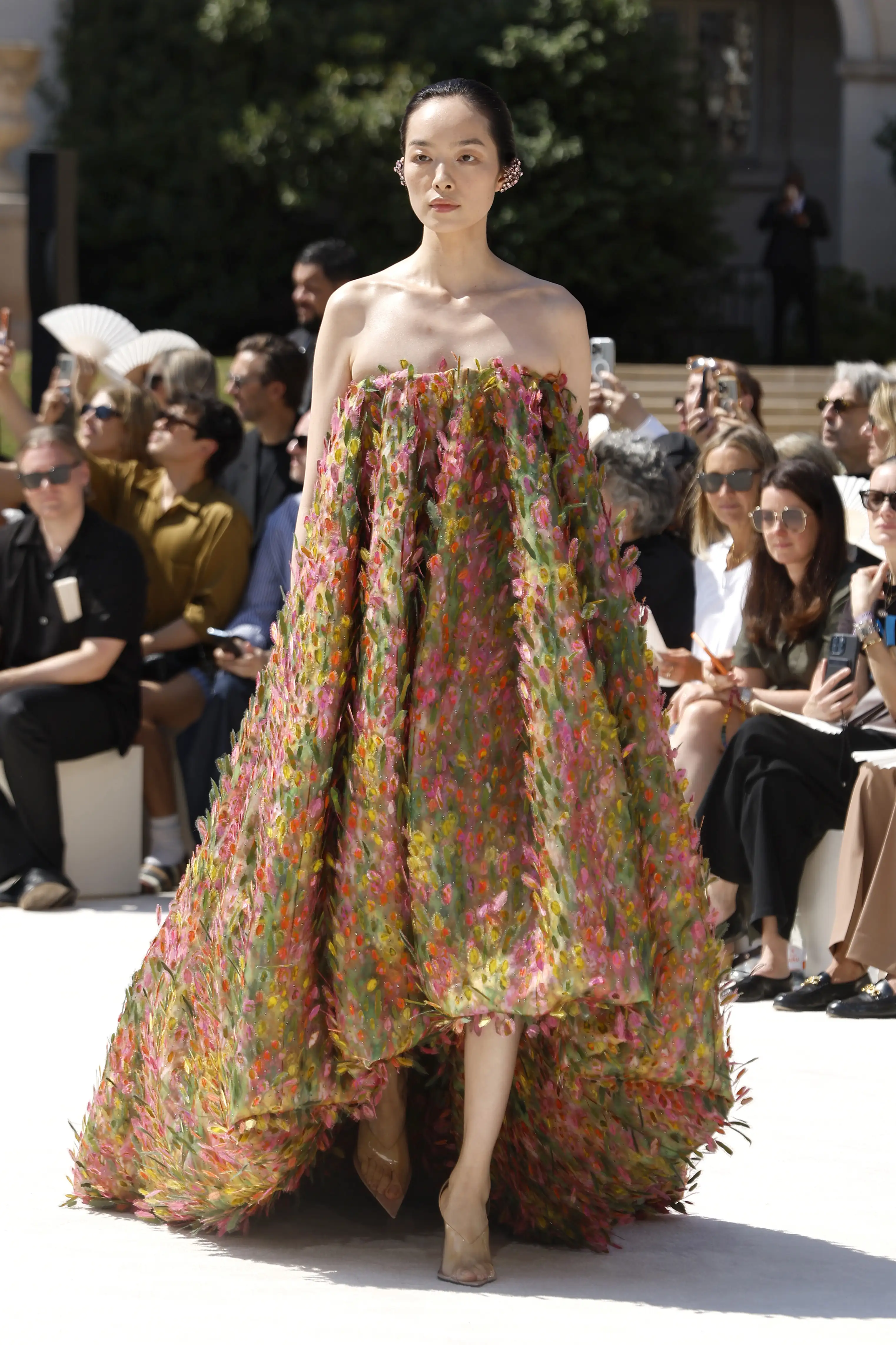
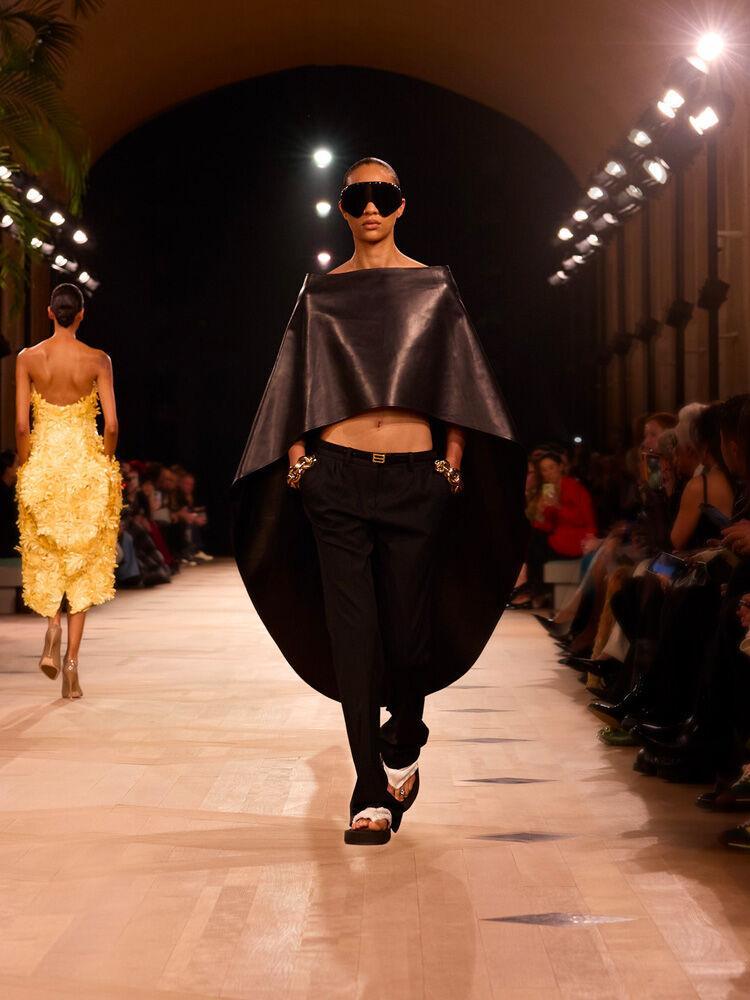
The July 8 show placed 52 looks in the gardens of the Cité Internationale Universitaire de Paris. Ballooning capes and ostrich feathers supplied scale, but Piccioli’s bow with the atelier gave the collection its emotional center. Couture became a collaboration to acknowledge, not a magic trick to conceal.
The show followed “The Heartbeat,” his October 2025 ready-to-wear debut, and March 2026’s co-ed “Clairobscur” collection. Together they show a designer moving beyond appointment headlines toward a repeatable language: color, generous volume and human presence.
A difficult inheritance
Balenciaga’s recent identity was inseparable from provocation. Piccioli does not need to reproduce that tone, but a warmer register still has to retain the house’s radical cut and sense of scale. The couture debut succeeds when emotion is carried by construction rather than used as a slogan.
The new Balenciaga is most convincing when softness and structure occupy the same silhouette.
Why this matters
Balenciaga is attempting a tonal reset without surrendering the radical silhouette that gives the house authority. Piccioli’s emphasis on emotion and atelier labor offers an alternative to provocation as the main attention engine. If it works, the brand can remain culturally sharp while rebuilding trust around clothes rather than controversy.
How we got here
The house’s recent era trained audiences to expect irony, distortion and confrontation. Piccioli comes from a couture vocabulary associated with color, volume and humanist spectacle, while Cristóbal Balenciaga’s archive demands architectural rigor. The transition therefore echoes a recurring fashion problem: a new director must change the emotional temperature without flattening the underlying design intelligence.
Winners, losers and the skeptical case
Atelier workers and couture clients benefit when craft becomes visible. Audiences exhausted by irony may welcome warmth, while those drawn to the previous edge may see retreat. Critics are right that bows and emotion can become public-relations theater; the defense must be found in cut, proportion and finishing, where sentiment either acquires structure or evaporates.
What the evidence actually says
The 52-look couture debut, following two earlier collections, provides enough sequence to identify repeated themes of color, volume and presence. It does not yet prove retail performance or long-term brand recovery. The comparison that matters is not applause versus outrage, but whether the same formal ideas can travel from couture’s one-off labor into ready-to-wear people actually encounter.
What happens next
A coherent next phase would translate generous volume into coats, tailoring and accessories without turning softness into blandness. The upside is a broader client base and renewed craft authority; the downside is losing the friction that made Balenciaga impossible to ignore. Watch whether future campaigns center the garment and maker, not only celebrity validation.
Sources and photo credits: Couture reporting via Reuters; couture image via TLife; second image via Numéro.