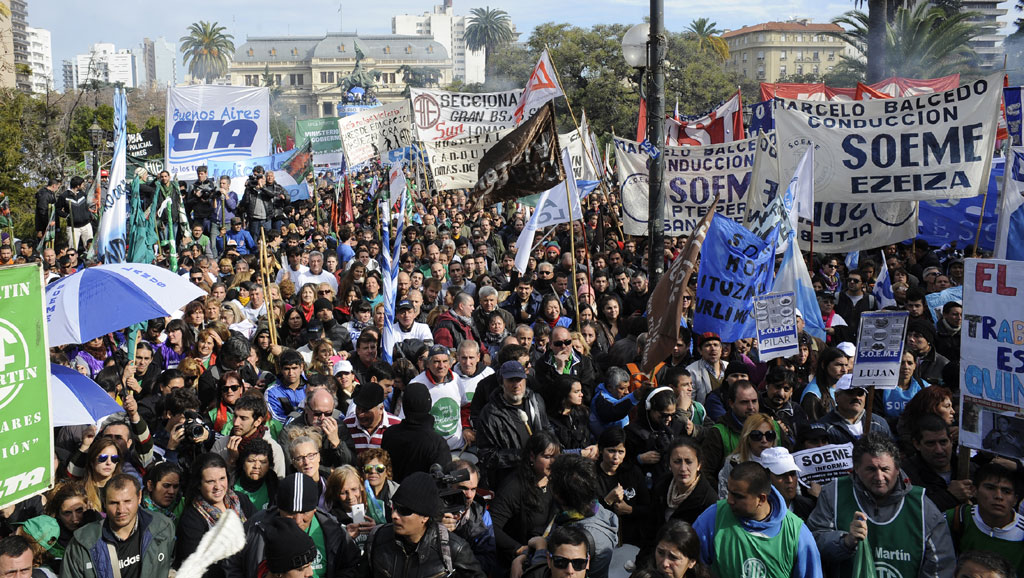
What happened on September 19
Thousands of left-wing activists, social movements, student groups, human-rights organizations and artists marched through central Buenos Aires to Plaza de Mayo on September 19. More than 200 organizations backed the mobilization, called the Marcha de la Bronca — the “March of Anger.” Signs reading “Milei out” and “Anger because our children are going hungry” condensed the protest's message into two claims: a rejection of the president's political project and an insistence that falling headline inflation has not ended household hardship.
The coalition's demands went well beyond a single wage claim. Organizers called for higher salaries and pensions, protections against layoffs, restored funding for healthcare and universities, action on household debt, a national strike by the CGT labor federation and a break with the International Monetary Fund. That breadth made the march less a sectoral dispute than an attempt to assemble a common opposition front.
The austerity at the center of the dispute
Since taking office in December 2023, Milei has pursued a balanced budget through deep reductions in subsidies, public works, transfers to provincial governments and the federal workforce. His government says this fiscal reset is the precondition for durable price stability and investment after years of chronic deficits and inflation. Critics say the state has shifted the adjustment onto people with the least room to absorb it.
The timing sharpened the argument. On September 15, the government tabled a 2027 budget projecting 4% growth and 18% inflation. It is Milei's final full-year fiscal plan before the October 2027 presidential election and therefore more than an accounting document: it is the government's case that discipline will produce recovery before voters judge the experiment.
Celeste Fierro of the Workers' Socialist Movement disputed that recovery narrative, arguing that much of the work being added is informal or precarious while factories continue to close. Her criticism identifies the central measurement problem: expansion in aggregate output can coexist with worsening security for the people being asked to endorse it.
Why this matters
Argentina has seen austerity programs collapse under street pressure before. The 2001 crisis remains a warning embedded in the country's political memory: fiscal arithmetic can look decisive until bank restrictions, unemployment and lost incomes turn a technical program into a legitimacy crisis.
Milei's wager is that disinflation will arrive quickly enough — and become tangible enough — to prevent that history from repeating. The opposition's wager is that the distribution of the costs will matter more than the direction of the national indicators. Ahead of the October 2027 election, the decisive question is which account voters believe: that today's pain is buying stability, or that stability is being purchased from households already at the limit.
The economy, in numbers
Argentina's economy grew 2% in the second quarter of 2026, while unemployment stood at 7.9%, according to figures reported by Reuters. The 2027 budget's 18% inflation projection would represent a dramatic retreat from the triple-digit rates that defined the earlier crisis. Those figures support the government's claim that the direction of travel has changed.
They do not settle the argument. Rising informality means an employment number can improve while job security, benefits and real purchasing power deteriorate. Utility-tariff increases have also squeezed households as subsidies are withdrawn. This is the protest movement's strongest economic case: disinflation without relief can still feel like recession at the kitchen table.
Who gains, who loses
In the government's telling, the beneficiaries are future Argentines spared another debt-and-inflation cycle, along with investors, exporters and savers who need a credible fiscal framework. Stable prices can protect the poor most of all because they have the fewest ways to hedge against inflation.
In the protesters' telling, pensioners, public-sector workers, students, indebted households and workers pushed into informal jobs are paying for a future whose benefits remain uncertain. Both sides claim the mantle of protecting the poor; they disagree over whether the greater danger is renewed inflation or an adjustment that fractures the social coalition needed to sustain reform.
What happens next
Three flashpoints now matter. The first is whether the CGT answers the march's call for a national strike. The second is the October congressional debate on the 2027 budget, where organizers have promised a larger mobilization and lawmakers will have to attach votes to Milei's projections. The third is the government's ability to keep inflation falling without provoking a broader social explosion.
If growth spreads into formal work and household incomes, the September march may look like a high-water mark for opposition anger. If factory closures, tariffs and debt overwhelm those gains, Plaza de Mayo may instead have marked the beginning of a larger test of Milei's mandate.
Sources
Associated Press via APT, "Argentina's Left Stages 'March of Anger' in Buenos Aires Against Milei's Economic Policies," September 19, 2026: Watch the report
Reuters via ANI, "WATCH: Argentina's left stages 'Anger March' against Milei government," September 19, 2026: Watch the report
NDTV, "Argentina's 'March Of Anger' Draws Hundreds In Buenos Aires Against President Milei Policies," September 19, 2026: Watch the report
France 24, "Argentines protest Milei's austerity, demanding higher wages and public spending," September 19, 2026: Watch the report